G11 - Geometry problems on coordinate axes
Use coordinates to work out lengths along grid lines, locate midpoints and complete shapes. Check geometric claims with exact coordinate evidence, rather than relying on how a sketch looks.
Horizontal and vertical lengths
A rectangle has corners , , and . Is it also a square? A sketch may suggest an answer, but the coordinates can settle it exactly.
You already know
In , the horizontal coordinate comes first. Points with the same -coordinate lie on a horizontal line; points with the same -coordinate lie on a vertical line. Subtracting a negative adds its positive opposite.
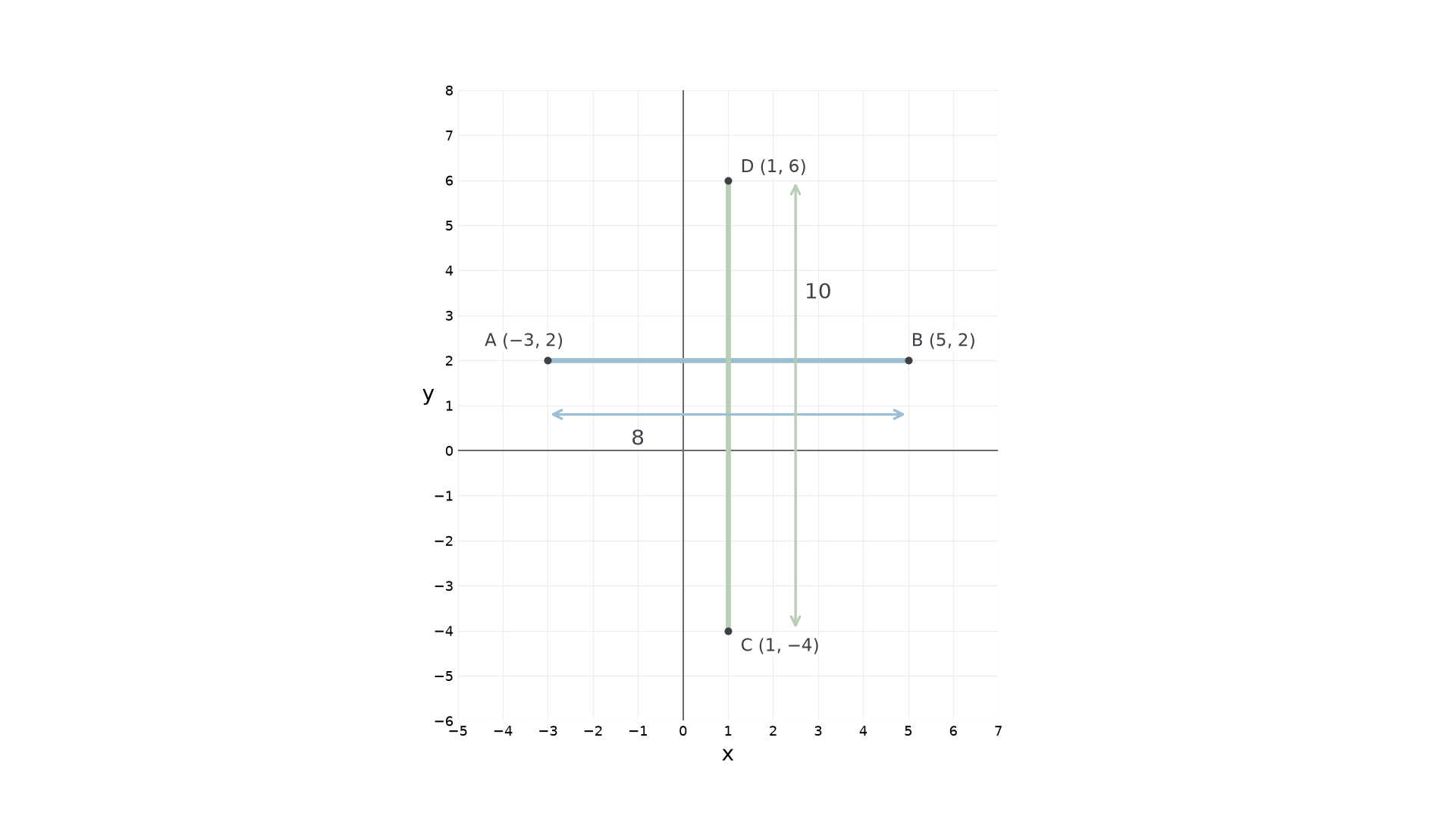
On a horizontal segment, only changes. On a vertical segment, only changes. The segment length is the larger changing coordinate minus the smaller one. Crossing an axis does not change this rule.
[DIAGRAM: asset_name: Distances across the axes; asset_slug: aqa8300_g32_axis_lengths; caption: Horizontal length uses the change in x; vertical length uses the change in y. Crossing zero still means subtracting the smaller coordinate; description: An equal-scale coordinate grid shows horizontal segment from minus 3 comma 2 to 5 comma 2 and vertical segment from 1 comma minus 4 to 1 comma 6. Separate blue and sage dimension arrows show lengths 8 and 10. Endpoints are clearly labelled without covering the axes.]
Lengths parallel to an axis
For a horizontal segment,
For a vertical segment, use the larger minus the smaller . These rules give positive lengths for distinct endpoints.
Not on the formulae sheet: learn them.
A coordinate difference is a movement with direction. A length is a positive distance. Subtract in the larger-minus-smaller order to avoid a negative length.
Worked example 1: a horizontal side
Question. and . Work out . Non-calculator.
Plan. The -coordinates agree, so use the difference in .
Why this step? The common height does not contribute to the horizontal distance.
Answer. units.
Check. Moving units right from reaches .
The second example changes the direction to vertical. It still crosses zero; read the changing coordinate before subtracting.
Worked example 2: a vertical side crossing zero
Question. and . Work out . Non-calculator.
Plan. The -coordinates agree, so subtract the smaller from the larger.
Why this step? From to is units, and from to is another .
Answer. units.
Check. .
These simple differences apply to horizontal or vertical segments. Adding both coordinate changes does not give the length of a sloping segment.
Watch out
Wrong: the distance from to is . Right: keep the negative sign inside brackets, .
Choose the changing coordinate for each side of the next shape.
Midpoints on a grid
Halfway along a sloping segment means halfway in each coordinate. Average the horizontal coordinates together, then average the vertical coordinates together.
Midpoint
The midpoint of a line segment is the point halfway between its endpoints. It divides the segment into two equal lengths. It need not be a grid intersection: a midpoint coordinate can be a fraction or decimal.
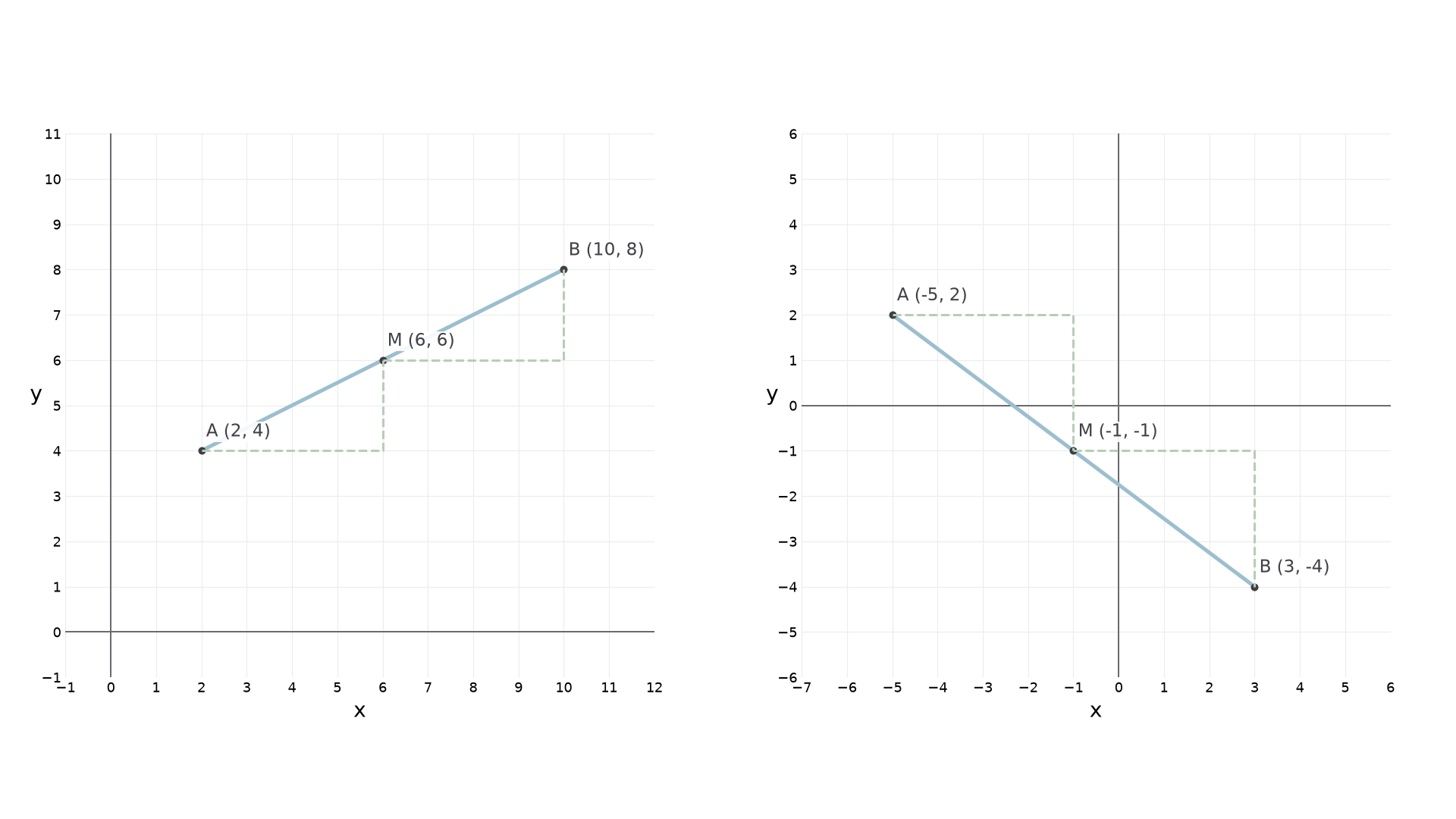
From to , the full movement is right and up. Half the movement is right and up, reaching . Averaging gives the same result without counting squares.
[DIAGRAM: asset_name: Half the movement in each coordinate; asset_slug: aqa8300_g32_midpoints; caption: The midpoint is halfway across and halfway up. The same rule works when coordinates are negative; description: Two equal-scale grid panels show segment from 2 comma 4 to 10 comma 8 with midpoint 6 comma 6, and segment from minus 5 comma 2 to 3 comma minus 4 with midpoint minus 1 comma minus 1. Dashed horizontal and vertical changes split into equal halves.]
Midpoint of a segment
For endpoints and , the midpoint is
Not on the formulae sheet: learn it.
This works because moving half of the difference from the first coordinate gives
The same argument works for . It also explains why averaging an -coordinate with a -coordinate has no geometric meaning.
Worked example 3: two positive endpoints
Question. Work out the midpoint of and . Non-calculator.
Plan. Average the two -coordinates and the two -coordinates separately.
Why this step? Each coordinate measures a different direction, so keep the two directions separate.
Answer. .
Check. to and to each move right and up.
The next example changes the signs of some coordinates. Average signed numbers in exactly the same way.
Worked example 4: negative coordinates
Question. Work out the midpoint of and . Non-calculator.
Plan. Add each pair with its signs, then divide by .
Why this step? Taking positive distances first would lose the midpoint's position relative to the axes.
Answer. .
Check. Both halves move right and down.
A midpoint can be the origin, but opposite signs alone do not guarantee that. The coordinates must cancel in each pair.
Watch out
Wrong: the midpoint of and is , found by averaging within each point. Right: combine the two horizontal coordinates and the two vertical coordinates, giving .
Try the signed-coordinate route with another pair.
Completing a shape from its properties
A missing vertex is fixed by the properties of the named shape. Read the vertices in their stated order: it tells you which sides are opposite.
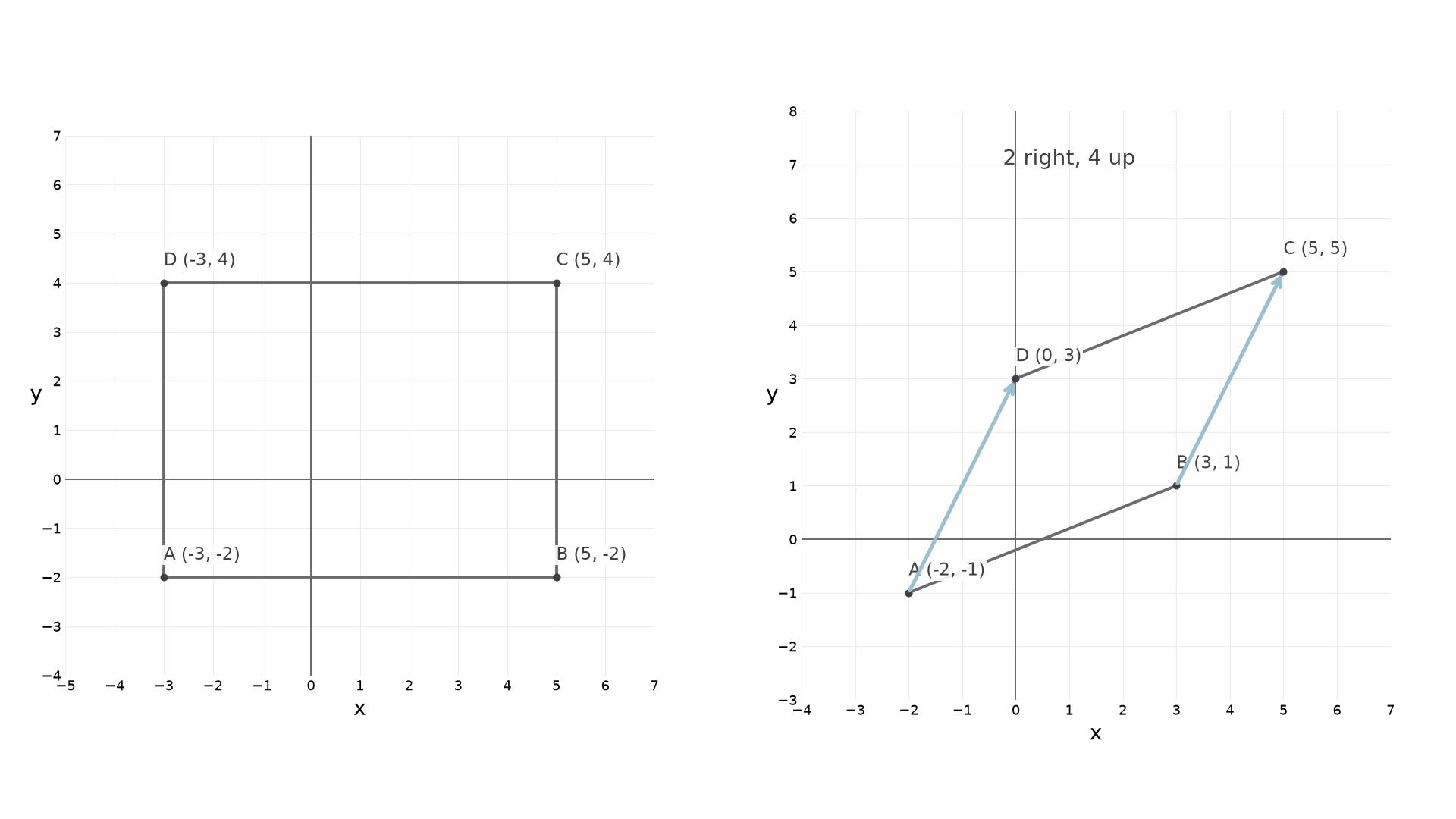
For a rectangle with sides parallel to the axes, the missing corner combines the unused horizontal and vertical coordinates. For a sloping parallelogram, opposite sides have the same horizontal and vertical movements when read in matching directions.
[DIAGRAM: asset_name: Completing rectangles and parallelograms; asset_slug: aqa8300_g32_missing_vertices; caption: A rectangle shares horizontal and vertical coordinates. A parallelogram repeats the same movement along opposite sides; description: Two equal-scale grids show rectangle A minus 3 comma minus 2 B 5 comma minus 2 C 5 comma 4 D minus 3 comma 4, and sloping parallelogram A minus 2 comma minus 1 B 3 comma 1 C 5 comma 5 D 0 comma 3. In the second panel matching blue arrows show the move 2 right and 4 up from B to C and from A to D.]
Continue this lesson.
You’re previewing NovaLearn without an account. Create a free account to read the rest.
Create free account