G19, R12 - Congruence and similar shapes
Decide when shapes are exact copies and when one is a scaled copy of another. G19 gives you the geometry of congruence and similarity; R12 lets you express comparisons as ratios and use them to work out missing lengths.
Congruent or similar
A rectangular photograph measures by . Can it fill an by frame without stretching or cropping? Both dimensions must grow by the same factor. Making just the width fit could leave you with a rather wide-looking face.
You already know
An enlargement multiplies every length by one scale factor. Reflections, rotations and translations preserve lengths and angles. The triangle congruence tests are SSS, SAS, ASA and RHS.
Think of putting one cut-out exactly over another. You may move it, turn it or flip it. If it fits exactly, the shapes are congruent. If you must also change its size, they may be similar.
Congruent and similar shapes
Congruent shapes have the same shape and size: corresponding sides and angles are equal. Similar shapes have equal corresponding angles and proportional corresponding lengths. Congruent shapes are also similar, with length scale factor .
The word corresponding means matching positions in the two shapes. A short side matches the corresponding short side, even if the second shape is turned round. Orientation does not decide congruence or similarity.
[DIAGRAM: asset_name: Matching rectangles and a distorted rectangle; asset_slug: aqa8300_g17_shape_comparison; caption: The first two rectangles have matching side ratios, while the third has been stretched in only one direction; description: Three separated rectangles, with accurate proportions, labelled A 12 cm by 8 cm, B 18 cm by 12 cm, and C 18 cm by 10 cm. A is blue, B is sage and C is clay. Below A and B the matching ratios 18 over 12 equals 12 over 8 equals 1.5 are shown. Below C a note says the length factors do not match.]
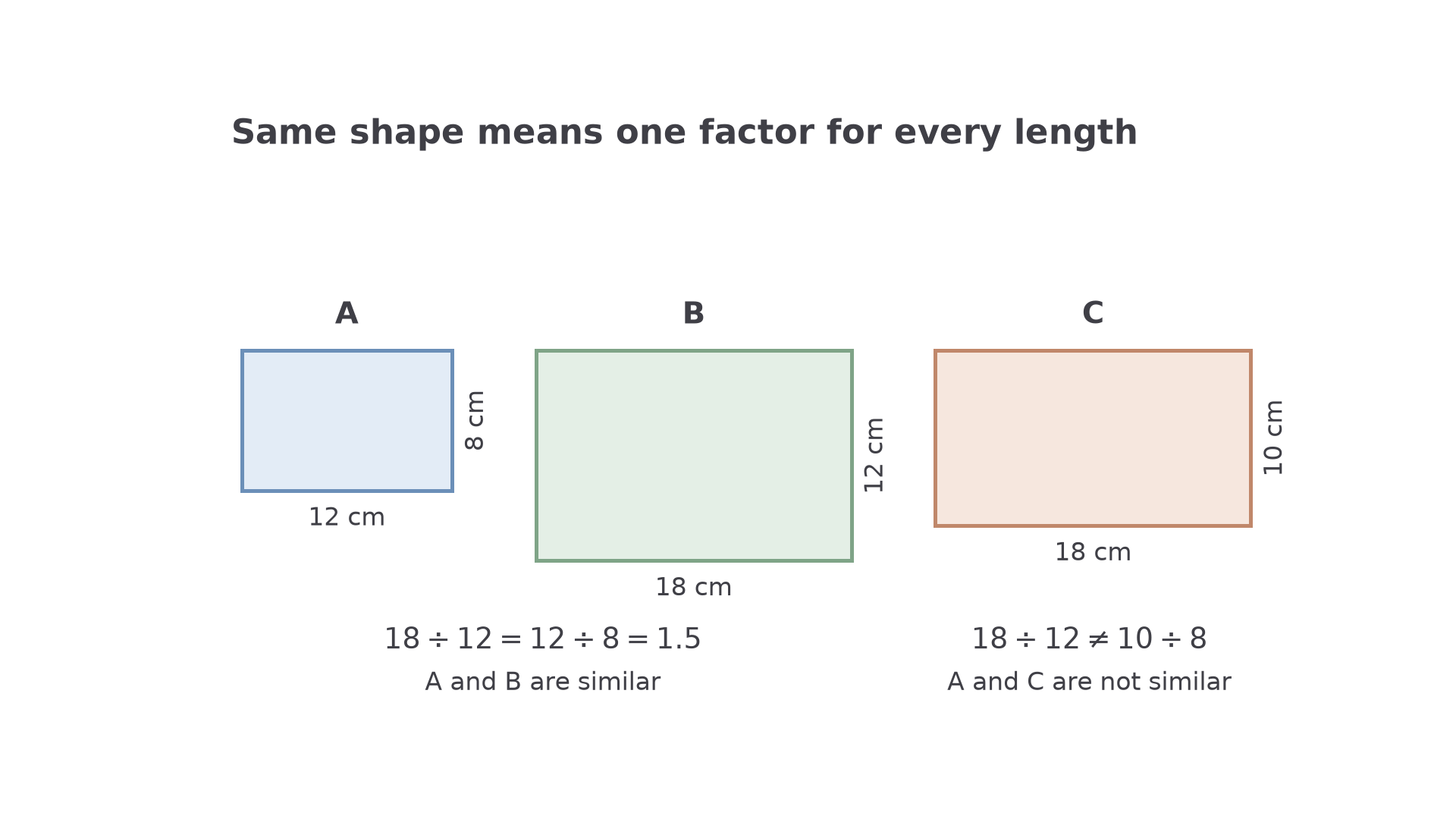
Equal angles alone do not prove that all polygons are similar. Every rectangle has four right angles, yet a long thin rectangle is not similar to a square. For triangles, equal corresponding angles do suffice: two matching angles force the third, giving the same shape. This is the AA similarity test.
Equal areas do not prove similarity either. Rectangles measuring by and by both have area , but their long-side-to-short-side ratios are and . The same amount of card can make quite different shapes.
Key idea
For similarity, every corresponding length changes by the same factor. For congruence, that factor is . These facts are not on the formulae sheet: learn them.
Use both the shape and the size information when judging the next claim.
Corresponding lengths
Write the matching side pairs before calculating a scale factor, especially when a diagram has been turned or reflected.
If is similar to , the order tells you that matches , matches and matches . Therefore matches , matches and matches . Sketch the shapes separately if that helps.
Length scale factor
For similar shapes, with lengths in the same units,
Use the same direction for every pair. A scale factor between and gives a smaller shape.
Not on the formulae sheet: learn it.
Start with a pair of lengths you know, then use that one factor for the missing pair.
Worked example 1: enlarging a triangle
Question. Non-calculator. Triangles and are similar in that order. , and . Work out .
Plan. Use and to find the factor from to , then scale .
Why this step? The ordered triangle names match with ; using instead would pair the wrong sides.
Answer. .
Check. , matching . The image is larger, as it should be.
Worked example 2 changes the direction: the unknown length belongs to the smaller shape. The factor can be less than ; it is still an enlargement scale factor in the mathematical sense.
Worked example 2: scaling down
Question. Non-calculator. Two similar ornaments have corresponding heights and . The larger ornament is wide. Work out the width of the smaller ornament.
Plan. Find the factor from larger to smaller, then multiply the larger width by it.
Why this step? Using would enlarge the width, even though the required ornament is smaller.
Answer. The smaller width is .
Check. , the same ratio as .
The common error is to transfer an increase rather than a factor.
Watch out
Wrong: “The height dropped by , so the width is .” Similarity multiplies all lengths by one factor; it does not subtract the same length from each side. The correct width is .
For the opening photograph, both factors are and . It fills the frame exactly, with no distortion. Now try a different reduction.
Similar triangles inside a figure
A line parallel to one side of a triangle makes a smaller triangle of the same shape at the opposite vertex.
Continue this lesson.
You’re previewing NovaLearn without an account. Create a free account to read the rest.
Create free account