A16 - Equation of a circle and tangents (Higher)
A circle centred at the origin has a short equation built from Pythagoras. You will recognise that equation, check whether points lie on the circle, and find tangent equations using perpendicular gradients. The coordinate rule links a curved shape to the straight line that just touches it.
A circle centred at the origin
The point lies on a circle of radius centred at the origin. What equation describes the straight line that just touches the circle there? A line through that point could cross the circle, so we need a way to pick the tangent.
You already know
Pythagoras gives the distance between two points from their horizontal and vertical separation. A circle is the set of points at a fixed distance, its radius, from its centre. A tangent is perpendicular to the radius at its point of contact.
Let lie on a circle of radius centred at . The horizontal and vertical distances from are and . Pythagoras gives ; squaring removes the signs. If a coordinate is zero, the same equation still holds on an axis.
[DIAGRAM: asset_name: Pythagoras gives the circle equation; asset_slug: aqa8300_g27_equation; caption: Every point on the circle has the same distance from the origin; description: Equal-scale coordinate axes and the circle x squared plus y squared equals 25. A radius from O to P at 3,4 is labelled 5. Dashed perpendiculars show horizontal distance 3 and vertical distance 4, with a right-angle square at 3,0. Axis intercepts plus and minus5 are labelled.]
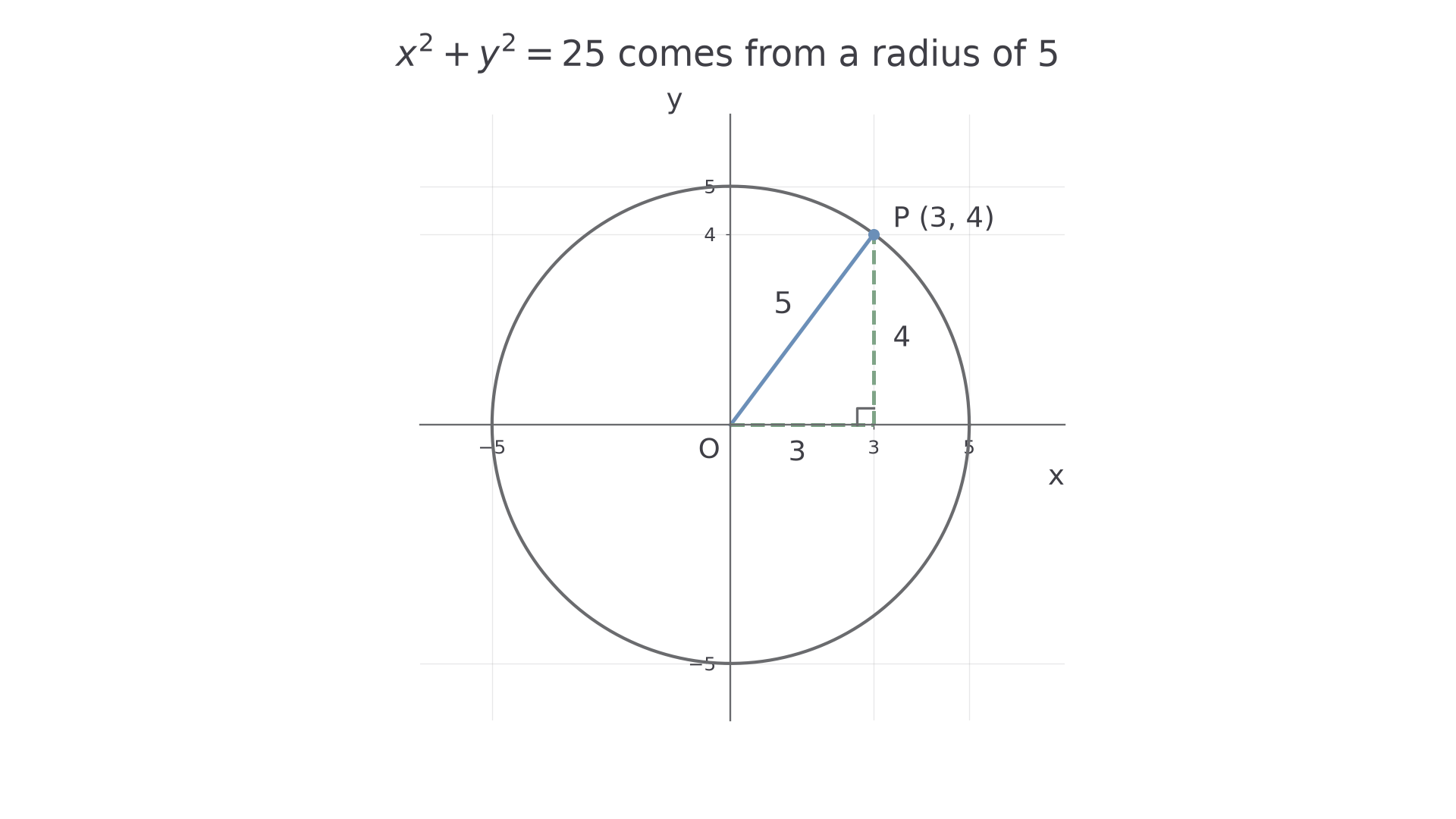
This is an equation for the circumference. Points strictly inside have a smaller sum of coordinate squares; points outside have a larger sum.
Equation of a circle
For a circle with centre and radius ,
The right-hand side is the radius squared. The intercepts are .
Not on the formulae sheet: learn it. It follows from Pythagoras, which is on the 2027 formulae sheet.
An equal scale on both axes is essential when sketching a circle; unequal scales would make its plotted shape look stretched.
Worked example 1: writing the equation
Question. Non-calculator. A circle has centre and radius . Write down its equation and its four axis intercepts.
Plan. Square the radius, then set one coordinate to zero at each axis.
Why this step? On an axis, one coordinate is zero. The other must be one radius away from the origin in either direction.
Answer. , with intercepts .
Check. Each intercept has coordinate squares summing to and distance from the centre.
Change the direction of the question: the equation is given, and you must recover the radius before sketching.
Worked example 2: reading the radius
Question. Non-calculator. A circle has equation . Write down its centre and radius, and describe the points to mark for a sketch.
Plan. Compare with , then take the positive square root.
Why this step? The is not the radius. It is the square of the distance to the centre.
Answer. Centre , radius . Mark , then draw a smooth circle on equal-scale axes.
Check. , while a supposed radius would give , not , on the right.
The equation contains both positive and negative coordinates. A circle is not just its first-quadrant arc.
Watch out
Wrong: a circle of radius has equation . Right: . Also, gives only the origin, not a circle with a positive radius.
Recover a radius from another equation.
Using coordinates on a circle
Substitution decides whether a point lies on a circle. A drawing can suggest an answer, but the equation settles it exactly.
For the circle , the point works because . Swapping the coordinates or changing either sign leaves the squares unchanged. In fact, exactly twelve points on this circle have integer coordinates: the four axis points and the eight sign-and-order variations of . A continuous curve contains only a handful of these lattice points.
Worked example 3: checking a point
Question. Non-calculator. Does lie on the circle ? Show working to support your answer.
Plan. Substitute both coordinates, including brackets around the negative one.
Why this step? The whole coordinate is squared. Writing would square only the before applying the minus sign.
Answer. Yes. The coordinates satisfy , so the point lies on the circle.
Check. Reflecting in the -axis gives at the same distance from the origin.
Now change from checking two known coordinates to finding one missing coordinate. A vertical line can meet a circle twice, so keep both square roots unless a condition selects one.
Continue this lesson.
You’re previewing NovaLearn without an account. Create a free account to read the rest.
Create free account