R16 - Compound interest, growth and decay
Model repeated percentage changes using multipliers, powers and year-by-year calculations. You will calculate compound interest, follow growth and decay, recover missing values and interpret when a target is reached. The final Higher part adds other operations to a repeated process.
Compound interest on a changing balance
At interest per year, does become after two years? That is true for simple interest. With compound interest, the first year's interest earns interest in the second year.
You already know
A increase uses multiplier . Simple interest uses the original principal every year. A power such as means multiply by three times.
Start with . After one year it is . The next is taken from , not , so the second year adds . The result is . The extra is interest on the first year's interest.
Compound interest
Interest calculated on the current balance at each stated interval, including earlier interest that remains in the account. The principal is the original amount. For example, annual compounding adds a year's interest before calculating the following year's interest.
A constant multiplier repeated times gives a power. The period must match the rate: an annual rate compounded annually uses the number of years.
Compound interest
For original principal , interest rate per period and compounding periods,
“Total accrued” is the full final balance. Subtract to find just the interest earned. Assume a fixed rate and no deposits, withdrawals or charges.
On the 2027 formulae sheet.
The formula gives a balance, not merely the extra interest. The first example separates those two amounts.
Worked example 1: two years of compound interest
Question. is invested at compound interest per annum for years. There are no deposits or withdrawals. Work out the final balance and the interest earned. A calculator may be used.
Plan. Use multiplier twice, then subtract the principal to find the interest.
Why use a square? Interest is added twice, each time to the balance then in the account.
Answer. Final balance ; interest earned .
Check. After one year the balance is . The second year's interest is , giving .
Change only the time from two years to three. The third year's percentage acts on the balance already built up.
Worked example 2: one more compounding period
Question. is invested at compound interest per annum for years, with no deposits or withdrawals. Work out the final balance and the interest earned, to the nearest penny. A calculator may be used.
Plan. Use the same annual multiplier three times, keeping all displayed digits until the final rounding.
Why keep the half-penny until the end? Rounding an intermediate balance can change the final answer. Here the question specifies rounding the final result.
Answer. Final balance ; interest earned .
Check. , extending the previous result by one year.
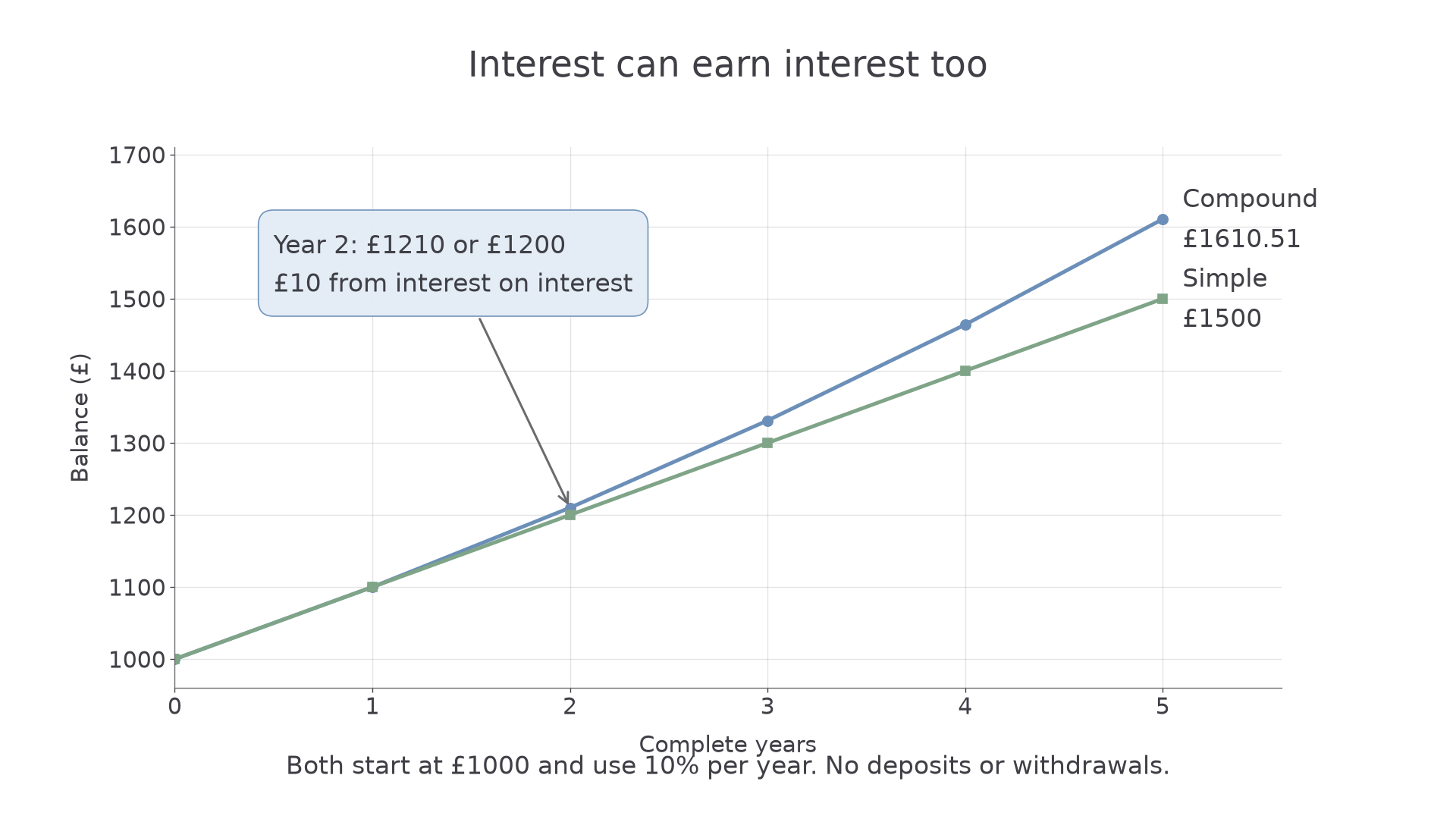
The graph below shows why compound and simple interest separate over time. The simple-interest increases are equal; the compound-interest increases grow.
[DIAGRAM: asset_name: Simple and compound interest compared; asset_slug: aqa8300_r06_interest_growth; caption: At the same annual percentage, compound interest earns increasing yearly amounts while simple interest earns a fixed yearly amount; description: Accurately plotted year-end balances for a principal of 1000 pounds at 10 percent per year for years zero to five. Blue points show compound balances 1000, 1100, 1210, 1331, 1464.1 and 1610.51. Sage points show simple-interest balances 1000, 1100, 1200, 1300, 1400 and 1500. Both series are labelled directly, with the year-two difference of 10 pounds marked.]
Watch out
Wrong: two years at compound interest means . That combines the percentages as if both used the original principal. Right: .
Use the same distinction between the balance and the interest in a new investment.
Repeated percentage growth and decay
A repeated percentage decrease uses the fraction left each time. The amount removed shrinks as the starting value for each period shrinks.
For example, a model that loses each year keeps , so its multiplier is . Starting at , the values become , , , rather than , , . Each loss is a percentage of the current value.
Repeated percentage change
For starting value , a fixed percentage per period and periods,
For a decrease of less than , the multiplier is between and . A decrease leaves zero after the first period.
The compound-interest growth form is on the 2027 formulae sheet. The general decay form is not on the formulae sheet: learn it.
Growth need not involve money. If a model starts with units and increases by per hour, after two hours it predicts units. Use a model only for the period and conditions stated; a real quantity need not grow forever.
Worked example 3: depreciation over three years
Question. A machine is worth . Its value depreciates by each year. Work out its value after years. A calculator may be used.
Plan. Find the fraction of value retained, then use that multiplier three times.
Why use , not ? The final value is what remains, not the amount removed in the final year.
Answer. .
Check. The year-end values are , , , each of the previous one.
Change only the number of years. The percentage decrease is applied repeatedly, not multiplied by the time.
Worked example 4: depreciation over five years
Question. A machine is worth . Its value depreciates by each year. Work out its value after years. A calculator may be used.
Plan. Use the same retention multiplier with exponent .
Why is the value not zero after five years? The five losses are not five equal chunks of the original value. Each is of a smaller current value.
Answer. .
Check. Starting from the three-year value, .
A positive amount multiplied by a number strictly between and stays positive after any finite number of repetitions. It approaches zero without reaching it in this exact model. For quantities counted in whole objects, a decimal prediction may need interpreting or rounding as the question directs.
Watch out
Wrong: five annual decreases of remove of the original value. Right: repeat the multiplier . Adding the percentages ignores their changing bases.
Use a different annual loss and interpret the retained value.
Finding a starting value or percentage rate
A final amount contains every repeated multiplier. To work backwards, undo the whole product, not a single year's percentage.
Suppose a value has been multiplied by twice. Dividing the final value by recovers the start. If the start and finish are known instead, their ratio gives the combined multiplier; a root recovers one period's multiplier.
Reversing repeated growth
For final value , where is a fixed multiplier and is a positive whole number,
For growth, the percentage rate is . For decay, it is .
These rearrangements are not on the formulae sheet: learn it. The compound-interest starting formula is on the 2027 formulae sheet.
First recover the starting amount when the multiplier is known.
Worked example 5: recovering the principal
Question. An investment grows at compound interest per annum for years to . There are no other account changes. Work out the principal. A calculator may be used.
Plan. Divide the final balance by the two-year multiplier .
Why divide by the square? Dividing by only once recovers the balance after one year, not the original principal.
Answer. .
Check. .
Continue this lesson.
You’re previewing NovaLearn without an account. Create a free account to read the rest.
Create free account