N14, N15 - Rounding, significant figures and estimation
An answer can be accurate without needing every digit. N15 shows you how to round to decimal places or significant figures and choose sensible accuracy in a context. N14 uses these simpler numbers to estimate calculations and check whether an answer, including a calculator answer, makes sense.
Rounding to a place value
A group needs seats for people. Each minibus seats . Will ordinary rounding always tell you how many minibuses to book? Keep that question in mind while we first learn what rounding actually does.
You already know
Place value tells you the value of each digit. The first two columns after the decimal point are tenths and hundredths; .
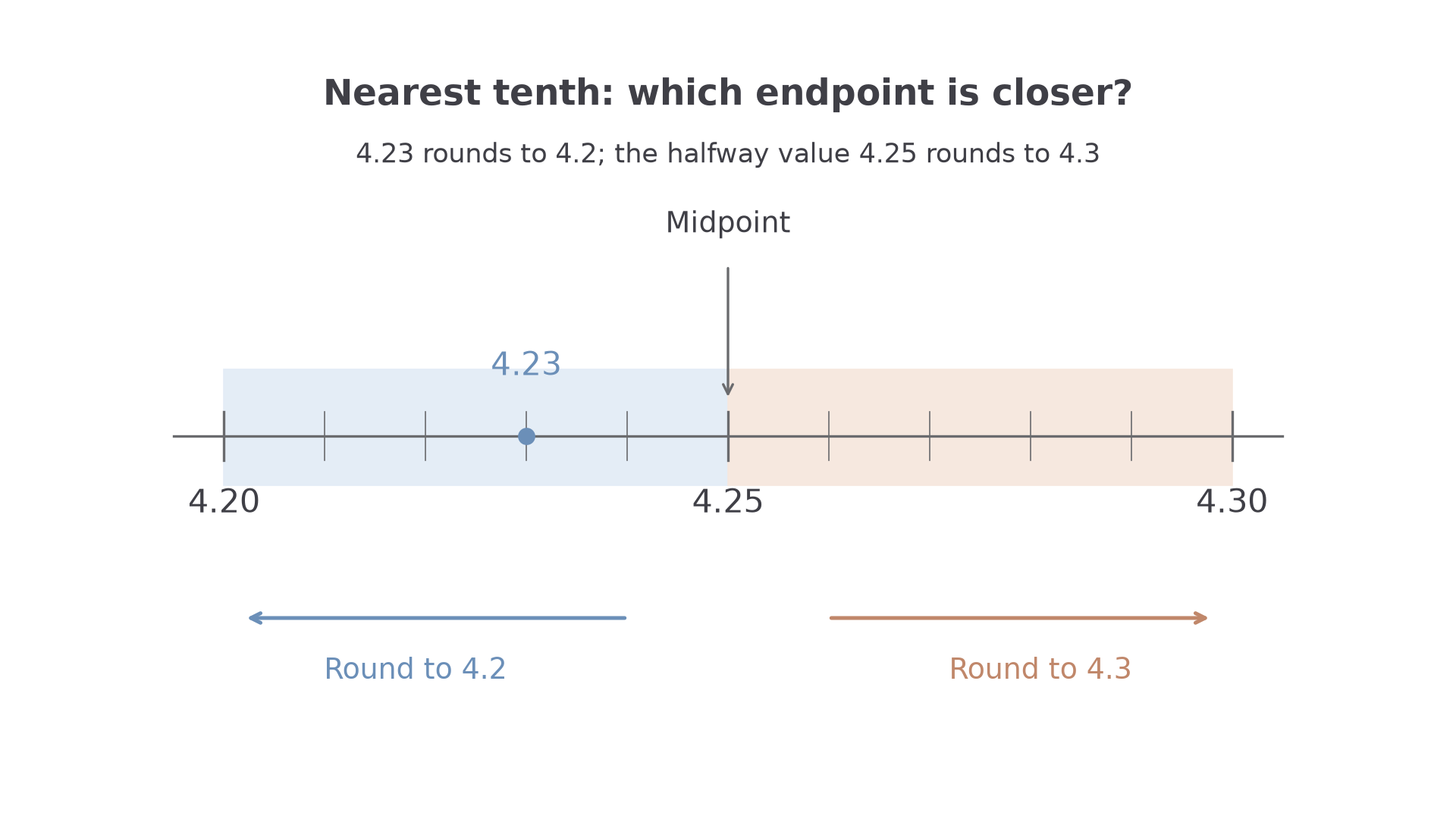
The number lies between and . It is closer to , so rounded to one decimal place is . Their midpoint is . Values below the midpoint round to ; for positive numbers, the midpoint and values above it round to .
[DIAGRAM: asset_name: Rounding to the nearest tenth; asset_slug: aqa8300_n14_rounding_midpoint; caption: The midpoint 4.25 decides whether a positive number rounds to 4.2 or 4.3; description: A number line from 4.20 to 4.30 has a labelled midpoint at 4.25. A blue point marks 4.23 to the left of the midpoint. Pale blue and clay bands distinguish the two halves, with arrows indicating rounding towards 4.2 and 4.3 respectively. The labels show 4.23 rounds to 4.2 and 4.25 rounds to 4.3.]
Decimal places
The number of digits written after the decimal point. For example, has two decimal places and also has two. The final zero in shows the requested accuracy.
To round, identify the last place you want to keep. Look at the next digit. A digit from to leaves the kept digit unchanged; a digit from to increases it by one. Remove digits to the right of the required decimal place. For whole numbers rounded to tens, hundreds or thousands, replace the discarded digits with zeros to preserve place value.
For instance, to the nearest hundred is , not . With negative numbers, think of the nearest point on the number line: is closer to than to .
Rounding to the nearest place
The gap between successive rounded values is the rounding unit. Round to the nearest multiple of that unit; halfway positive values round to the higher multiple.
The requested place determines the unit, not the length of the original number.
Not on the formulae sheet: learn it.
Keep the hundredths column in the following example.
Worked example 1: rounding a decimal
Question. Write correct to decimal places. Non-calculator.
Plan. Keep the hundredths and inspect the thousandths.
Why use the ? It tells us the value is more than halfway from to .
Answer. .
Check. The distances are to and to .
Now change the kept digit to . Rounding up must carry into the next column.
Worked example 2: carrying when rounding
Question. Write correct to decimal places. Non-calculator.
Plan. Round up the hundredths, carrying when increases by one.
Why keep the final zero? The question asks for two decimal places, so the hundredths column must be shown.
Answer. .
Check. is only below .
The first discarded digit makes the rounding decision; the rest cannot reverse it.
Watch out
Wrong: to two decimal places. The value is right but the requested written accuracy is missing. Right: .
Use the same carrying idea with a new number.
Rounding to significant figures
Significant figures count from the first non-zero digit, wherever the decimal point sits.
In , the first significant digit is . The zeros before it only locate the number on the place-value scale. The zero between and counts, so this number has three significant figures. In , the final zero also counts because it is written after the decimal point to show accuracy.
Significant figures
The important digits counted from the first non-zero digit. Zeros between significant digits count, and trailing decimal zeros show accuracy. For example, has two significant figures: and . Its leading zeros do not count.
After finding the last significant digit you want, use the next digit to decide whether to round up. Keep place value: rounding to two significant figures still gives a number in the tens of thousands. This rule is not on the formulae sheet: learn it.
Worked example 3: a large number
Question. Write correct to significant figures. Non-calculator.
Plan. Keep the and ; inspect the next digit and preserve the number's size.
Why write three zeros? They keep in the thousands; alone is far too small.
Answer. .
Check. is closer to than to .
The next example changes only the scale: the same digits appear in a small decimal. Start counting at the same .
Worked example 4: a small decimal
Question. Write correct to significant figures. Non-calculator.
Plan. Ignore the leading zeros when counting significant figures.
Why keep the leading zeros? They locate the in the thousandths column, although they are not significant figures.
Answer. .
Check. has two significant figures but four decimal places.
Decimal places and significant figures answer different questions.
Watch out
Wrong: to two significant figures. That is rounding to two decimal places. Right: begin at the , giving . Rounding can also carry: to two significant figures is , stated to two significant figures.
For this check, the next digit now causes an increase.
Estimating and checking calculations
An estimate makes a calculation simple enough to check its size without a calculator.
You already know
Round to one significant figure by keeping the first non-zero digit. Follow the order of operations: powers before multiplication, and multiplication before addition.
For an exam question that says “By rounding each number to one significant figure”, show those rounded numbers. Keep the operations unchanged. In particular, rounding a number inside a power does not remove its exponent. This estimation method is not on the formulae sheet: learn it.
Worked example 5: an estimate with a square
Question. By rounding each number to significant figure, estimate . Non-calculator.
Plan. Round the three numbers, then follow the original order of operations.
Why retain ? The question still asks for a square; only its base has been approximated.
Answer. An estimate is . It is an overestimate: all three positive numbers were rounded upwards, increasing both terms.
Check. Both terms are positive, so a result smaller than would not fit these rounded values.
Change the square to a cube. That single symbol makes a large difference to the estimate.
Worked example 6: an estimate with a cube
Question. By rounding each number to significant figure, estimate . Non-calculator.
Plan. Use the same rounded bases but cube this time.
Why not again? , whereas uses only two factors.
Answer. An estimate is , again an overestimate.
Check. is between and , so the whole estimate should be between and .
An overestimate is greater than the exact value; an underestimate is smaller. For positive quantities, increasing a numerator increases a quotient, but increasing its denominator decreases it. When some rounding changes pull in opposite directions, do not guess which effect wins.
Watch out
Wrong: round only the final calculator answer when the question asks for an estimate using rounded inputs. Right: show the simpler input numbers and calculate with them. Use between an exact expression and its estimate, not .
Estimation also checks technology. The exact first expression is ; a display of is far too large compared with . Check the entered expression, brackets and decimal points. A result near the estimate is plausible, but that alone does not prove every key was correct. A quick estimate for , for example, is , so a calculator answer near needs checking.
Choosing accuracy in context
The context decides whether an ordinary nearest-value answer is useful.
For money, a final price in pounds normally needs two decimal places. For whole objects, ask whether you need enough capacity or only complete groups. A fractional vehicle is not something you can book.
Worked example 7: enough seats
Question. Each minibus seats people. Work out the least number of minibuses needed for people. Calculator allowed.
Plan. Divide to find the number of full vehicle loads, then allow for the remaining people.
Why round up? You need seats for every person, including those in the last partly filled minibus.
Answer. minibuses.
Check. , so four are insufficient and five are enough.
Now change the demand from enough capacity to complete groups. The quotient stays the same; the direction of rounding changes.
Worked example 8: complete teams
Question. There are players. Each full team needs players. Work out the greatest number of full teams. Calculator allowed.
Plan. Divide, then count only the complete teams.
Why round down? A partly filled team does not meet the question's condition.
Answer. full teams.
Check. Five teams need players, more than are available.
Even when ordinary rounding is appropriate, do it once at the end. A surprising trap is that rounds directly to at one decimal place, but rounding first to , then to one decimal place, gives . The first rounding has changed the later decision.
Watch out
Wrong: round to , then multiply by to get . Right: keep unrounded, so , which rounds to at two decimal places. On a calculator, keep the value in memory or use the whole expression.
The opening minibus answer happens to agree with rounding to the nearest integer. That is a coincidence: if the quotient had been , enough seats would still require five vehicles. Read what the answer has to achieve.
Quick Recap
- Decimal places count from the decimal point; significant figures count from the first non-zero digit.
- Keep the number's place value and show final decimal zeros when needed for the requested accuracy.
- Estimate with simple inputs, keeping the original operations, then use the result to check the size of an answer.
- Keep intermediate values unrounded and round the final result once.
- In context, enough capacity may require rounding up; complete groups may require rounding down.
The group must book minibuses: ordinary rounding is not the rule that guarantees enough seats.