A25 - The nth term of a linear sequence
A term-to-term rule gets you to the next term. An nth-term rule lets you reach any position in one calculation. In A25 you will build linear nth-term rules, including decreasing sequences and sequences with missing terms, then use your rule to decide whether a number appears.
Building a rule from the common difference
Will the sequence ever reach ? Listing hundreds of terms would work, but a rule can settle it much faster.
You already know
An arithmetic, or linear, sequence has a constant difference. The position normally starts at . Substituting a position into an nth-term rule gives the value at that position.
The differences in are all . Compare those terms with , the multiples of . Every term is bigger than the matching multiple. That fixed extra amount is what the common difference alone does not tell you.
[DIAGRAM: asset_name: Multiples and a fixed extra amount; asset_slug: aqa8300_a16_linear_groups; caption: Each pattern has n groups of three tiles and two extra tiles, giving the rule 3n plus 2; description: Pattern 1 has a column of three blue tiles and two green tiles, Pattern 2 has two columns of three blue tiles and two green tiles, and Pattern 3 has three columns of three blue tiles and two green tiles. Below each is an equation: 3 times 1 plus 2 equals 5, 3 times 2 plus 2 equals 8, and 3 times 3 plus 2 equals 11. The final line reads n groups of 3 plus 2 fixed tiles.]
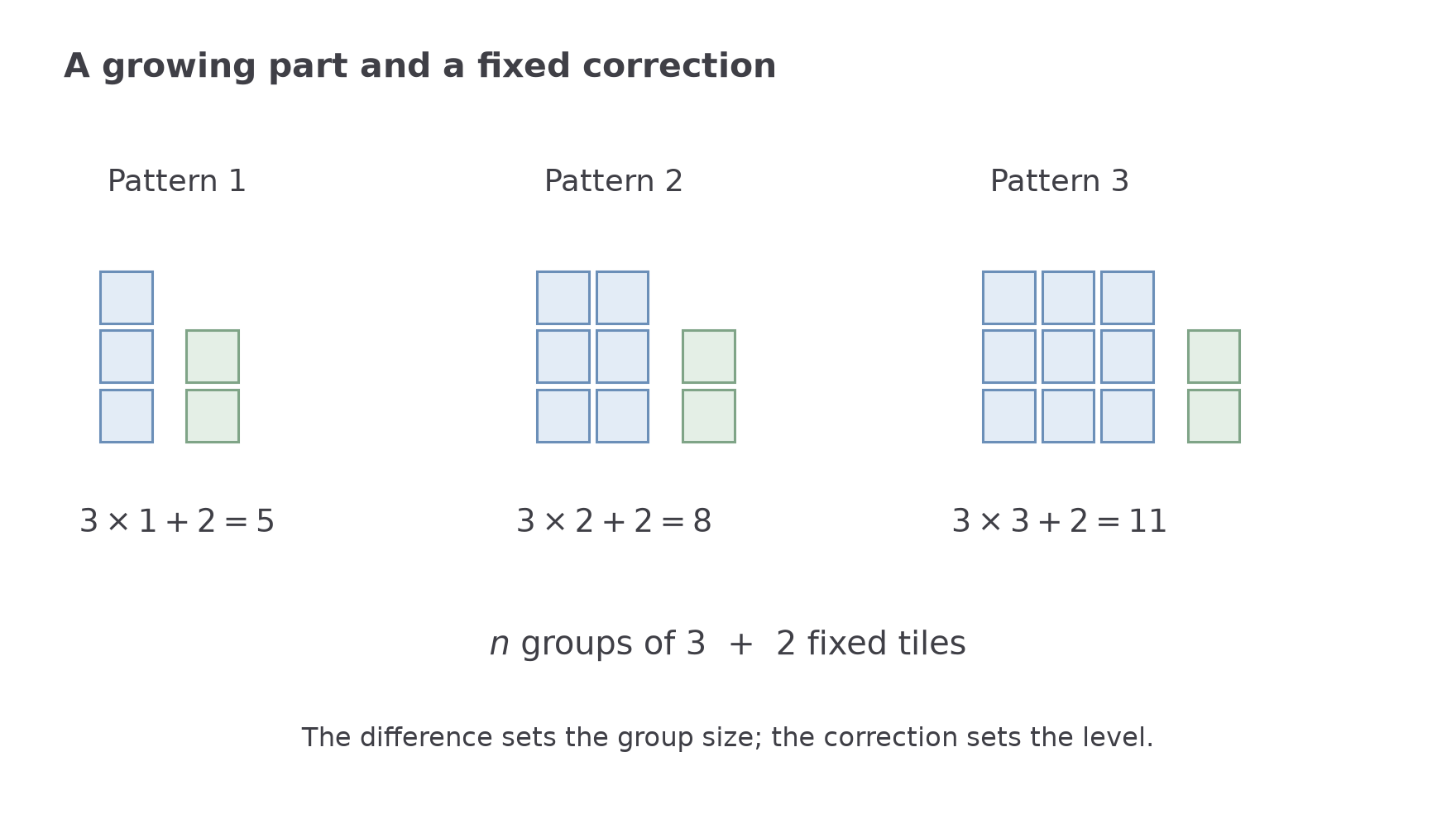
The picture shows why the rule has two jobs: counts the growing part; supplies the same correction at every position.
The nth term of a linear sequence
For positions , a linear sequence with first term and common difference has
Equivalently, write , where .
Not on the formulae sheet: learn it.
Why differences? To reach the first term you make no moves. To reach the second you make one move. To reach the nth you make moves. You can use that route or compare the sequence with the multiples of .
Worked example 1: a positive correction
Question. A linear sequence begins . Work out an expression for the nth term. Non-calculator.
Plan. Find the common difference, use its multiples, then work out the fixed correction.
Why this step? The difference is the coefficient of , because increasing by increases by .
Answer. .
Check. At , . At , , matching both ends of the given list.
Now move the whole sequence down by . The difference stays , but the fixed correction changes sign.
Worked example 2: a negative correction
Question. A linear sequence begins . Work out an expression for the nth term. Non-calculator.
Plan. Compare the terms with , then use the first term to find the correction.
Why this step? The first term is , but the constant correction is . They are different because starts at , not .
Answer. .
Check. and .
There is a pleasing balance in an arithmetic sequence: terms equally far from opposite ends of a finite list have the same sum. Here . Moving one term up by and its partner down by leaves the total unchanged.
Watch out
Wrong: write because the rule is “add ”. That expression gives , increasing by . Right: start with , then find the fixed correction.
Change the difference, while keeping the idea of a negative correction.
Decreasing sequences and fractional differences
A negative common difference gives a negative coefficient of .
For , calculate . Using would describe growth in the opposite direction. The same rule still works; the sign belongs to the difference.
Signed common difference
The common difference is the next term minus the previous term. For a decreasing linear sequence it is negative. It may also be a fraction or decimal: has common difference .
Use the first term to find after choosing the signed coefficient. Subtracting a negative number increases the correction.
Worked example 3: a negative coefficient
Question. A linear sequence begins . Work out an expression for the nth term. Non-calculator.
Plan. Use difference , then choose the constant that gives when .
Why this step? begins at . Adding , rather than , brings its first term to .
Answer. .
Check. The first and fourth values are and .
Now change only the size of the decrease, from to , keeping the first term at . A decimal difference needs no new method.
Worked example 4: a decimal decrease
Question. A linear sequence begins . Work out an expression for the nth term. Non-calculator.
Plan. Put the difference in front of , then match the first term.
Why this step? A half-unit in the difference must stay in the rule. Rounding to changes the sequence.
Answer. , or .
Check. and .
A constant sequence is the boundary case: has difference , so its nth term is simply . A decreasing number sequence can continue below zero, unless its context restricts the number of terms. These are applications of the linear rule, which is not on the formulae sheet: learn it.
Watch out
Wrong: for . At this gives , already one term too far along. Right: .
Keep the first term fixed again, but change the size of the decrease.
Continue this lesson.
You’re previewing NovaLearn without an account. Create a free account to read the rest.
Create free account