N6 - Powers and roots
Powers compress repeated multiplication, while roots undo it. You will work with squares, cubes and higher powers, recognise useful number facts, and distinguish a root from the power that produced it. The final part estimates unfamiliar powers and roots for Higher tier.
Positive integer powers and squares
Can be arranged both as a square of counters and as a cube of small blocks? The two arrangements need different side lengths, but they contain the same number. Powers and roots will tell us both lengths.
Start smaller: four rows of four counters contain counters. We write this as , read “four squared”. The raised counts the factors of ; it does not mean multiply by .
You already know
Multiplication combines equal groups. Brackets tell you which number an operation acts on: squares the whole negative number, while means the negative of .
With three equal factors, , read “four cubed”. A fourth power has four factors, and so on. The base can be a decimal, a fraction, a negative number or zero.
Base and index
In , is the base and is the index or exponent. For a positive integer , it means a product of factors, each equal to . For example, , not .
A power with index contains one factor, so . You will meet zero and negative indices in the next lesson; they need a different interpretation.
Positive integer powers
Here is a positive integer. In particular, is a square and is a cube.
Not on the formulae sheet: learn it.
Square facts make roots and later calculations much quicker. Learn the squares through , rather than counting from scratch each time.
| Number | Square | Number | Square | Number | Square |
|---|---|---|---|---|---|
These square facts are not on the formulae sheet: learn them. The next examples keep the base fixed and change the number of factors.
Worked example 1: squaring a number
Question. Work out . Non-calculator.
Plan. Write two factors of , then multiply.
Why two factors? The index is ; the base tells us what each factor is.
Answer. .
Check. A square of six rows of six contains counters.
Change only the index from to . This adds one factor, rather than adding to the answer.
Worked example 2: cubing the same number
Question. Work out . Non-calculator.
Plan. Use the square already known, then multiply by one more .
Why multiply by ? Increasing the index by adds a factor of the base, not a fixed amount.
Answer. .
Check. , the square from example 1.
The size of the base matters. For a number between and , repeated multiplication makes the result smaller: and .
Watch out
Wrong: . That is . Right: . Write the factors if the notation feels uncertain.
Keep the same distinction in a slightly larger cube.
Square roots, cube roots and higher roots
A root reverses a power: if , the non-negative square root of is .
[DIAGRAM: asset_name: Squaring and taking a square root; asset_slug: aqa8300_n03_square_root; caption: A square with side 4 has area 16, so the square root of 16 is 4; description: A four-by-four array of unit squares. Arrows connect the side length 4 to the area 16 by squaring, and connect the area back to the side length by taking its square root.]
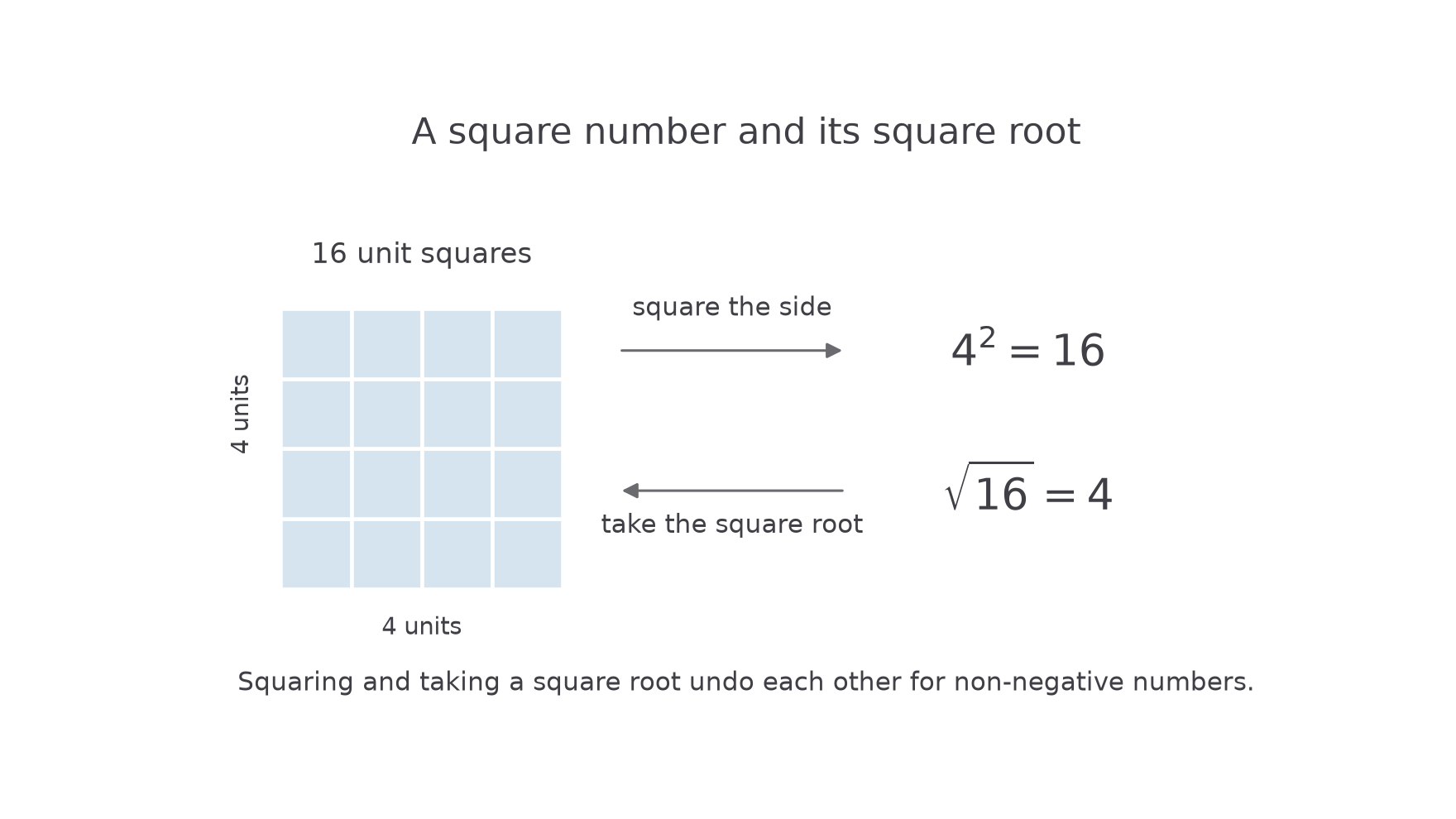
The little index on a root sign tells you which power to undo. , because . The square-root sign is the exception: its little is normally left out.
Real roots
A root of order is a real number whose power with index gives the number inside the root. For an even root, the root symbol means the non-negative root: , even though both and square to . An odd root can be negative: .
Every real square is non-negative. So has no real value. By contrast, . A root is not division by the index: is , not .
Undoing a positive power
For a positive integer and ,
For odd , this also holds for negative . For even , a negative input returns its non-negative magnitude, for example .
Not on the formulae sheet: learn it.
Read the entire root before looking for a number fact. The root bar covers everything whose root is being taken.
Worked example 3: using a square fact backwards
Question. Work out . Non-calculator.
Plan. Find the non-negative number whose square is .
Why not ? The square-root symbol asks for the non-negative value.
Answer. .
Check. Squaring the answer gives .
Change only the root index: a cube root needs a three-factor fact instead of a square fact.
Worked example 4: using a cube fact backwards
Question. Work out . Non-calculator.
Plan. Find the number whose cube is .
Why three factors? The small belongs to the root sign and tells us which power to undo.
Answer. .
Check. .
Higher roots follow the same meaning: , because , and , because . A higher root is a different operation from dividing or taking repeated square roots indiscriminately.
Watch out
Wrong: . Right: . If a question instead asks for all numbers that square to , both and are answers. Read what is being asked.
Use a power fact to justify a root, even if you spot its answer immediately.
Recognising powers of 2, 3, 4, 5 and 10
Recognising a power lets you read a large number as a short multiplication story.
The table begins each sequence. Move right by multiplying by the base again, rather than adding it. These facts are not on the formulae sheet: learn the familiar ones and build the others.
| Base | First power | Second | Third | Fourth | Fifth |
|---|---|---|---|---|---|
One number can belong to more than one row. : it really can be both a square and a cube. For the opening arrangements, the square has side , and the cube has side .
Worked example 5: recognising a power
Question. Write as a power of . Non-calculator.
Plan. Multiply by repeatedly, keeping track of the number of factors.
Why count the factors? is the value; the requested index records how many fours made it.
Answer. .
Check. .
Change only the base being searched for: use instead of .
Worked example 6: building the next familiar power
Question. Write as a power of . Non-calculator.
Plan. Start with the known cube of , then extend it.
Why start at ? Recognising a nearby power avoids rebuilding the whole sequence from .
Answer. .
Check. .
Powers of have an especially visible pattern. , and : a million is a thousand thousands. For a positive integer index, the index counts the zeros after the .
Watch out
Wrong: . Right: contains six factors of , giving . The same index means six factors for any base, but it counts written zeros only for base .
You can now recognise the number and name the base it comes from.
Estimating powers and roots (Higher)
When a number is unfamiliar, put it between two familiar numbers and use their powers or roots to trap the answer.
For example, and . Since lies between and , its square root lies between and . It is not exactly halfway: equal steps in a number do not give equal steps in its square.
Comparing positive powers and roots
For positive numbers and a positive integer ,
Nearby convenient inputs give estimates; testing closer inputs refines them.
Not on the formulae sheet: learn it.
The positivity condition matters. Squaring does not keep every negative-number comparison in the same order: , but .
Worked example 7: estimating an unfamiliar power
Question. Without a calculator, estimate , and decide whether your estimate is above or below the exact value.
Plan. Replace by the nearby whole number , then compare the positive bases.
Why cube the rounded base? Repeated multiplication uses the base three times, so the approximation must replace all three factors.
Answer. About ; this is an overestimate.
Check. , so the value is between and and close to the upper end.
Change only the direction of the operation: estimate a root by testing powers of possible answers.
Worked example 8: refining an unfamiliar root
Question. Estimate to one decimal place. Non-calculator.
Plan. Locate the root between whole numbers, then compare it with the halfway point between candidate tenths.
Why test ? Values at or above this midpoint round to , whereas values below it round to .
Answer. to one decimal place.
Check. is close to . It is an estimate, so use , not .
The same comparison works at any positive scale: and , so . For a fourth root, compare fourth powers rather than squares.
Watch out
Wrong: because is halfway between and . It is not halfway, and the square-root scale is not linear. Right: test nearby powers and mark an estimate with .
Refine only as far as the required accuracy needs. A whole-number bracket is enough when the question asks for consecutive integers.
Quick Recap
- A positive integer index counts equal factors: .
- A root undoes a power. The square-root symbol returns the non-negative root; odd roots can be negative.
- Know squares through , recognise familiar powers of , , , , and remember and .
The opening counters make an -by- square, or a cube with side , because .