N2 - Calculating with fractions and mixed numbers
Fractions let you calculate with equal parts exactly. You will add, subtract, multiply and divide positive and negative fractions, including improper fractions and mixed numbers. Each operation has a reason behind its rule, so you can choose a method rather than guess which numbers to combine.
Adding fractions
You have of ribbon. How many lengths is that? The calculation is . Should dividing make the answer smaller? We will return to this once the fraction rules have a meaning.
You already know
Equivalent fractions have the same value. Use a common multiple to make a shared denominator, and divide top and bottom by their HCF to simplify. Convert mixed numbers by counting all the parts in the whole-number and fractional portions.
Three eighths plus two eighths makes five eighths: . You count more parts, but each part is still an eighth. The denominator stays .
With different denominators, first rename both fractions in equal-sized parts. A quarter plus a sixth becomes three twelfths plus two twelfths. The LCM of the denominators keeps the new numbers small.
Adding fractions
For a positive common denominator ,
If the denominators differ, make equivalent fractions with a common denominator first. Simplify the result when possible.
Not on the formulae sheet: learn it.
A sum can be smaller than one whole or larger than it. The method is the same in either case.
Worked example 1: different-sized parts
Question. Work out . Non-calculator. Give your answer in its simplest form.
Plan. Change both fractions to twelfths, then add the numerators.
Why keep below the line? Combining parts does not change their size: they remain twelfths.
Answer. .
Check. Both fractions are positive, so the sum exceeds ; both are at most , so the sum is at most . The answer fits.
The next example changes only the second numerator. More sixths push the sum past one whole.
Worked example 2: a sum greater than one
Question. Work out . Non-calculator. Give your answer in its simplest form.
Plan. Use twelfths again and combine all the parts.
Why allow a numerator larger than the denominator? There are twelfths, more than the needed to make one whole.
Answer. , or .
Check. One sixth would complete to . Adding a quarter instead leaves beyond .
A whole can also be made from three different-sized parts: . The three different fractions fit together exactly when you measure everything in sixths.
Watch out
Wrong: . Adding the denominators changes the size of the parts and makes the sum smaller than . Right: .
The next question changes only the second fraction from Worked example 2. Choose the common denominator afresh.
Subtracting fractions and crossing zero
Subtraction also needs equal-sized parts. If tenths lose tenths, tenths remain. If the amount subtracted is greater than the starting amount, the answer is negative.
A negative fraction follows the same addition and subtraction rules as a negative integer. Adding has the same effect as subtracting ; subtracting has the same effect as adding .
Subtracting fractions
For a positive common denominator ,
Make a common denominator first if needed. Keep the subtraction in its stated order, including any negative sign.
Not on the formulae sheet: learn it.
Do the common-denominator step before deciding the sign of the final difference.
Worked example 3: a positive difference
Question. Work out . Non-calculator. Give your answer in its simplest form.
Plan. Use twelfths and subtract the numerator of the second fraction.
Why subtract , not ? A quarter is three twelfths; its name has changed but its value has not.
Answer. .
Check. Adding back gives .
The next example changes only the numerator of the subtracted fraction. The answer now crosses zero.
Worked example 4: a negative difference
Question. Work out . Non-calculator. Give your answer in its simplest form.
Plan. Use twelfths again and keep the numerator subtraction in order.
Why negative? You remove twelfths from twelfths, leaving twelfths below zero.
Answer. .
Check. , which restores the start.
To subtract a negative fraction, first turn the operation into addition: . To add two negative fractions, combine the negative counts: .
Watch out
Wrong: , from always taking the smaller numerator from the larger. Right: , so the result is .
The second fraction grows again in the next check. Predict the sign before calculating.
Multiplying fractions and cancelling factors
Multiplying by a fraction means taking that fraction of an amount. Half of is : each quarter is split in half, leaving three eighths.
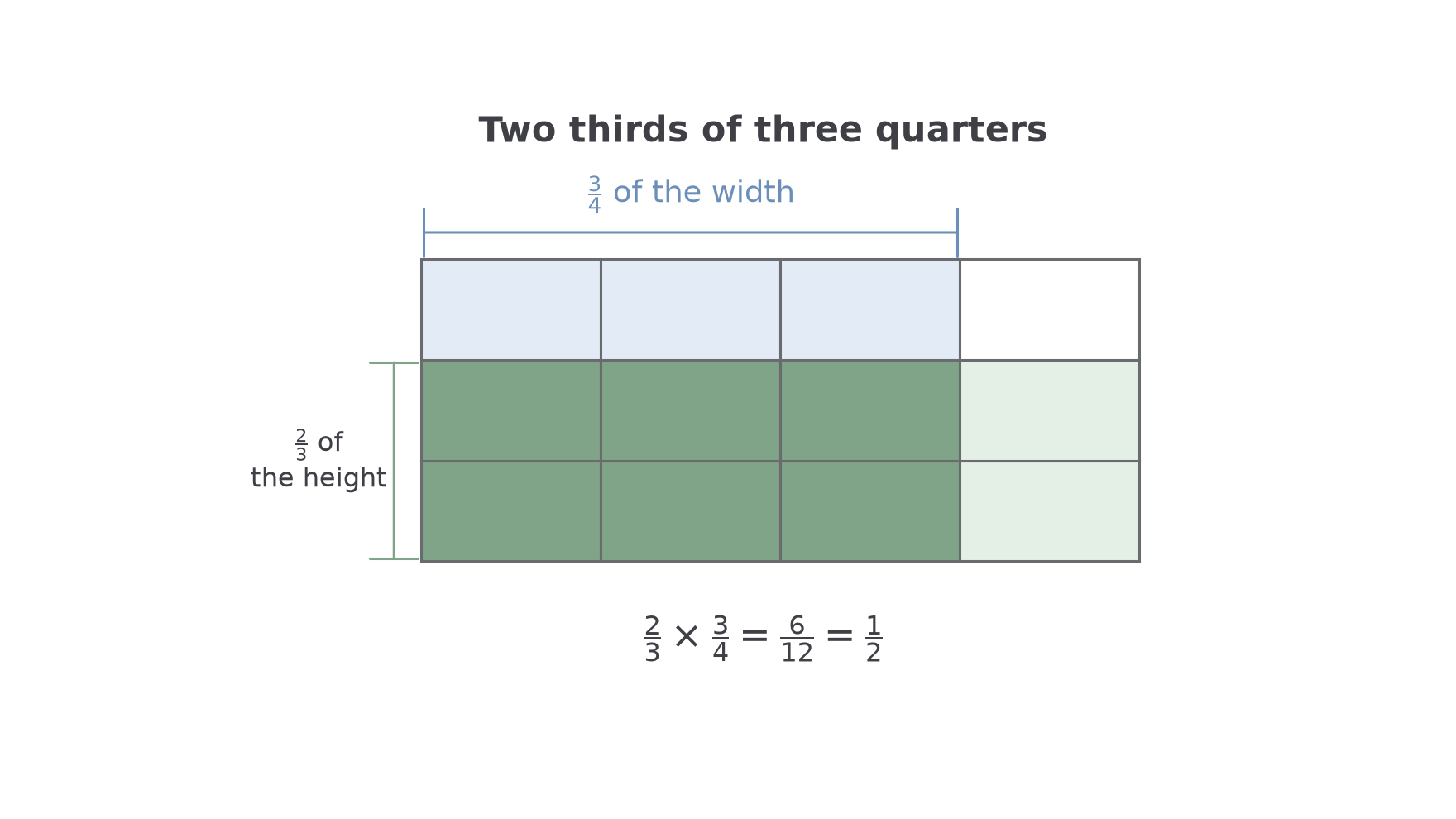
For of , divide a whole rectangle into equal rows and equal columns. There are equal cells. Taking of the rows and of the columns selects cells, so the product is .
[DIAGRAM: asset_name: Two thirds of three quarters; asset_slug: aqa8300_n07_fraction_product; caption: Two of three rows and three of four columns overlap in 6 of 12 equal cells, so two thirds times three quarters is one half; description: A rectangle split into three rows and four columns. The left three columns are pale blue, the bottom two rows pale sage, and the six overlapping cells a darker sage. A top bracket labels three quarters of the width, and a left bracket labels two thirds of the height. A note identifies six selected cells out of twelve.]
Multiplying fractions
For non-zero denominators and ,
Multiply numerators together and denominators together. You may cancel common factors between the complete numerator and denominator before multiplying. Matching signs give a positive product; different signs give a negative product.
Not on the formulae sheet: learn it.
Cancellation here is ordinary fraction simplification done early. Each factor you remove from the top must also be removed from the bottom.
Worked example 5: cancelling before multiplying
Question. Work out . Non-calculator. Give your answer in its simplest form.
Plan. Cancel the common factor of between and , then multiply.
Why cancel across the two fractions? After multiplication, is a factor of the whole numerator and is a factor of the whole denominator.
Answer. .
Check. Multiplying first gives , which simplifies to . The product is below , because .
The next example changes only the sign of the second factor. The size calculation stays the same.
Worked example 6: a negative product
Question. Work out . Non-calculator. Give your answer in its simplest form.
Plan. Decide the sign, then multiply the positive sizes using the same cancellation.
Why is only the sign different? The two factors have unchanged distances from zero; only one direction has reversed.
Answer. .
Check. Multiplying by , the reciprocal of the second factor, gives , restoring the first factor.
Two negative factors give a positive product: . A whole number can be written over , so .
Watch out
Common denominators are needed for adding or subtracting, not for multiplying. Also, cancel factors across the complete numerator and denominator, not two numerators. Wrong: cancelling the two numerator values of in . Right: .
The next product changes the second fraction's size as well as keeping its negative sign. Cancel before multiplying.
Dividing by a fraction
Division asks how many groups of the divisor fit into the starting amount. Two half-metre lengths fit into one metre, so . Dividing by a positive number below can make the answer larger.
Return to the ribbon: contains three quarter-metres, and each half-metre contains two quarter-metres. The number of half-metre lengths is therefore . You have one complete half-metre length and half of another.
Dividing fractions
For , and ,
Keep the first fraction and multiply by the reciprocal of the divisor. Use the usual sign rule. Division by a zero fraction is undefined.
Not on the formulae sheet: learn it.
Why the reciprocal? Multiplying both the amount and its group size by the same non-zero number leaves a division unchanged. Multiplying by the divisor's reciprocal turns the divisor into , leaving just the scaled amount.
Worked example 7: dividing by a half
Question. Work out . Non-calculator. Give your answer in its simplest form.
Plan. Multiply both parts of the division by , so the divisor becomes .
Why multiply by ? It is the reciprocal of , so it turns the group size into one whole.
Answer. , or .
Check. ; multiplying the quotient by the divisor returns the start.
The next example changes only the sign of the divisor. Its reciprocal changes sign too.
Worked example 8: a negative divisor
Question. Work out . Non-calculator. Give your answer in its simplest form.
Plan. Keep and multiply by the reciprocal .
Why keep the first fraction? The operation is changed so that the second number becomes a multiplier; the first amount is still the starting amount.
Answer. .
Check. , with matching negative signs giving a positive product.
A whole-number divisor follows the same rule: . If both fractions are negative, the quotient is positive. Zero divided by a non-zero fraction is zero; a non-zero fraction divided by zero has no defined answer.
Watch out
Wrong: , from flipping the first fraction. Right: flip only the divisor, giving . You multiply by the reciprocal; you do not divide by it again.
Now change the negative divisor's size. Check your answer by multiplying back.
Calculating with mixed numbers
Mixed numbers still describe single amounts. Converting them to improper fractions lets every part of the amount take part in the same calculation.
For addition or subtraction you can sometimes handle whole parts separately. Conversion is a reliable method for all four operations, especially when a subtraction crosses zero or a multiplication involves two mixed numbers.
Write the full operation after converting. For a negative mixed number, the minus applies to the whole amount: . Changing the form must not change that sign. Mixed-number conversion and calculation rules are not on the formulae sheet: learn them.
Worked example 9: adding two mixed numbers
Question. Work out . Non-calculator. Give your answer as a mixed number in its simplest form.
Plan. Convert both to improper fractions, use a common denominator, then convert the answer back.
Why convert first? It makes each mixed number one fraction, so no whole-number part can be missed.
Answer. .
Check. The whole parts total ; the fractional parts total , giving .
The next example changes only addition to subtraction. Keep both conversions, but change the operation between them.
Worked example 10: subtracting mixed numbers
Question. Work out . Non-calculator. Give your answer in its simplest form.
Plan. Convert to the same improper fractions, then subtract in twelfths.
Why not subtract from and keep a whole? That would reverse only the fractional subtraction. The order must stay consistent throughout.
Answer. .
Check. .
Multiplication needs the same complete conversion. A mixed number is a sum of its whole and fractional portions; multiplying only those portions separately would miss some of the product.
Worked example 11: multiplying complete mixed amounts
Question. Work out . Non-calculator.
Plan. Convert both amounts, then cancel factors before multiplying.
Why is the answer larger than ? The multiplier is greater than one.
Answer. .
Check. One third of is ; adding that to gives .
The next example changes only the operation to division. Convert first, then take the reciprocal of the divisor.
Worked example 12: dividing mixed amounts
Question. Work out . Non-calculator. Give your answer as a mixed number in its simplest form.
Plan. Write both as improper fractions, then multiply by the reciprocal of the second.
Why not flip and separately? The divisor is the single amount , whose reciprocal is .
Answer. .
Check. .
Negative mixed numbers use the same methods. For example, . The sign follows the two factors, and the size follows the usual fraction multiplication.
Watch out
Wrong: , from multiplying whole parts and fractional parts separately. Right: . Convert complete mixed numbers before multiplying or dividing.
The next subtraction changes the second mixed number from Worked example 10, so the result now crosses zero.
Quick Recap
- Add or subtract fractions by first making equal-sized parts with a common denominator.
- Multiply numerators and denominators; cancel common factors early if helpful.
- Divide by multiplying by the reciprocal of the divisor, which must be non-zero.
- Convert complete mixed numbers to improper fractions before using the same rules.
- Keep sign rules separate from size calculations, and simplify the final answer.
The ribbon contains half-metre lengths: dividing by doubles the number, because each group is only half a metre long.