G17 - Spheres, pyramids, cones and composite solids
Work out volumes and surface areas of curved and pointed solids, including shapes made by joining or removing pieces. You will distinguish a vertical height from a slant height, and count only the surfaces that are actually exposed.
Spheres and hemispheres
A cone and a cylinder have the same circular base and the same height. Would one, two or three full cones of sand fill the cylinder? We will settle that once the different solids and their measurements are clear.
You already know
A circle has area . A prism has volume equal to cross-sectional area times length; both results are on the 2027 formulae sheet. Surface area measures exposed faces in square units; volume measures space in cubic units.
A sphere has a curved surface whose points are all the same distance, the radius, from its centre. Cutting a sphere through its centre gives two hemispheres. Each hemisphere has half the sphere's curved surface, but the cut also creates a new flat circular face.
[DIAGRAM: asset_name: A sphere and a closed hemisphere; asset_slug: aqa8300_g16_sphere_hemisphere; caption: A hemisphere has half the curved surface of a sphere plus a new circular face; description: Left a pale blue sphere with centre O and radius r. Right a hemisphere is shown with a pale sage curved surface and a pale clay flat circular cut face. A radius r is marked on the flat face. Separate notes identify curved surface and flat circle. Diagrams not drawn accurately.]
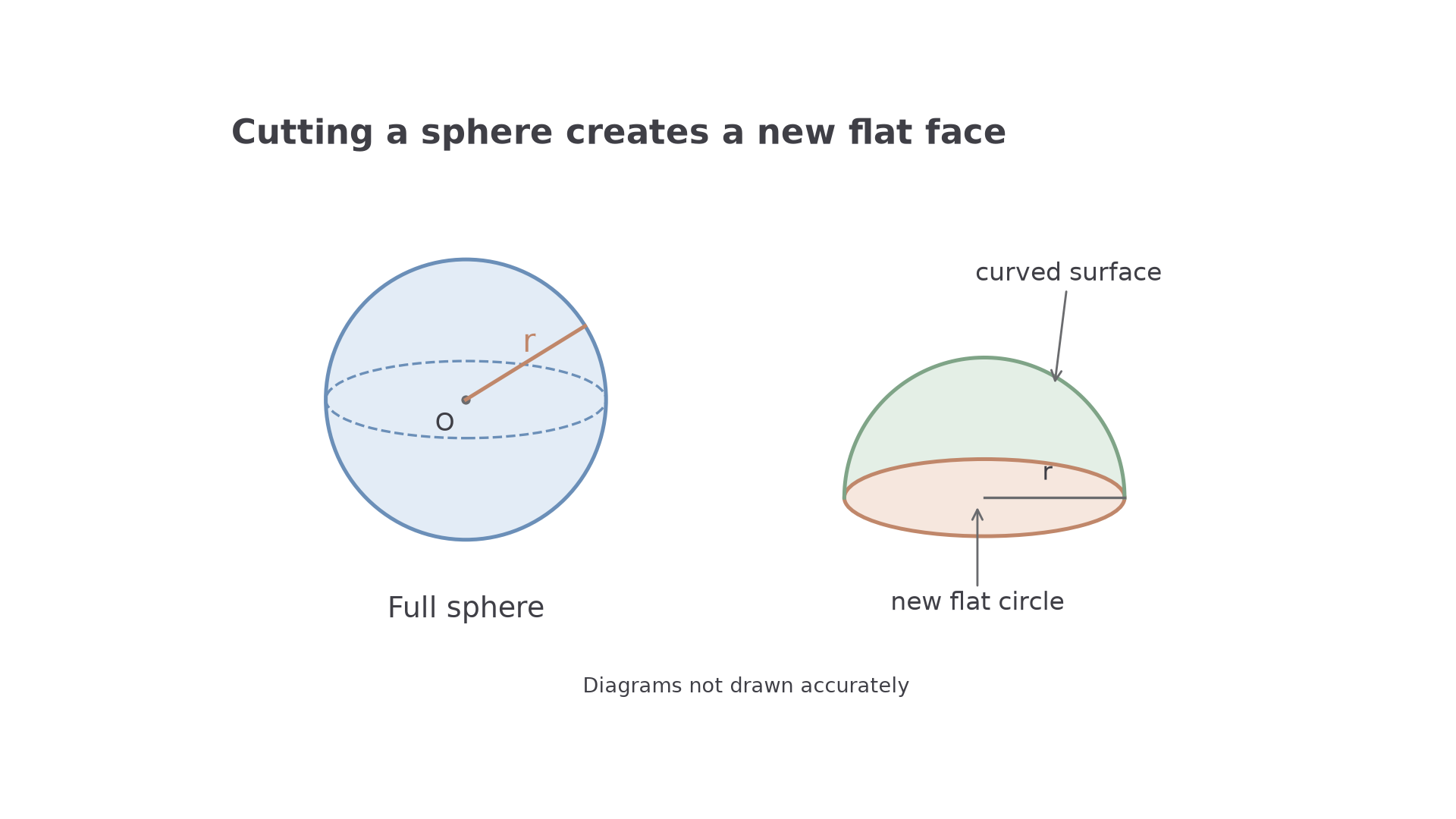
A useful surprise follows: a closed hemisphere has three quarters of the full sphere's surface area, not one half. The new circle makes the difference.
Sphere surface area and volume
For a sphere of radius ,
These are not printed on the formulae sheet.
Given in the question.
For a hemisphere, halve the sphere volume. Halve the curved surface area too, then add if the flat face is exposed. Thus a closed hemisphere has total area . This last result is not supplied separately: derive it by counting the surfaces.
Worked example 1: a sphere with a given radius
Question. Non-calculator. A sphere has radius . Work out its volume and surface area in terms of . Use and .
Plan. Substitute the radius into each supplied formula, keeping the units distinct.
Why this step? Volume contains three length factors, while surface area contains two. Swapping and changes both the value and the kind of measure.
Answer. Volume ; surface area .
Check. A sphere of radius fits inside a cube of side . Its volume is about , less than the cube's .
Worked example 2 changes the solid to a closed hemisphere. The diameter is given, so find the radius before using either formula.
Worked example 2: the new face on a hemisphere
Question. Non-calculator. A solid hemisphere has diameter . Work out its volume and total surface area in terms of . For a sphere, and .
Plan. Halve the diameter, halve the sphere results, then add the circular face to the area.
Why this step? Cutting removes half the volume but creates an extra surface. Halving the full sphere's area misses the flat face.
Answer. Volume ; total surface area .
Check. The full sphere area is . Our is three quarters of it: half curved surface plus one quarter for the circle.
The word “total” tells you to count every outside surface, including flat ones.
Watch out
Wrong: “A hemisphere has total surface area .” That counts only the curved part. A closed solid hemisphere also has its circular face, giving . An open hemispherical shell may need only the curved area; read the description.
Try a new radius, and keep the area and volume units separate.
Pyramids and their triangular faces
A pyramid has a polygon base and triangular faces meeting at an apex. Its volume uses the height measured perpendicular to the base, while the area of each triangular face uses the height within that face.
Place your finger on the base and move straight up to the apex: that is the perpendicular height. Move up the middle of a sloping triangular face instead: that is a different length, the face's slant height.
[DIAGRAM: asset_name: A pyramid has two different heights; asset_slug: aqa8300_g16_pyramid_heights; caption: The vertical height is used for volume and the triangular face height is used for surface area; description: Left a right square-based pyramid with base edge 6 cm, perpendicular central height 4 cm and face slant height 5 cm. Right a net shows a square of side 6 cm and four triangular faces, each with perpendicular face height 5 cm. The central height is sage and the face height is blue. Diagrams not drawn accurately.]
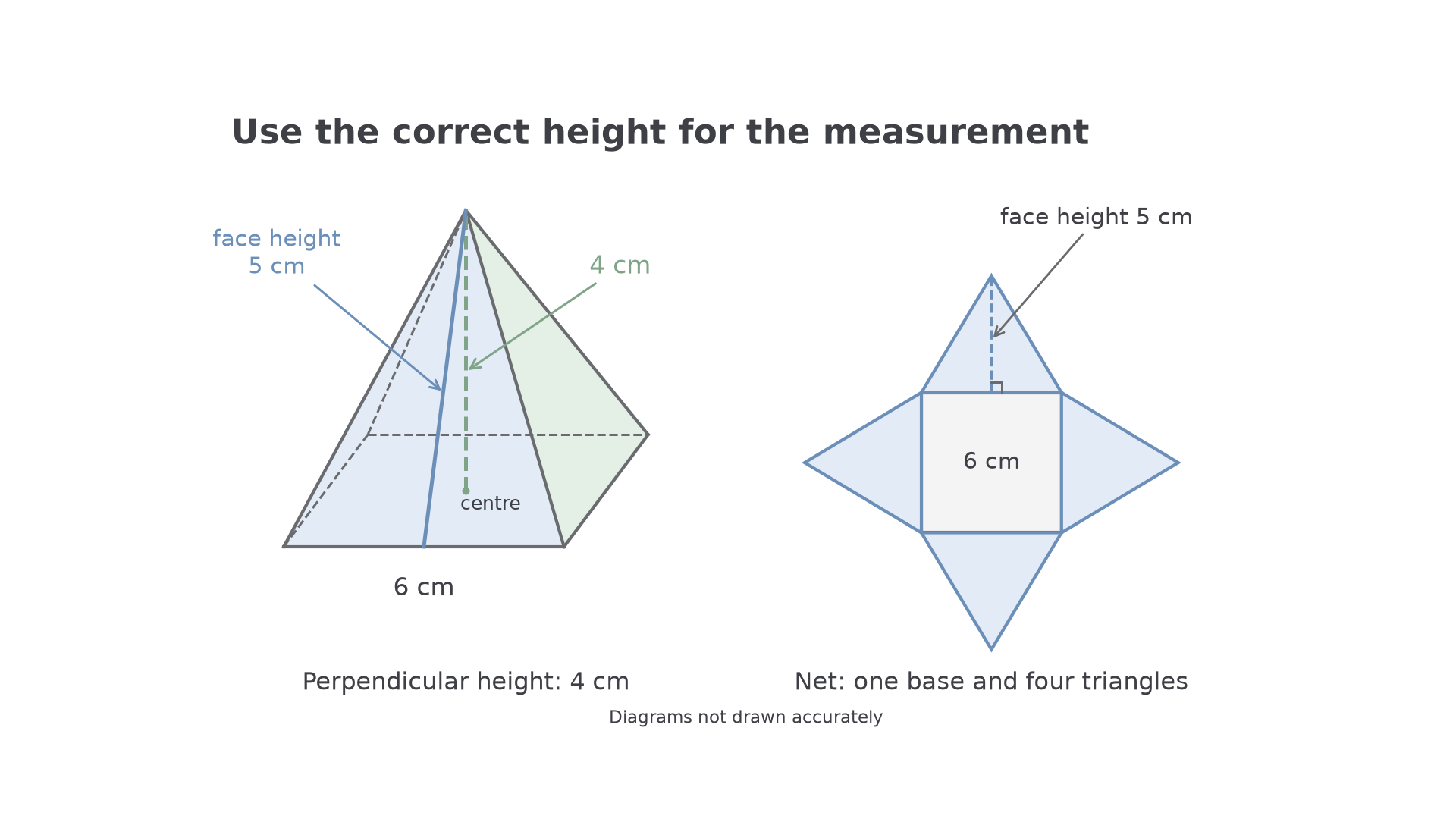
A pyramid tapers as you move away from its base. Its volume is one third of the prism with the same base area and perpendicular height.
Volume of a pyramid
For a pyramid with base area and perpendicular height ,
Not on the formulae sheet: learn it.
There is no single surface-area shortcut to memorise for all pyramids. Add the base area and the areas of the triangular faces, using . The triangle area rule is not on the formulae sheet: learn it.
Worked example 3: a square-based pyramid
Question. Non-calculator. A right square-based pyramid has base side , perpendicular height and face slant height . Work out its volume and total surface area.
Plan. Use the perpendicular height for volume and the slant height for each triangular face.
Why this step? The height does not lie in a triangular face. It cannot be used as that face's area height.
Answer. Volume ; total surface area .
Check. A prism with the same base and height has volume , three times the pyramid's volume.
Worked example 4 changes the square base to a rectangle. The four triangular faces now come in two different matching pairs.
Worked example 4: a rectangular-based pyramid
Question. Non-calculator. A right pyramid has rectangular base by and perpendicular height . The triangular faces with base have face height . Those with base have face height . Work out its volume and total surface area.
Plan. Use one base area for volume, but count the two pairs of faces separately for surface area.
Why this step? Multiplying one triangle area by four would pretend all four faces were identical. The rectangular base gives different face widths and heights.
Answer. Volume ; total surface area .
Check. The four faces contribute , so the total exceeds the base area. The volume is one third of .
A net is often the quickest way to see which face heights go with which base edges.
Watch out
Wrong: “Every pyramid has four equal triangular faces.” A square-based right pyramid does; a rectangular-based pyramid usually has two different pairs. A triangular-based pyramid has only three side faces. Count and calculate the actual faces.
Apply the two-pair method to another rectangular base.
Cones and slant height
A cone has a circular base and a curved surface meeting at an apex. The curved surface uses the slant height, while the volume uses the perpendicular height.
Cut a right cone vertically through its apex and the centre of its base. Half of the resulting isosceles triangle is right-angled: its sides are the radius , perpendicular height and slant height . Pythagoras gives . This is a two-dimensional right-triangle calculation.
[DIAGRAM: asset_name: Radius perpendicular height and slant height of a cone; asset_slug: aqa8300_g16_cone_section; caption: In the centre cross-section the radius and vertical height are perpendicular and the slant height is the hypotenuse; description: Left a right cone with base radius r, central perpendicular height h and slant height l marked in different colours. Right an isolated right triangle from half the central cross-section has horizontal leg r equals 5 cm, vertical leg h equals 12 cm and hypotenuse l equals 13 cm. A right-angle square marks the base centre. Diagrams not drawn accurately.]
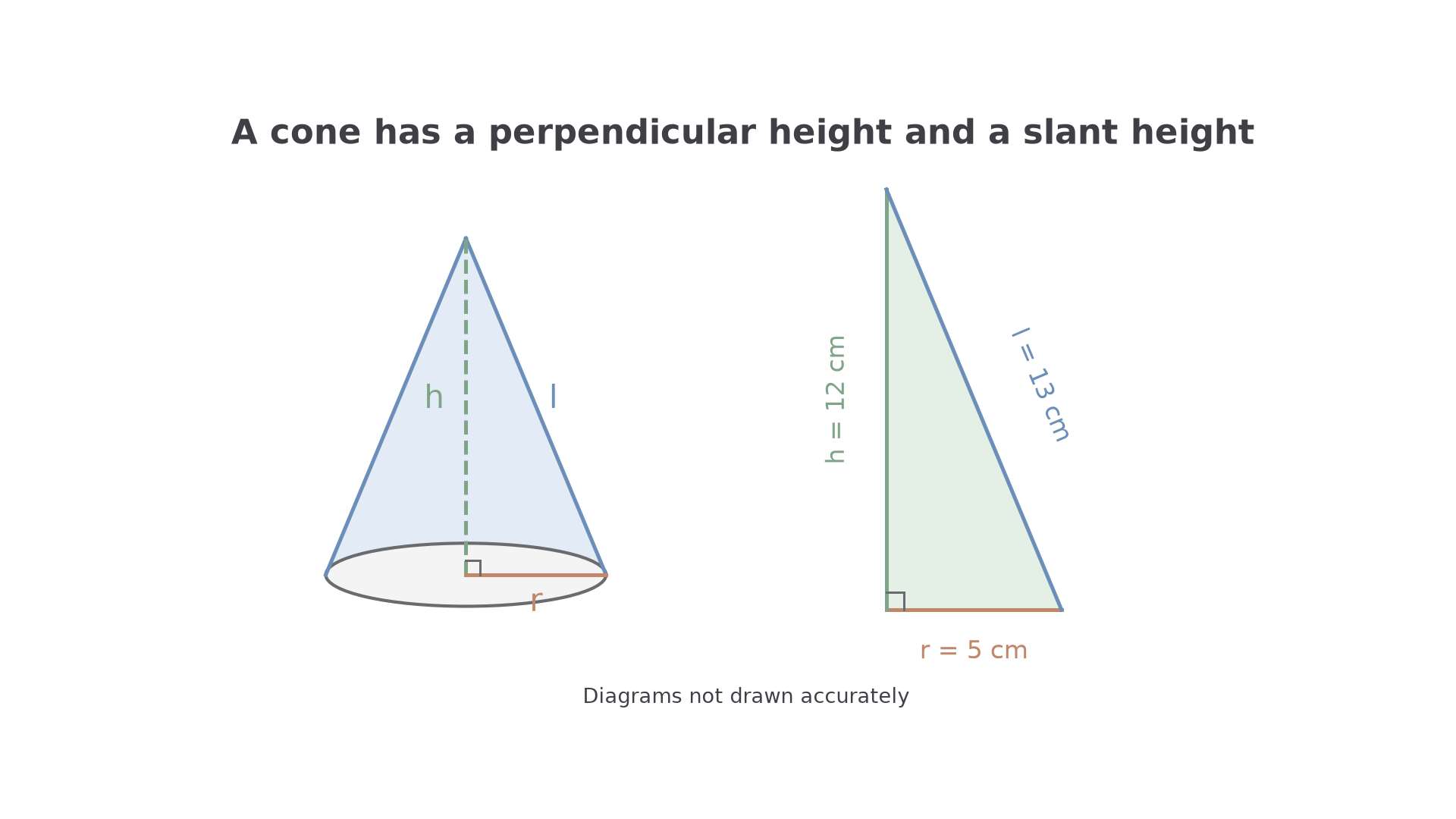
Do not use the whole base diameter in that half-triangle. The horizontal distance from the centre to the rim is one radius.
Cone volume and curved surface area
For a right circular cone of base radius , perpendicular height and slant height ,
These are not printed on the formulae sheet.
Given in the question.
For a closed cone, add the base circle: total surface area is . Derive that sum by counting its surfaces; it is not supplied as a separate formula. The radius and perpendicular height also show why the opening cone has one third of the cylinder's volume.
Worked example 5: two different heights
Question. Non-calculator. A cone has radius , perpendicular height and slant height . Work out its volume and total surface area in terms of . Use and .
Plan. Use in the volume formula and in the curved-area formula, then add the base.
Why this step? The two heights describe different routes from base to apex. Each formula needs its own measurement.
Answer. Volume ; total surface area .
Check. , so the three stated lengths fit the cone's half cross-section.
Worked example 6 changes one thing: the slant height is not supplied. Find it from the centre cross-section before using the area formula.
Continue this lesson.
You’re previewing NovaLearn without an account. Create a free account to read the rest.
Create free account