G17 - Circumference and area of circles
A circle needs only one length to fix its size. In G17 you will use radius and diameter to work out circumference and area, keep exact answers in terms of , and combine circles with straight edges in perimeter and area problems.
Circumference from radius or diameter
A running track has two straight sections, each long, joined by two semicircular ends of diameter . Is one lap metres or metres? We need to count how much of a circle the ends actually make.
You already know
A radius joins the centre to the circle; a diameter crosses the circle through its centre. The diameter is twice the radius. An answer in terms of keeps rather than replacing it with a decimal.
The circumference is the distance all the way around a circle. If you divide any circle's circumference by its diameter, you get the same number, . A small coin and a large circular pond have the same ratio. That is why one formula works at every size.
[DIAGRAM: asset_name: Radius diameter circumference and area; asset_slug: aqa8300_gd_circle_measures; caption: Circumference measures the curved boundary and area measures the surface inside; description: A pale blue circle has centre O, a clay diameter d across it and a sage radius r from its centre to its circumference. Text gives C equals pi d equals 2 pi r, and A equals pi r squared. Not drawn accurately.]
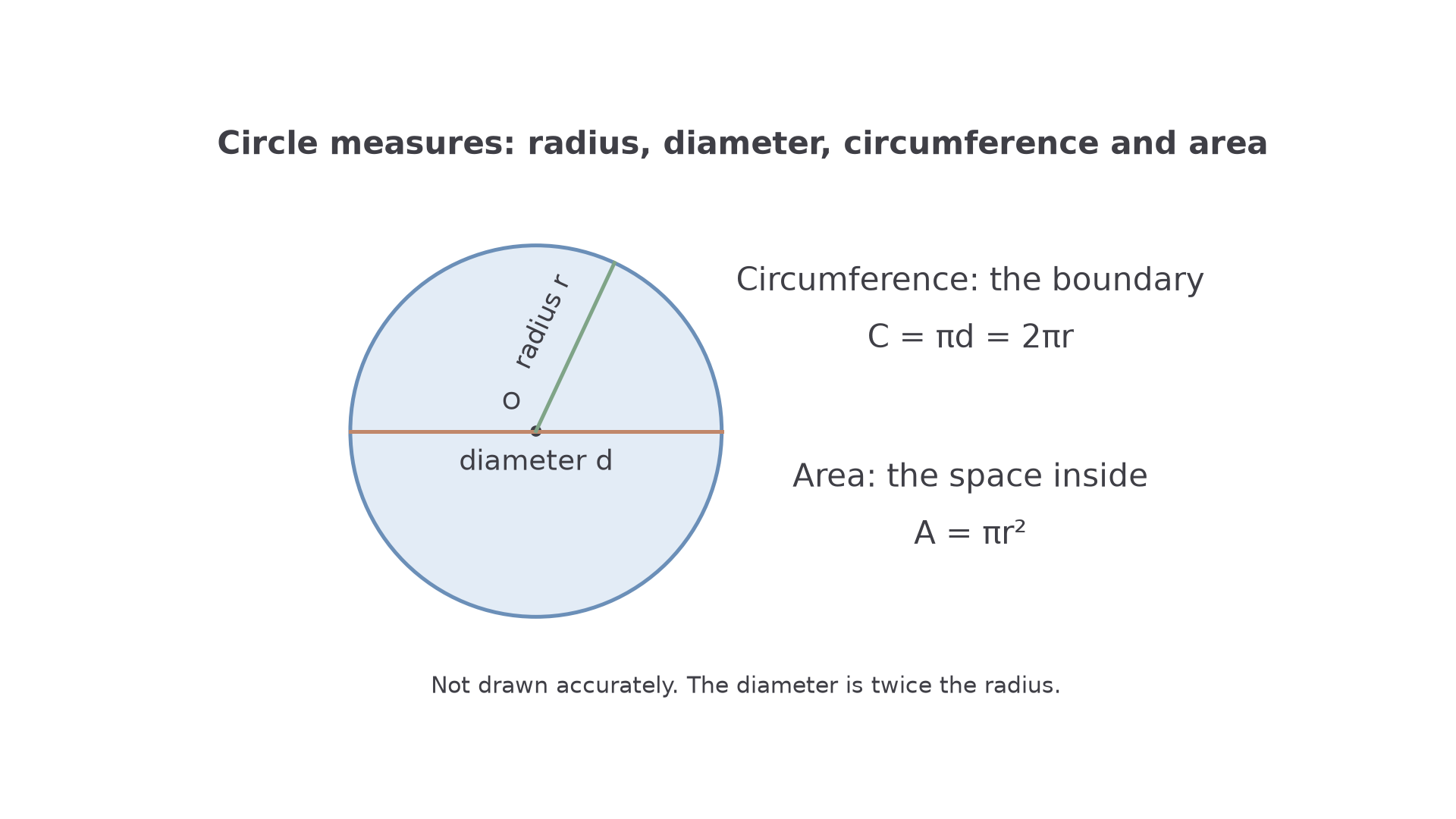
Circle circumference
For radius and diameter ,
Use the same length unit for , and .
On the 2027 formulae sheet.
Decide whether the supplied length crosses the whole circle or only reaches its centre before choosing a substitution.
Worked example 1: a radius is supplied
Question. A circle has radius . Work out its circumference. Give your answer to significant figures. Calculator allowed.
Plan. Use , keeping in the calculator until the final rounding.
Why use the factor ? The given length is a radius, half the diameter.
Answer. to significant figures.
Check. is a little more than , so the circumference should be a little more than .
Change only the way the same circle's size is given: supply its diameter instead. The circumference must stay unchanged.
Worked example 2: a diameter is supplied
Question. A circle has diameter . Work out its circumference. Give your answer in terms of . Non-calculator.
Plan. Multiply the diameter directly by .
Why not multiply by again? The full diameter has already been supplied.
Answer. .
Check. Half the diameter is , the radius in Worked example 1.
Both formulae give the same boundary length when their inputs describe the same circle.
Watch out
Wrong: a diameter of gives . That treats the diameter as a radius and doubles the answer. Right: .
Read the next supplied length carefully before substituting.
Circle areas and unknown radius
A circle's area depends on the square of its radius, so finding area needs a different calculation from finding circumference.
Imagine cutting a circle into many thin sectors and alternating them into a long strip. As the pieces get thinner, the strip approaches a rectangle with height and length half the circumference, . Multiplying these gives .
Circle area
For radius ,
The area uses square units. If a diameter is given, halve it before squaring.
On the 2027 formulae sheet.
The order matters: square the radius, then multiply by . Squaring the whole product would square too.
Worked example 3: area from radius
Question. A circle has radius . Work out its area. Give your answer to significant figures. Calculator allowed.
Plan. Square , multiply by , then round once.
Why use ? Area measures two dimensions, so the radius contributes twice as a factor.
Answer. to significant figures.
Check. The circle fits inside a square of side , whose area is . The circle's area is smaller.
Change the given measurement from radius to circumference. Recover the radius before calculating area.
Worked example 4: area from circumference
Question. A circle has circumference . Work out its area. Give your answer in terms of . Non-calculator.
Plan. Solve the circumference formula for , then use the area formula.
Why not put into the area formula? It is a circumference, not a radius.
Answer. .
Check. The radius is the same as in Worked example 3, so both areas agree.
If area is supplied instead, reverse the squaring with a square root. The radius is positive because it represents a length.
Continue this lesson.
You’re previewing NovaLearn without an account. Create a free account to read the rest.
Create free account