G2 - Loci and shortest distances
Find every possible position that fits a distance rule. Use circles, perpendicular bisectors and angle bisectors to construct loci, then combine conditions to locate a point or shade a region.
A fixed distance from a point
A garden light must be exactly from a tree. Is there just one place it can go? Imagine walking around the tree while keeping a rope stretched tight. Your possible positions form a complete circle.
You already know
A compass draws points at one fixed distance from its centre. A perpendicular bisector passes halfway between two points, and an angle bisector splits an angle equally.
The construction is a way of finding all the answers at once. “Every possible position” is the crucial idea: one correctly placed dot is not the complete answer.
Locus
The set of all points which satisfy a stated condition. The plural is loci. For example, the locus of points exactly from is the circumference of a circle with centre and radius . The interior is not part of that locus.
Changing “exactly” to “at most” includes points nearer the centre as well. Read that word before choosing a line or a region.
[DIAGRAM: asset_name: Circle and circular region; asset_slug: aqa8300_g04_circle; caption: Exactly 3 cm gives a circumference; at most 3 cm gives the closed disc; description: Two circles have centre A and radius 3 cm. The first shows only the circumference. The second has its entire interior shaded with its boundary included.]
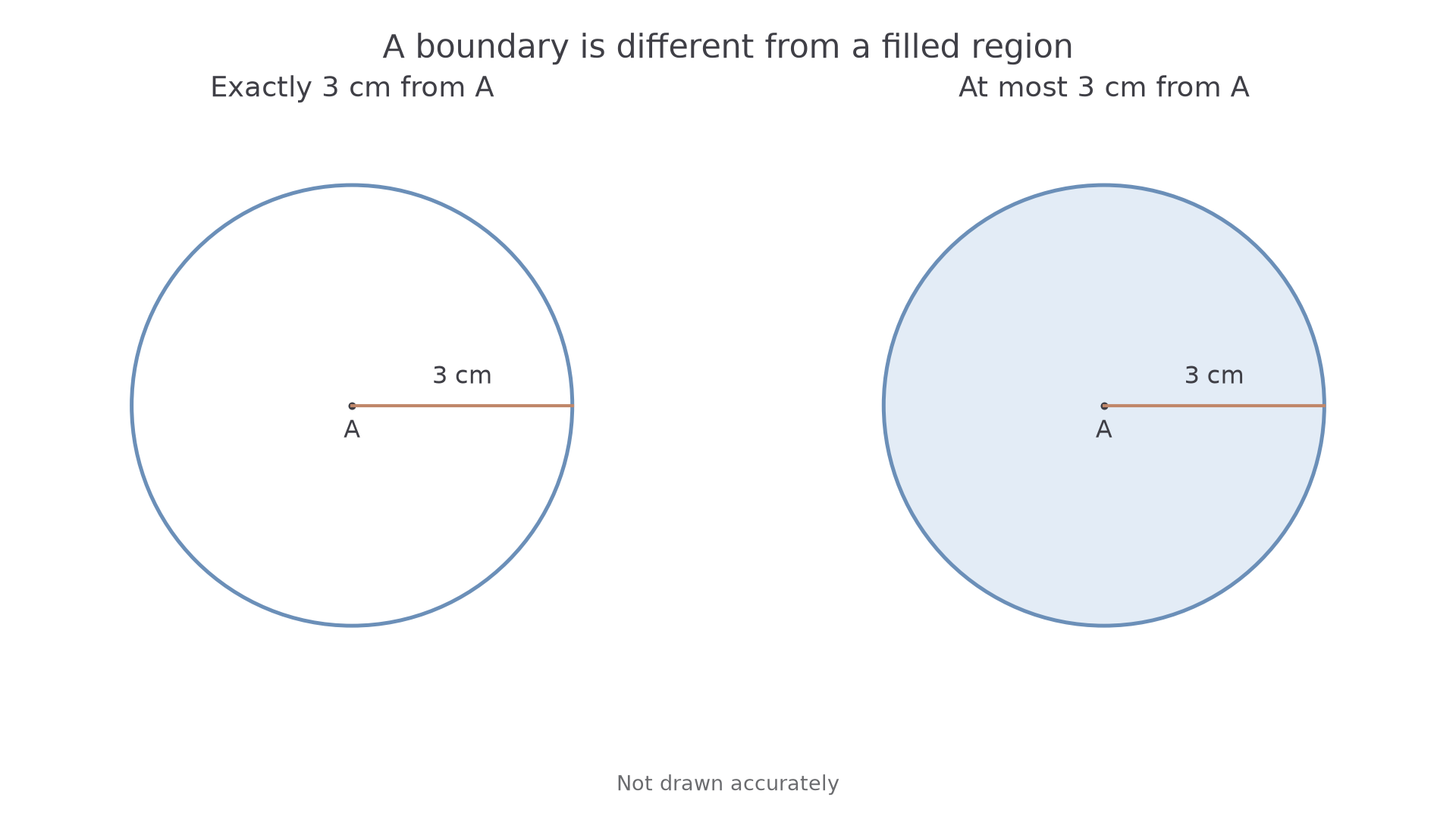
Worked example 1: one fixed distance
Question. Describe and construct the locus of points exactly from point .
Plan. Use as the centre and the stated distance as the radius.
- Set the compasses to : this fixes the distance.
- Place the point at and draw the complete circle: every direction must be included.
- Leave the inside unshaded: its points are less than from .
Why this step? A complete circle includes every possible direction from , not just positions left and right of it.
Answer. The circumference of a circle with centre and radius .
Check. Every boundary point is from ; the centre itself is not.
The next example changes “exactly” to “at most”, so the required answer becomes a filled region.
Worked example 2: include the interior
Question. A point must be at most from . Describe the required region.
Plan. Construct the limiting circle, then include the positions nearer .
- Draw the circle with centre and radius : its circumference is the boundary.
- Shade its interior and include the circumference: both shorter distances and exactly work.
Why this step? “At most” means “less than or equal to”, so the boundary belongs to the answer.
Answer. The closed circular region of radius centred at .
Check. Distances , and work; does not.
For “less than”, the boundary is excluded; a dashed boundary makes that clear. For “more than”, use the outside. These locus rules are not on the formulae sheet: learn them.
Watch out
Wrong: shade a circle's interior when the question says “exactly”. Right: exactly one distance means its circumference alone.
Return to the garden light: the tree is one centre, but there are infinitely many positions around its circle. A further condition can reduce that choice.
Equally far from two points
Two houses share a path. Every point on the path must be equally far from both front doors. The midpoint between the doors works, but so do points beyond it on the perpendicular bisector.
A compass construction explains why. Equal arcs from the two doors intersect at positions which have the same distance from each. Their line is the perpendicular bisector, and every point on that line has the required equality.
[DIAGRAM: asset_name: Equidistant loci; asset_slug: aqa8300_g04_equidistant; caption: Equal distances from two points give their perpendicular bisector; equal distances from two intersecting lines give angle bisectors; description: The first panel shows P on the perpendicular bisector of AB, with PA and PB equal. The second shows P on the internal bisector of a right angle, with equal perpendicular distances to its two arms.]
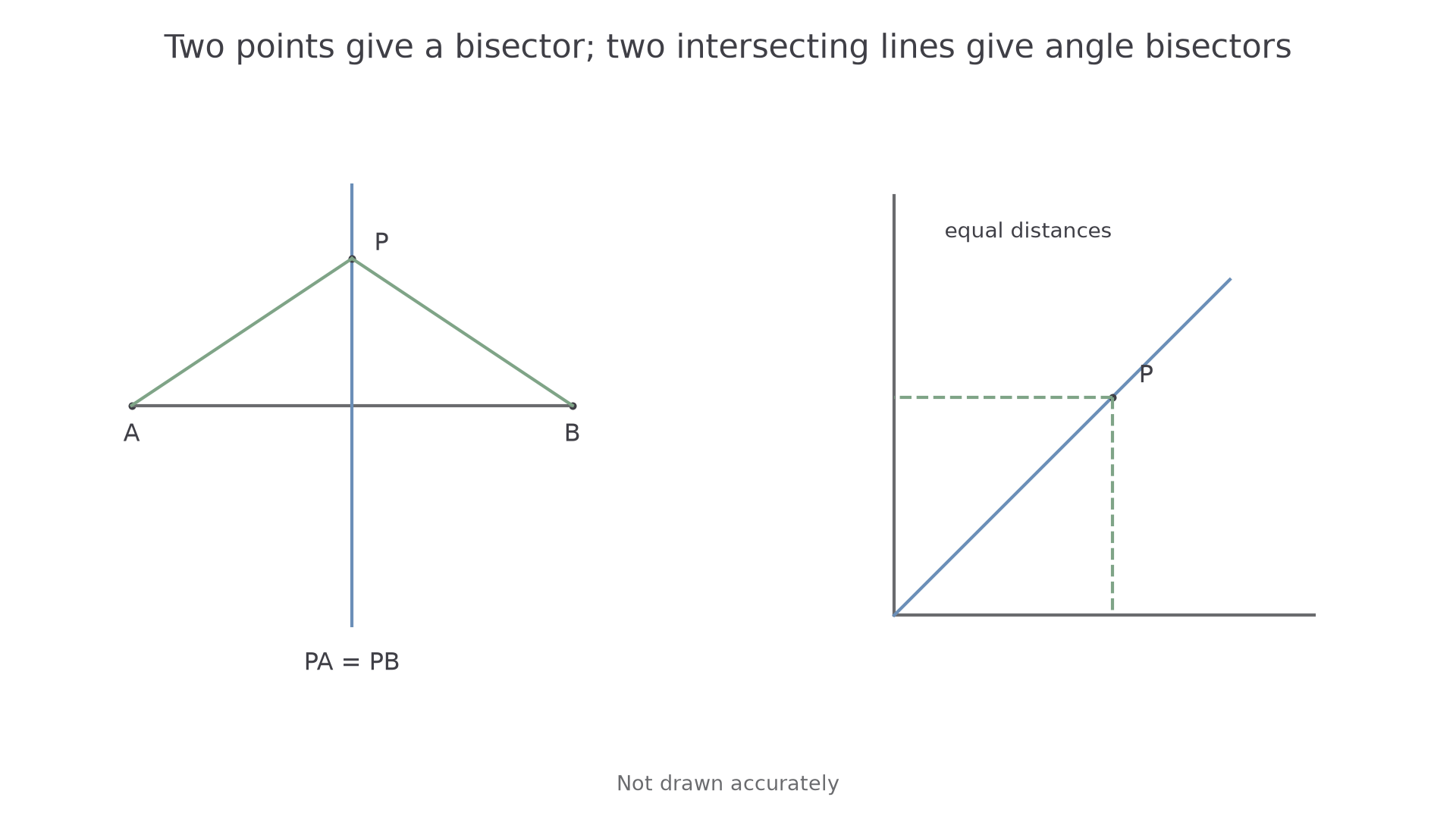
Equidistant from two points
For distinct points and ,
exactly when lies on the perpendicular bisector of .
Not on the formulae sheet: learn it.
The whole line is the locus, including the part outside any particular pair of compass arcs. A question may restrict you to the inside of a field or rectangle.
Worked example 3: construct a shared boundary
Question. Points and are apart. Construct the locus of points equally far from them.
Plan. Construct the perpendicular bisector of .
- Use a compass opening greater than : the equal arcs must cross.
- From and , draw equal arcs above and below : label their crossings.
- Join the crossings and extend the line: this is the complete locus.
Why this step? Equal distances do not mean a fixed distance. Points further along the bisector are further from both endpoints, but the two distances stay equal.
Answer. The perpendicular bisector of , crossing it from each end.
Check. The midpoint is on the locus. Neither nor is, because their distances to themselves are zero.
The second example replaces equality by a choice of which point is closer.
Worked example 4: choose one side
Question. A location must be closer to than to . Describe the region when .
Plan. Draw the equal-distance boundary, then choose the side containing .
- Construct the perpendicular bisector of : it crosses at .
- Shade the half-plane containing : moving to that side makes nearer.
- Exclude the bisector: points on it are equally far away, rather than closer to .
Why this step? Testing itself settles which side to choose: its distance from is zero.
Answer. The side of the perpendicular bisector containing , with the boundary excluded.
Check. is included; and the midpoint are excluded.
Closer-to regions are separated by a straight boundary even though distance itself is measured in every direction.
Watch out
Wrong: draw a circle with centre the midpoint for equal distances from two points. Right: use the perpendicular bisector. A circle would unnecessarily fix the distance from its centre.
A boundary point is a useful test whenever “closer” or “equally far” appears.
Distances from straight lines
Distance to a line means perpendicular distance. Walk from a point towards a straight fence: a sloping route reaches the fence, but the route at a right angle is shortest.
The sloping route is the longest side of a right-angled triangle made with the perpendicular route. It is longer than that perpendicular side. You do not need to calculate its length to compare them.
Continue this lesson.
You’re previewing NovaLearn without an account. Create a free account to read the rest.
Create free account