G20, G21 - Right-angled trigonometry and exact values
An angle can tell you a length, even when you cannot reach it with a tape measure. G20 gives you sine, cosine and tangent for right-angled triangles; G21 gives exact values for special angles. You will choose a ratio, find missing lengths and angles, and solve two-dimensional problems with a calculator or exact values.
Choosing a trigonometric ratio
You stand from a vertical wall. From an instrument above the ground, the angle up to the top is . Can you work out the wall's height without climbing it? Keep that triangle in mind.
You already know
Similar triangles have equal corresponding angles and equal ratios of corresponding sides. In a right-angled triangle, the hypotenuse is opposite the right angle. Pythagoras connects three sides; it does not use an acute angle.
Take a right triangle with sides , and enlarge it to sides . Choose the acute angle opposite the side of length in the first triangle. Its opposite-to-hypotenuse ratio is . The matching angle in the enlarged triangle has ratio , the same number. Every right triangle with this acute angle is similar, so its side ratios stay fixed. This is why an angle can determine a ratio.
[DIAGRAM: asset_name: The same angle gives the same side ratios; asset_slug: aqa8300_g18_ratios; caption: Enlarging the triangle changes the side lengths but keeps all three ratios; description: Two similar right triangles with perpendicular sides 3 and 4, then 6 and 8, and hypotenuses 5 and 10. Matching lower-left acute angles are marked theta. Opposite sides are clay, adjacent sides sage, and hypotenuses blue. A separate small rotated triangle shows theta at its other acute vertex, so the opposite and adjacent labels swap.]
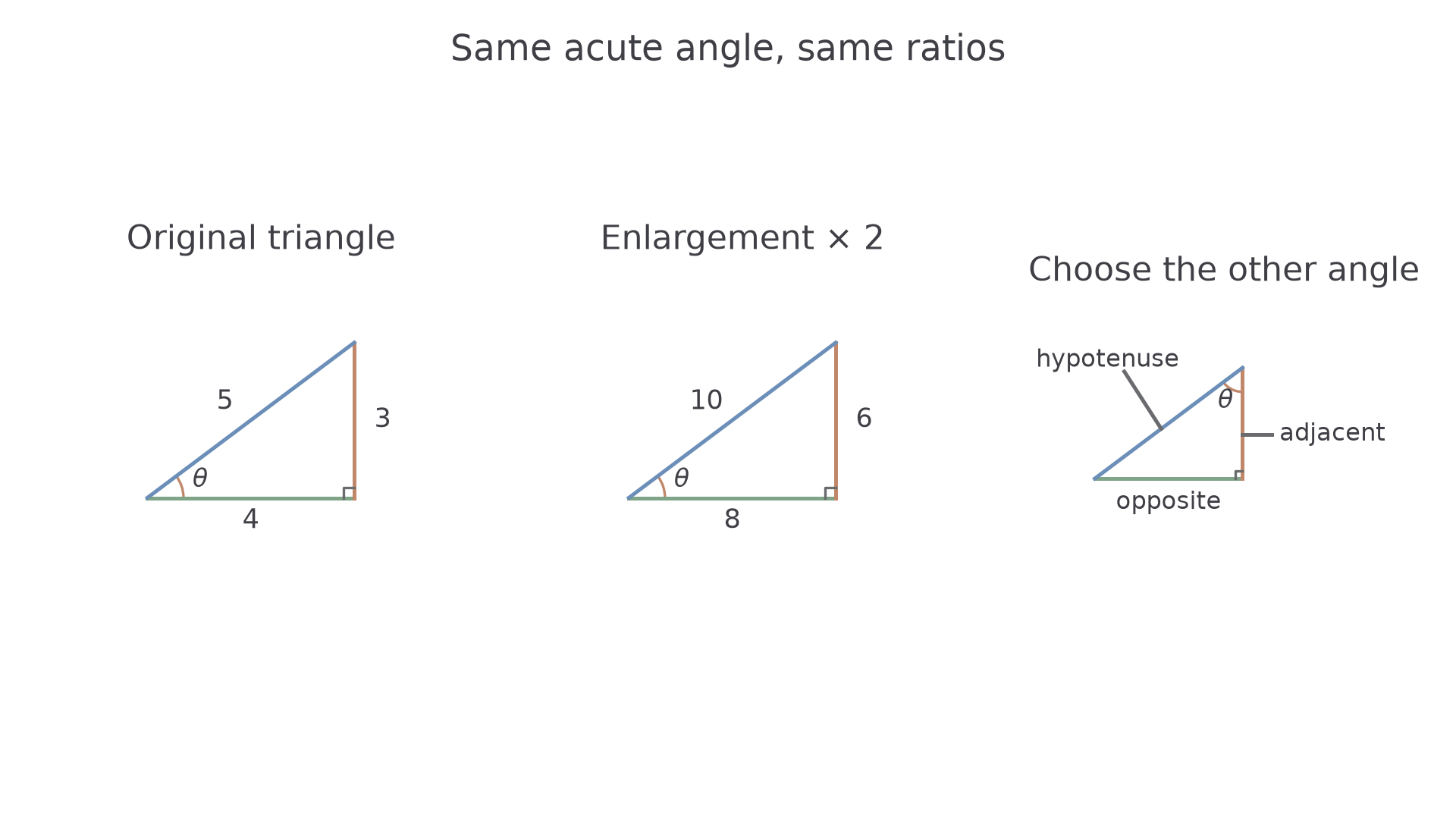
The names depend on the angle you choose. Point at that angle before labelling the sides.
Opposite, adjacent and hypotenuse
Relative to a chosen acute angle , the opposite side does not touch . The adjacent side touches and is not the hypotenuse. The hypotenuse is opposite the right angle and is always the longest side. Changing the chosen acute angle swaps opposite and adjacent; it never changes the hypotenuse.
The three names give three ratios. Sine and cosine compare a shorter side with the hypotenuse. Tangent compares the two shorter sides.
Right-angled trigonometry
For an acute angle in a right-angled triangle,
The mnemonic SOHCAHTOA puts the letters in that order. These side-ratio definitions apply to right-angled triangles.
On the 2027 formulae sheet.
To choose, label the sides and circle the two involved in the question: the known side and the wanted side. Opposite and hypotenuse choose sine; adjacent and hypotenuse choose cosine; opposite and adjacent choose tangent. The unused side can stay unknown.
Watch out
Wrong: “The sloping side is the hypotenuse.” A triangle can be turned. Right: find the right angle, then take the side opposite it. For example, a vertical side can be the hypotenuse in a rotated diagram.
Test the side names before reaching for a calculator.
Finding a missing length
Write an equation before pressing any buttons. Your calculator evaluates a ratio; the equation tells you whether to multiply or divide. Use degree mode, usually labelled DEG, because the angles here are in degrees.
For example, in degree mode. That is a quick mode check. A different result means the calculator is using another angle unit.
Worked example 1: the unknown is on top
Question. Calculator allowed. A right-angled triangle has hypotenuse . The side is opposite . Work out to significant figures.
Plan. Use sine because opposite and hypotenuse are involved, then multiply by .
Why this step? is the numerator, so multiplication removes the denominator.
Answer. .
Check. , as a shorter side must be shorter than the hypotenuse; .
Now change the unknown's position: the hypotenuse is missing. The ratio contains the unknown in the denominator, so the rearrangement changes.
Worked example 2: the unknown is underneath
Question. Calculator allowed. A right-angled triangle has side adjacent to , and hypotenuse . Work out to significant figures.
Plan. Write the cosine equation, multiply by , then divide by .
Why this step? Multiplying by cosine would make the hypotenuse smaller than , which is impossible.
Answer. .
Check. , and .
The same rearrangement works with tangent when the adjacent side is missing. For , multiply by and then divide by to get . This is a rearrangement of the ratio on the formulae sheet.
Watch out
Wrong: from , write . Right: . Write the intervening line if the denominator makes you hesitate.
Keep the full calculator value until the final rounding step.
Finding a missing angle
Two known sides give a ratio. To turn the ratio back into an angle, use an inverse trigonometric function. On many calculators this uses SHIFT or second-function with the sine, cosine or tangent key.
Inverse trigonometric functions
For an acute angle in a right-angled triangle,
Here are opposite, adjacent and hypotenuse. The superscript means “undo the function”, not “take the reciprocal”. Use degree mode.
These inverse instructions are not on the formulae sheet: learn how to use them.
The key choice is still the same: identify the two sides before choosing a function.
Worked example 3: two shorter sides
Question. Calculator allowed. Relative to angle , a right triangle has opposite side and adjacent side . Work out to decimal place.
Plan. Use tangent, then inverse tangent to undo it.
Why this step? is a ratio, not an angle. Inverse tangent finds the acute angle with that ratio.
Answer. .
Check. . Opposite is shorter than adjacent, so the angle is below .
Change which two sides are known: one is now the hypotenuse, so tangent no longer matches.
Worked example 4: opposite and hypotenuse
Question. Calculator allowed. A right triangle has hypotenuse and side opposite . Work out to decimal place.
Plan. Use sine and then inverse sine.
Why this step? Inverse cosine would find the other acute angle because it would treat as adjacent.
Answer. .
Check. . The other acute angle is , and together they make .
For a genuine acute angle, sine and cosine lie strictly between and . If you obtain , the sides have been reversed: no angle has sine greater than .
Watch out
Wrong: . That takes the cosine of a small angle. Right: from , use . Check the inverse symbol on the calculator screen.
Continue this lesson.
You’re previewing NovaLearn without an account. Create a free account to read the rest.
Create free account