G20 - Pythagoras and trigonometry in 3D (Higher)
A line through a solid can belong to a right triangle that is not on any outside face. You will find that triangle, use Pythagoras in stages, and work out lengths and angles in cuboids and pyramids. The arithmetic is familiar; choosing the correct cross-section is the new skill.
Space diagonals and missing edges
A cuboid measures by by . Is its longest corner-to-corner diagonal , the sum of the edges, or something else? A straight line through the inside should be shorter than a route along three edges.
You already know
Pythagoras applies to a right-angled triangle, with the hypotenuse opposite the right angle. A cuboid has rectangular faces. You can redraw a triangle separately so perspective does not disguise its right angle.
A face diagonal crosses one rectangular face. A space diagonal joins opposite vertices through the inside of the cuboid. First find a diagonal across the base; then combine it with the vertical height. The height is perpendicular to the whole base, so it is perpendicular to that base diagonal.
[DIAGRAM: asset_name: Two right triangles inside a cuboid; asset_slug: aqa8300_g20_diagonal; caption: The base diagonal becomes a shorter side in the second right triangle; description: A cuboid ABCDEFGH with rectangular base ABCD and E,F,G,H directly above A,B,C,D. Edges AB 3 cm, BC 4 cm and CG 12 cm are labelled. Base diagonal AC is sage, space diagonal AG blue, and vertical CG clay. A separate true-shape triangle ACG shows AC 5, CG 12 and AG 13 with a right-angle mark at C.]
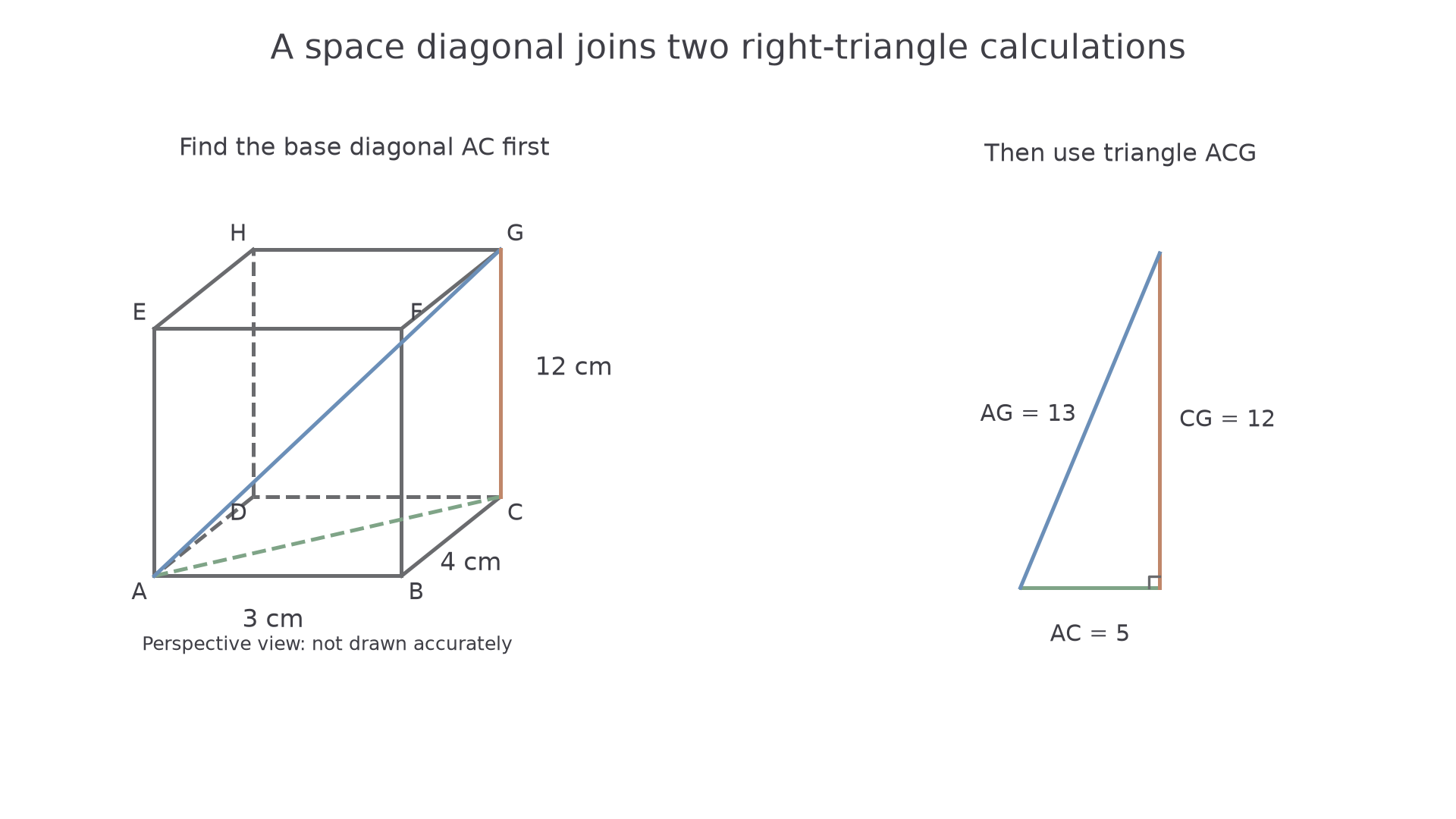
The two applications of Pythagoras can be combined, but the diagram explains why addition is valid.
Cuboid space diagonal
For a cuboid with perpendicular edge lengths and space diagonal ,
This follows from two right triangles: , then .
This combined form is not on the formulae sheet: derive it from Pythagoras, which is on the 2027 formulae sheet.
Keep intermediate squared lengths or exact roots. Rounding the first diagonal can change the final answer.
Worked example 1: the opening cuboid
Question. Non-calculator. A cuboid measures by by . Work out its space diagonal.
Plan. Find the base diagonal, then use it with the height.
Why this step? The second triangle has sides , not : the diagonal crosses the full base as well as the height.
Answer. .
Check. . It is longer than every edge but shorter than .
A pleasing surprise is hidden here: all three edges, the base diagonal and the space diagonal are whole numbers. A three-dimensional problem can contain two familiar right triangles, and .
Now change the unknown from the diagonal to one edge. The diagonal is still the longest side, so subtract the known squares.
Worked example 2: recovering a height
Question. Calculator allowed. A cuboid has base edges and , height , and space diagonal . Work out to significant figures.
Plan. Subtract the two base-edge squares from the space-diagonal square.
Why this step? The given is the hypotenuse of the interior right triangle. Adding its square would make the missing edge longer than the space diagonal.
Answer. .
Check. , and the height is less than .
A sketch can look convincing even when the wrong vertices have been joined. Name the endpoints of each diagonal.
Watch out
Wrong: . That is a route across the base and then vertically up. Right: for the straight space diagonal of a cuboid.
Use the reverse method once more.
Angles between a line and a plane
A line through a cuboid makes several different angles: one with the base plane, another with a base edge. They share a vertex but belong to different triangles.
Angle between a line and a plane
Project the line perpendicularly onto the plane. The angle between the line and the plane is the acute angle between the line and its projection. For a cuboid diagonal from a bottom vertex to the opposite top vertex, its projection onto the base is the base diagonal.
“Angle with the base” means the plane, unless the question names a particular edge. A perpendicular vertical drop fixes the projection.
[DIAGRAM: asset_name: A plane angle and an edge angle are different; asset_slug: aqa8300_g20_angles; caption: The base-plane angle uses the base diagonal; the edge angle uses the named edge; description: Two true-shape right-triangle panels for a cuboid with base AB 6, BC 8 and vertical height CG 5. Left panel shows triangle ACG with adjacent AC 10, opposite CG 5 and hypotenuse AG square root 125, and angle CAG at A. Right panel shows triangle ABG, with AB 6, BG square root 89 and AG square root 125, and angle BAG at A. The true-shape triangles have right-angle squares and distinct angle arcs.]
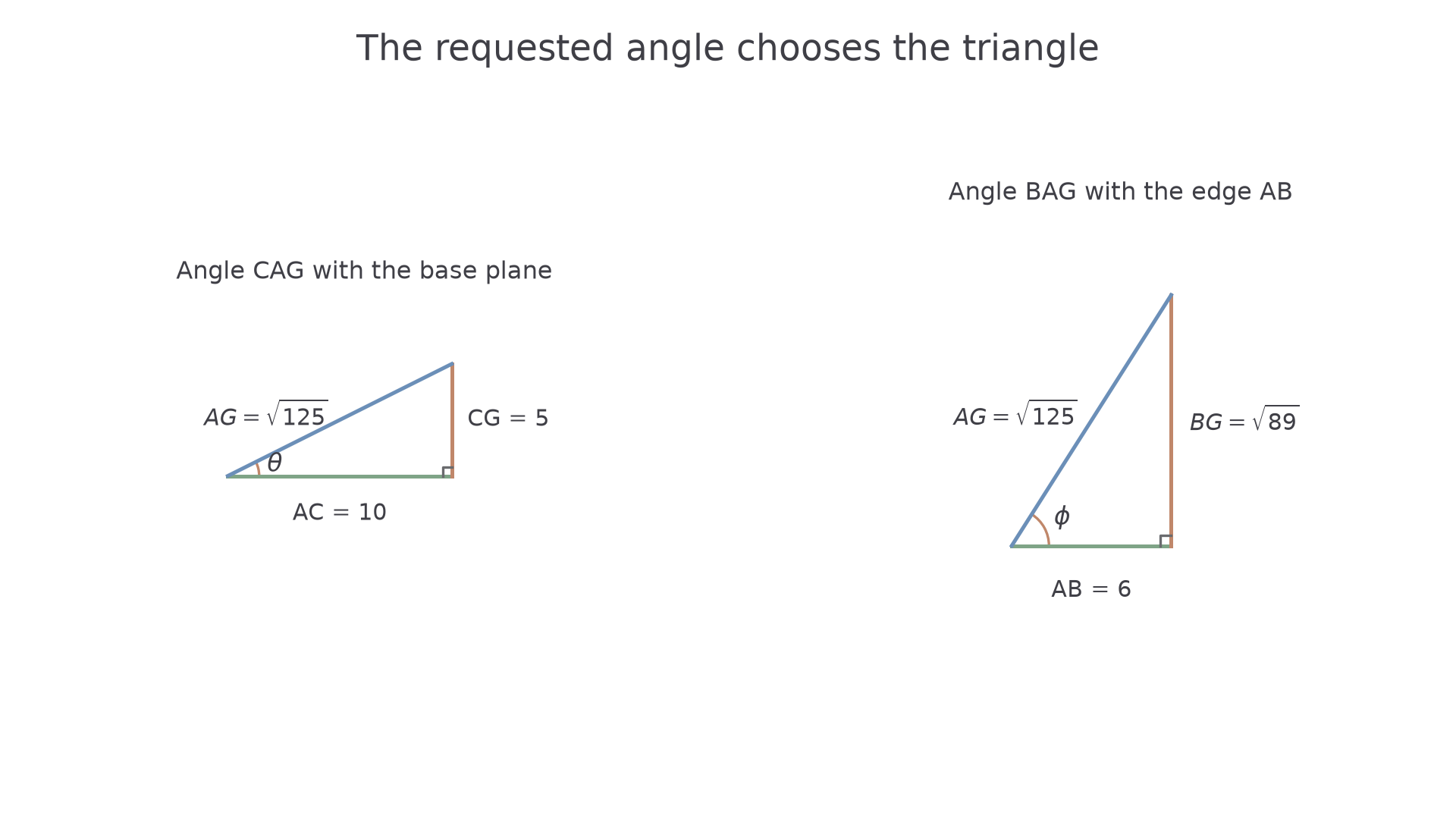
Both triangles use the same space diagonal. The adjacent side changes because the requested angle changes.
Worked example 3: angle with the base plane
Question. Calculator allowed. Cuboid has , and vertical , with above . Work out the angle between and the base , to decimal place.
Plan. Find projection , then use tangent in right triangle .
Why this step? The projection of on the base is , not edge . The angle is .
Answer. .
Check. The rise is half the horizontal distance , so the angle is below .
Continue this lesson.
You’re previewing NovaLearn without an account. Create a free account to read the rest.
Create free account