R3, R4 - Comparing quantities as fractions and ratios
A fraction and a ratio can compare the same quantities in different forms. R3 shows how to express one quantity as a fraction of another, including answers greater than one. R4 adds ratio notation, order and simplest form, so you can make fair comparisons even when the units or numbers look different.
One quantity as a fraction of another
One ribbon is long. Another is long. What fraction of the second ribbon's length is the first ribbon's length? And what is their length ratio? The units are hiding a simple comparison.
You already know
Equivalent fractions have the same value. Divide numerator and denominator by a common factor to simplify, and make units agree before comparing measurements.
“Express as a fraction of ” means . The quantity you are describing goes on top. The quantity you are comparing it with goes underneath. The second quantity is your reference amount; it need not be a total.
One quantity as a fraction of another
For quantities in the same units, with the reference quantity non-zero,
The fraction is less than if the first quantity is smaller, equal to if they match, and greater than if the first is larger.
Not on the formulae sheet: learn it.
The wording decides the order. First compare a smaller amount with a larger one.
Worked example 1: a fraction less than one
Question. Express as a fraction of . Give your answer in its simplest form. Non-calculator.
Plan. Put over , then divide both by their highest common factor.
Why is underneath? The question asks what fraction of the represents.
Answer. .
Check. , and a smaller mass should give a fraction below .
Reverse only the order of the quantities. The new answer must exceed .
Worked example 2: a fraction greater than one
Question. Express as a fraction of . Give your answer in its simplest form. Non-calculator.
Plan. Put the quantity now being described on top, then simplify.
Why keep this improper fraction? “A fraction of” does not mean the answer must be less than a whole.
Answer. , or .
Check. . The answer is greater than , as expected.
There is no need to turn a fraction into a rounded decimal.
Watch out
Wrong: put the smaller number on top every time. This would give for both questions. Right: follow the wording; reversing the comparison changes to .
Read “of” carefully in this new comparison.
Ratio order and simplest form
A ratio keeps the compared quantities in a stated order.
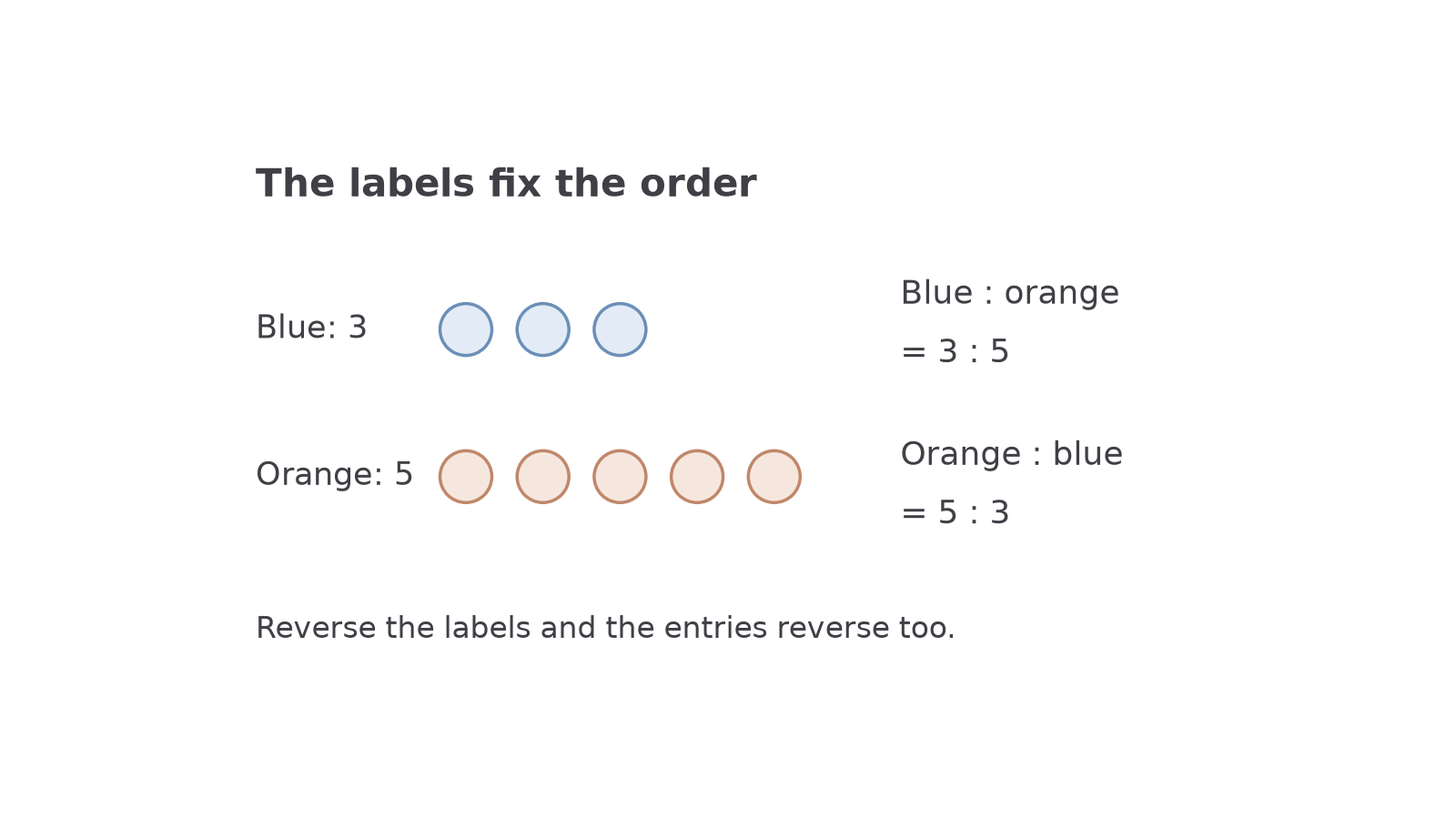
If there are blue counters for every orange counters, write . The colon separates the entries. It does not mean subtract. Reversing the labels gives .
[DIAGRAM: asset_name: The order in a ratio; asset_slug: aqa8300_r01_ratio_order; caption: Three blue counters and five orange counters give blue to orange as 3 to 5; description: Two labelled rows of equal-sized counters. The upper row contains three pale-blue counters and is labelled Blue: 3. The lower row contains five pale-clay counters and is labelled Orange: 5. A right-hand label states Blue : orange = 3 : 5 and beneath it Orange : blue = 5 : 3.]
Equivalent ratios
Ratios that describe the same relative amounts. For example, , and are equivalent because every entry is multiplied by the same positive factor. A ratio is in simplest form when its entries are whole numbers with no common factor greater than .
Here is a useful surprise: and make exactly the same comparison. A ratio records the relative size, not the size of the batch. Adding the same amount is different: and are not equivalent, since .
Continue this lesson.
You’re previewing NovaLearn without an account. Create a free account to read the rest.
Create free account