N3 - Inverse operations and order of operations
The same numbers can give different answers when you change the order of the operations. You will learn which operations come first, how brackets, powers, roots and fraction bars group a calculation, and how inverse operations undo a process. You will also use cancellation to make a calculation smaller before doing it.
Operations that undo each other
Two friends work out . One gets and the other gets . Can both answers be right? The expression needs a shared reading rule, just as a sentence needs punctuation. We will settle it once that rule is in place.
You already know
You can add, subtract, multiply and divide positive and negative numbers. A multiplication checks a division, and an addition checks a subtraction: because .
If you add , subtracting takes you back. If you multiply by , dividing by takes you back. These are inverse operations. To undo a chain, start with its last operation, because that is the one acting on the final result.
[DIAGRAM: asset_name: Undoing a two-step number machine; asset_slug: aqa8300_n19_inverse_machine; caption: Multiply by 4 then add 7 goes from 9 to 43; undoing subtracts 7 then divides by 4; description: A top row of three boxes shows 9, 36 and 43 joined left to right by multiply by 4 and add 7. A lower row shows 9, 36 and 43 joined right to left by divide by 4 and subtract 7. Blue arrows show the forward route and sage arrows the reverse route.]
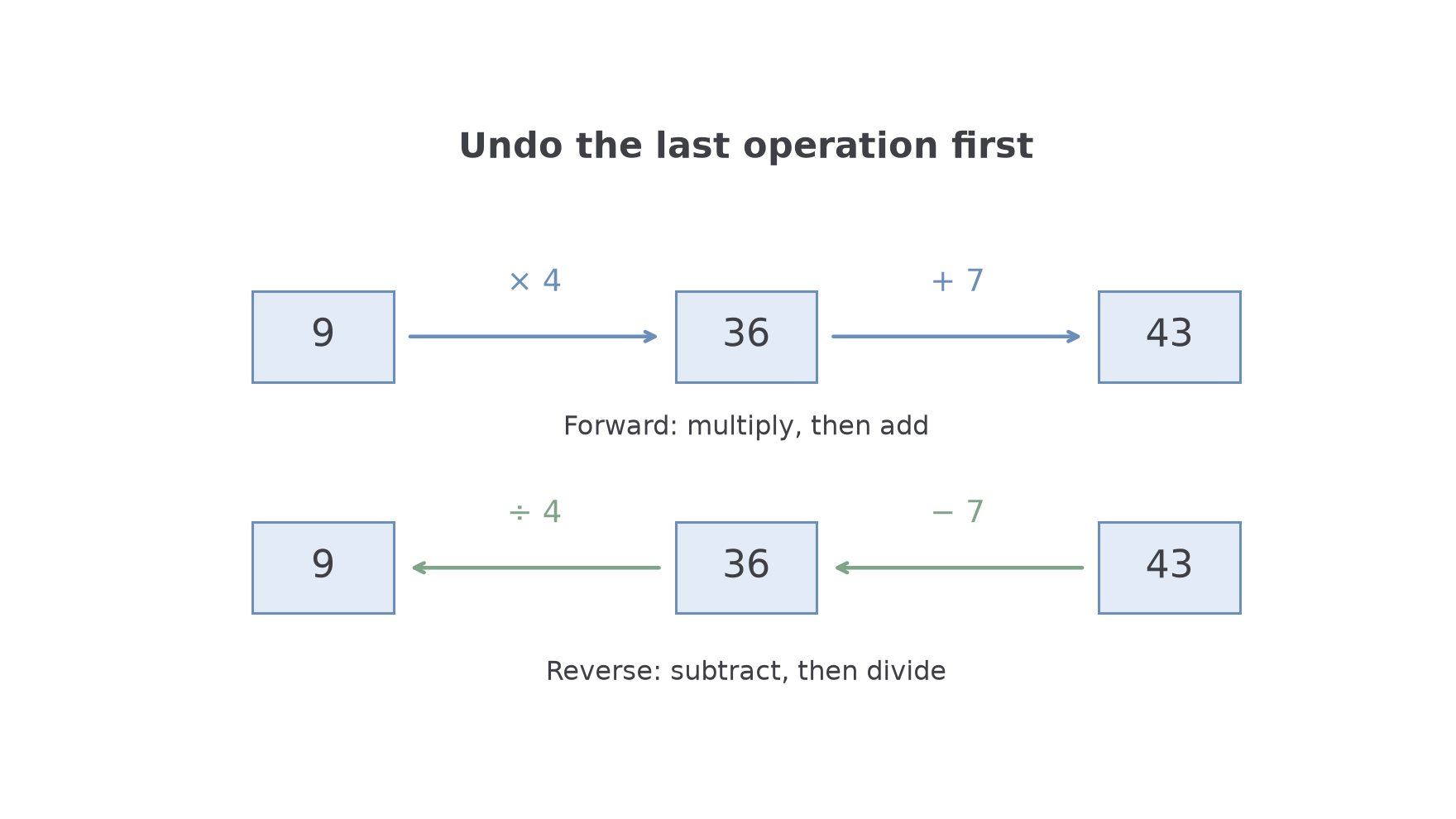
The reverse route must use the reverse order. Starting at , dividing by first would undo a multiplication that happened before the later addition; it would not return .
Inverse operations
Operations that undo each other. Addition and subtraction of the same number form an inverse pair. Multiplication and division by the same non-zero number form another pair. Dividing by zero is undefined, so multiplication by zero has no inverse operation that recovers the starting number.
An operation can be checked by asking whether its inverse restores the input. These inverse relationships are not on the formulae sheet: learn them.
Worked example 1: undoing one step
Question. A number is multiplied by . The result is . Work out the starting number. Non-calculator.
Plan. Undo multiplication by using division by .
Why divide? You need the amount in one of the six equal groups, not six more groups.
Answer. .
Check. .
The next example changes only the length of the process: an addition comes after the multiplication. Undo that last step first.
Worked example 2: undoing two steps
Question. A number is multiplied by , then is added. The result is . Work out the starting number. Non-calculator.
Plan. Subtract , then divide by .
Why this order? The was added to the complete product, so it must be removed before the product is divided.
Answer. .
Check. , then .
There is a boundary case worth noticing. Multiplying either or by zero gives zero. The output no longer tells you which input was used.
Watch out
Wrong: undo “multiply by , then add ” by dividing by , then subtracting . Right: subtract , then divide by . Undo a chain from its end.
In the next chain, change the final amount while keeping the same reverse-order idea.
Reciprocals and cancellation
Some operations can cancel before you calculate. In , multiplying and then dividing by undo each other, leaving .
A reciprocal is a number that makes a product of . The reciprocal of is , because . The reciprocal of is ; the reciprocal of is . Zero has no reciprocal, because zero times any number is zero, never .
Reciprocal and cancellation
For a non-zero number , its reciprocal is , and
Multiplying by has the same effect as dividing by . Multiplication by and division by cancel when they act on the same complete quantity.
Not on the formulae sheet: learn it.
Cancellation means replacing a factor and its inverse by . It does not mean deleting any matching numbers you happen to see.
Worked example 3: cancellation after multiplication
Question. Work out . Non-calculator.
Plan. Cancel the multiplication and division by the same non-zero number.
Why avoid ? That larger product is immediately divided by , so finding it is unnecessary.
Answer. .
Check. The long route gives .
The next example changes only the final divisor. It cancels part of the multiplier rather than all of it.
Worked example 4: cancellation that leaves a factor
Question. Work out . Non-calculator.
Plan. Divide the factor by before multiplying by .
Why can divide the ? The whole numerator is a product, so dividing one factor by divides that product by .
Answer. .
Check. .
Addition has its own inverse cancellation: . But in , the divisor acts on the whole sum. The and are not inverses, so they do not cancel.
Watch out
Wrong: , from dividing only the final term. Right: the whole is divided by , giving . If you split the division, both terms must be divided: .
The multiplier now has a different cancelling factor. Show the smaller calculation you use.
Which operation comes first?
An expression has one conventional reading. In , the multiplication belongs together: three groups of , with added afterwards. That gives , not .
The order of operations is the priority rule for reading a calculation. Brackets come first; powers and roots come next; multiplication and division share a priority; addition and subtraction share the final priority. Work from left to right when operations have the same priority.
| Priority | What to do |
|---|---|
| First | Work out bracketed groups, starting with the innermost |
| Next | Evaluate powers, roots and reciprocals of the indicated quantities |
| Next | Multiply and divide, left to right |
| Last | Add and subtract, left to right |
You may know the reminder BIDMAS or BODMAS. Neither means that division always comes before multiplication, or that addition always comes before subtraction. The equal-priority pairs matter. These conventions are not on the formulae sheet: learn them.
Worked example 5: multiplication before subtraction
Question. Work out . Non-calculator.
Plan. Work out the product before subtracting it.
Why not first? Without brackets, the belongs to the multiplication by .
Answer. .
Check. Subtracting four times from also gives .
The next example changes only one feature: the product includes a division as well. Resolve that equal-priority chain from left to right.
Worked example 6: division and multiplication tie
Question. Work out . Non-calculator.
Plan. Complete the division and multiplication left to right, then subtract.
Why not multiply by first? That would introduce an unwritten group , which is a different calculation.
Answer. .
Check. The amount subtracted is twice , so it is .
The same left-to-right rule applies to addition and subtraction: , not . A subtraction sign stays with the quantity being subtracted.
Watch out
Wrong: . Right: . Multiplication and division have equal priority.
We can now resolve the opening disagreement. . The friend who got worked through every sign from left to right, including subtraction too early.
Brackets, powers, roots and grouped expressions
Brackets tell you to treat their contents as one quantity. Powers, root signs and fraction bars also tell you exactly which quantity an operation acts on.
In , first make , then square it: . In , square only the , giving . A square means multiply the base by itself; a square root reverses squaring for a non-negative input. For example, , because . Here we use familiar squares; the full set of powers and roots comes later.
A root bar groups everything underneath it: , whereas . A fraction bar groups its complete numerator and denominator: . The reciprocal of is , not . These notation rules are not on the formulae sheet: learn them.
Worked example 7: a power inside a bracketed calculation
Question. Work out . Non-calculator.
Plan. Resolve the power inside the brackets, finish the brackets, then multiply.
Why not subtract before squaring? The exponent belongs only to , not to .
Answer. .
Check. The bracket equals , so three equal groups give .
The next example changes only the squared quantity: a new pair of brackets makes the whole difference the base of the power.
Worked example 8: the brackets change the base
Question. Work out . Non-calculator.
Plan. Find the bracketed base, square that base, then multiply.
Why is the answer different? The squared quantity changed from to . Brackets are instructions, not decoration.
Answer. .
Check. Expanding the square as multiplication gives .
A minus sign needs the same care: , because both factors are , but , because the minus is outside the square. Also, , not : the square-root symbol means the non-negative square root. Solving an equation with a square is a later, different task.
Here is an unusual coincidence: and . The same trick fails when you include : , while . Agreeing in one example does not make two operations interchangeable.
Watch out
Wrong: . Right: work out the grouped sum first, giving . A square root does not split across an addition.
Read the brackets before calculating. The next check changes the numbers from Worked example 8.
Quick Recap
- Inverse operations undo each other; undo a chain in reverse order.
- The reciprocal of a non-zero number is . Cancel inverse operations only when they act on the same quantity.
- Brackets come first, then powers and roots, then multiplication and division, then addition and subtraction.
- Equal-priority operations go from left to right. Division does not outrank multiplication.
- Brackets, fraction bars and root bars define complete groups; an exponent applies only to its stated base.
The opening calculation has the single conventional value : complete before subtracting it from .