N4 - Factors, multiples, primes and prime factorisation
Factors tell you how a number can be shared exactly; multiples tell you what happens when equal groups are repeated. You will recognise primes, break whole numbers into prime factors, and use the highest common factor and lowest common multiple to solve grouping and timing problems. You will also learn why a prime factorisation gives a reliable description of a number.
Factors and multiples
You have blue beads and gold beads. What is the greatest number of identical bags you can make, using every bead? Each bag must contain the same number of blue beads and the same number of gold beads. We need a number that divides both totals exactly.
You already know
Multiplication and division are inverses. If , then and . An exact division has no remainder.
A whole number can be built from equal groups in several ways. For , those ways include , and . Each pair gives two factors. Repeating groups of instead gives multiples: , , , and so on.
Factor and multiple
A factor, or divisor, of a positive integer divides it exactly. A multiple of a number is the result of multiplying it by an integer. For example, is a factor of , and is a multiple of . Not an example: is not a factor of , because is not an integer.
Unless a question says otherwise, “list the factors” means positive factors. Every positive integer has and itself as factors. Multiples go on without end; is a multiple too, although the lowest common multiple means the lowest positive common multiple. Factors and multiples are not listed on the formulae sheet: learn their meanings and methods.
Worked example 1: finding every factor
Question. Write down all the factors of .
Plan. List factor pairs in order, starting with .
Testing and gives remainders. At , a possible partner would already be smaller than ; continuing would repeat a pair already tested.
Why use pairs? Finding automatically finds , which stops you overlooking a large factor.
Answer. , , , , , .
Check. Every listed number divides exactly; the pair products all give .
The next example changes only the number to a square. The last factor pair has equal members, so that factor appears once in the list.
Worked example 2: a repeated factor pair
Question. Write down all the factors of .
Plan. List the pairs until the two members meet.
Why write once? The question asks which numbers are factors, not how many times they appear in pairs.
Answer. , , , , , , , , .
Check. , and the factors below match partners above it.
The factors of hide a pleasing fact: . The positive factors smaller than the number add up to the number itself. Numbers with this property are called perfect numbers; works too, since . You do not need that name for an exam, but it gives you a useful check on this particular factor list.
Watch out
Factors and multiples answer different questions. is a factor of ; is a multiple of . Listing , , does not answer “Write down all the factors of ”.
Try a different square, then distinguish a factor from a multiple.
Prime numbers and composite numbers
Some positive integers have only one factor pair. For , it is ; no other positive integers multiply to give . For , there is also . This separates primes from composite numbers.
Prime number
A positive integer with exactly two distinct positive factors: and itself. For example, , , , , and are prime. Not an example: , which has only one positive factor, or , which has four.
A composite number is a positive integer greater than that is not prime. It has a factor other than and itself. The number is neither prime nor composite. Neither nor a negative integer is a prime number under this definition.
The only even prime is . Every larger positive even number has as an extra factor. But odd does not mean prime: , and are odd composites.
To decide whether is prime, test possible small factors. It is not divisible by , , or . Any new pair starting at or above would have product at least , so it cannot make without a smaller partner already tested. Thus is prime. For , the single calculation already proves it is composite.
Key idea
Prime means exactly two distinct positive factors. It does not mean odd, and it does not include .
Prime recognition is not on the formulae sheet: learn the definition. A claimed factorisation is checked by multiplying its factors, not by the appearance of the digits.
Writing a product of prime factors
A composite number can be split into factors, and any composite factor can be split again. Keep going until every final factor is prime.
For , splitting gives . Splitting instead gives . The order changes but the final prime factors do not.
Prime factorisation
Writing a positive integer greater than as a product of prime numbers. For example, . The exponent counts two factors of multiplied together. A product such as is a factorisation of , but is not yet a prime factorisation.
The unique factorisation theorem says that each integer greater than has exactly one prime factorisation, apart from the order of the factors. Different correct factor trees must therefore finish with the same prime factors, including repeats. This result and prime-factor methods are not on the formulae sheet: learn them.
[DIAGRAM: asset_name: Two factor trees for 84; asset_slug: aqa8300_n04_factor_trees; caption: Different first splits of 84 give the same final primes, 2, 2, 3 and 7; description: Two separate factor trees. The left starts 84 splitting into 12 and 7, with 12 splitting into 3 and 4 and 4 into 2 and 2. The right starts 84 splitting into 6 and 14, then 6 into 2 and 3 and 14 into 2 and 7. All terminal primes are circled in sage, and both products are labelled 2 squared times 3 times 7.]
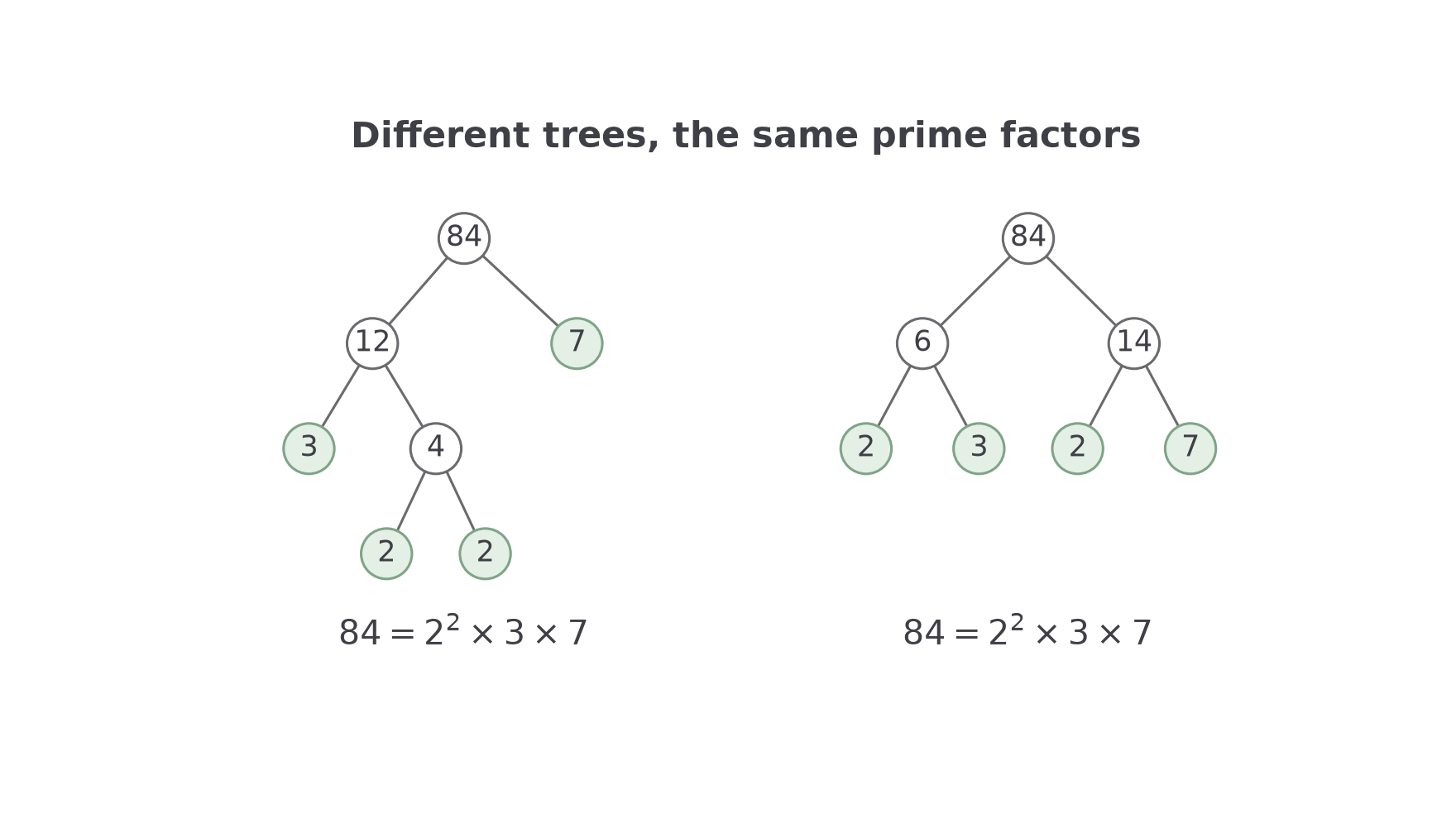
Each branch keeps the product unchanged. A final leaf is allowed to stay only when it is prime.
Worked example 3: from a tree to index form
Question. Express as a product of prime factors in index form.
Plan. Split composite factors until only primes remain, then collect repeated factors.
Why stop at these factors? , and are all prime; none can be split into smaller positive factors other than .
Answer. .
Check. .
The next example changes only the number to . A different prime repeats, so the exponent moves with it.
Worked example 4: a repeated odd prime
Question. Express as a product of prime factors in index form.
Plan. Take out a factor of , then split the remaining odd number.
Why is the exponent on ? It records which factor repeats, not how many different primes there are.
Answer. .
Check. .
Write primes in increasing order to make two factorisations easy to compare. This ordering is helpful, although the product has the same value in any order.
Watch out
Wrong: . This loses one of the two factors of , giving . Right: retain every terminal prime, so . A list of distinct prime factors is not the same as a prime factorisation.
The next number has a different repeated prime again.
The highest common factor
A common factor divides two or more numbers exactly. The highest common factor is the largest possible equal-group count that works for every total.
For and , the common factors are , , and , so their highest common factor, or HCF, is . Listing factors works well for small numbers. Prime factorisation is more efficient when the lists get long.
HCF from prime factors
Write each positive integer as a product of prime factors. Use only the primes shared by all the numbers, taking the smallest exponent of each shared prime.
If there are no shared primes, the HCF is .
Not on the formulae sheet: learn it.
Why the smallest exponent? The common factor must fit inside every factorisation. You can use only as many copies of a prime as the number with the fewest copies provides. For and , three factors of would not divide , but two do: the HCF is .
Worked example 5: using shared primes
Question. Work out the highest common factor of and .
Plan. Write both prime factorisations and select the common prime factors.
Why leave out and ? Neither divides both numbers, so neither can be part of a common factor.
Answer. .
Check. and . There are no additional shared prime factors to make a greater common factor.
The next example changes only the second number, from to . One shared exponent becomes smaller and a different prime is shared.
Worked example 6: using the smaller exponent
Question. Work out the highest common factor of and .
Plan. Compare the available copies of each prime in both numbers.
Why use only one and one ? There is only one in and only one in .
Answer. .
Check. and . The leftover factors and have no common factor above .
Now answer the bead problem: the greatest number of bags is . Each contains blue beads and gold beads. “Greatest number of identical groups with none left” points to the HCF, because that group count must divide both totals.
Watch out
Wrong: use all the primes appearing in either number for the HCF. That can produce a number larger than a starting total. Right: use shared copies only. The HCF cannot exceed the smallest starting number.
Keep fixed and change the second number once more.
The lowest common multiple
A common multiple is reached by counting in either of the starting numbers. The lowest common multiple is the first positive total both counts reach.
For and , list positive multiples:
The lowest common multiple, or LCM, is . It is not , even though is also common. With prime factors, a multiple must contain every copy needed by either number, but extra copies would make it unnecessarily large.
LCM from prime factors
Write each positive integer as a product of prime factors. Include every prime that appears, taking the largest exponent needed for each prime.
Not on the formulae sheet: learn it.
The HCF uses the shared copies; the LCM uses enough copies for both complete numbers. A repeated factor is counted as often as needed, rather than copied from both lists and counted twice.
Worked example 7: two repeating signals
Question. One light flashes every seconds and another every seconds. They flash together now. Work out how many seconds it will be until they next flash together.
Plan. Find the lowest positive common multiple of the two intervals.
Why a multiple? The elapsed time must contain a whole number of both -second intervals and -second intervals.
Answer. seconds.
Check. and . The lists and first meet at .
The next example changes only the second interval, from to seconds. A new prime is needed in the common multiple.
Worked example 8: including an unshared prime
Question. One light flashes every seconds and another every seconds. They flash together now. Work out how many seconds it will be until they next flash together.
Plan. Include the highest power of each prime appearing in either interval.
Why include both and ? Without the answer would not be divisible by ; without it would not be divisible by .
Answer. seconds.
Check. and , and every prime copy is needed for at least one interval.
For three numbers the same rule works: . Each required prime power must fit. If one number is already a multiple of the other, such as and , their LCM is the larger number, . The HCF of that pair is the smaller number, .
Watch out
Multiplying the two numbers gives a common multiple, but not always the lowest one. Wrong: . Right: the shared factors are counted only as often as needed, giving .
Bags and flashing lights ask different questions. A group count divides the available totals, so use a common factor; a meeting time is built from repeated intervals, so use a common multiple.
Quick Recap
- A factor divides a number exactly; a multiple is made by multiplying the number by an integer.
- A prime has exactly two distinct positive factors. The number is not prime.
- Prime factorisation keeps splitting until every factor is prime. Apart from order, the result is unique.
- For the HCF, use the smallest shared prime powers. For the LCM, include every required prime at its largest needed power.
- Equal grouping points to a common factor; repeating events meeting again point to a common multiple.
The greatest number of identical bead bags is , each with blue beads and gold beads, using all blue and gold beads.