G20 - Pythagoras' theorem
Work out a missing length in a right-angled triangle, then use the same idea inside rectangles and on coordinate grids. You will learn when to add, when to subtract, and why the square root must come last.
Finding the hypotenuse
A rectangular court is wide and long. How much shorter is a straight walk across its diagonal than a walk along two edges? The edge route is easy; the diagonal needs a relationship between the three sides of a right triangle.
You already know
Squaring and taking the positive square root undo each other for positive lengths. The area proof with four congruent triangles gave . A rectangle has right angles.
A right-angled triangle has two perpendicular sides meeting at . The side opposite that right angle is the hypotenuse. It is the longest side, however the triangle is turned. Find it from the right-angle mark, rather than from the slope of the picture.
[DIAGRAM: asset_name: Hypotenuse opposite the right angle; asset_slug: aqa8300_g15_hypotenuse; caption: The hypotenuse is opposite the right angle in both orientations; description: Two separated right triangles with the same perpendicular side lengths 6 and 8 and hypotenuse 10, the second rotated. Clear right-angle squares identify the angle opposite the blue hypotenuse in each. The perpendicular sides are grey and labelled a and b as well as 6 and 8. Diagrams not drawn accurately.]
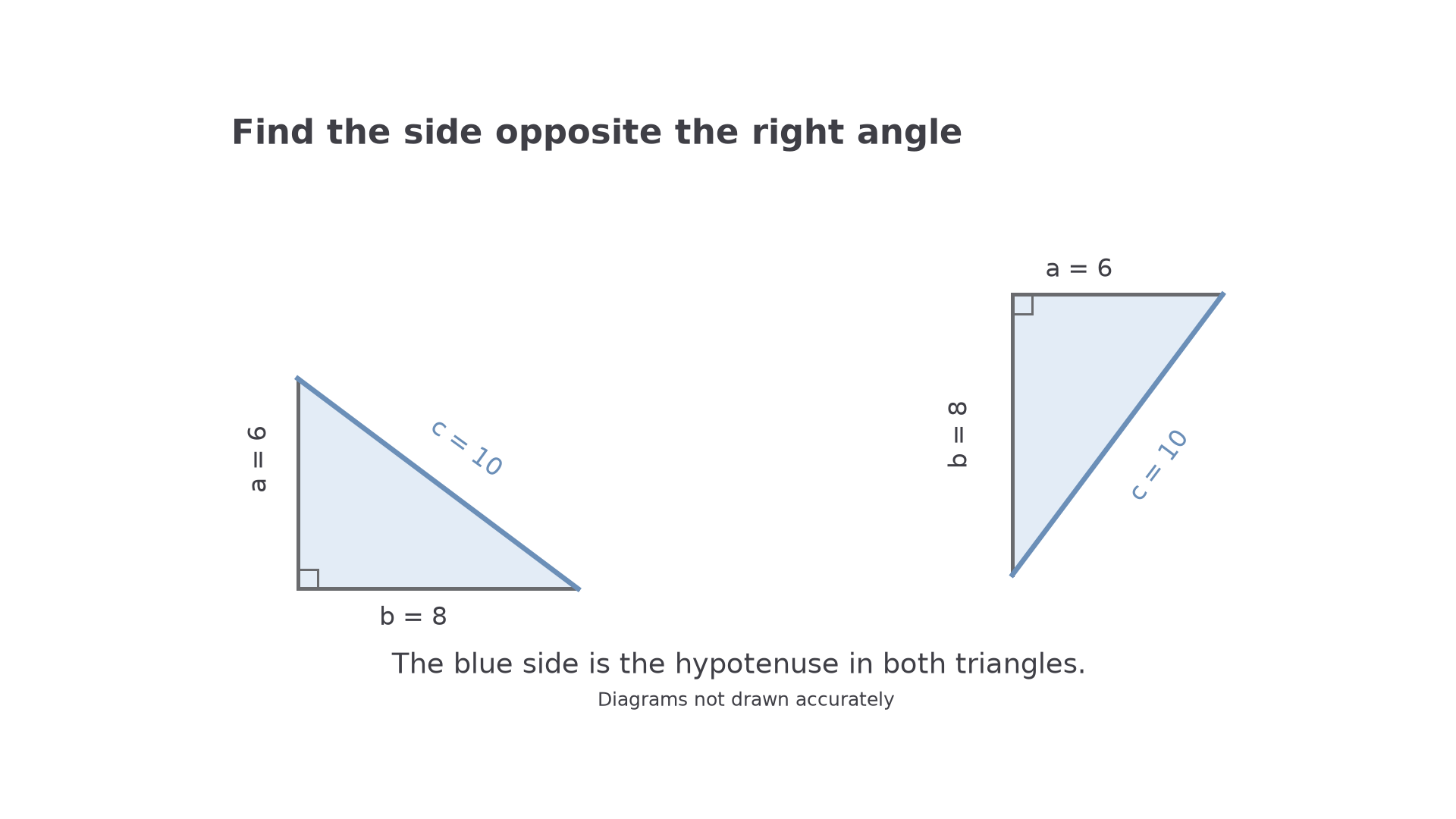
The theorem connects the squares of the lengths. It does not say that the two shorter lengths add to the longest one.
Pythagoras' theorem
For a right-angled triangle with perpendicular side lengths and hypotenuse ,
To find the hypotenuse, add the squares and take the positive square root:
On the 2027 formulae sheet.
The square root turns the squared length back into a length. There is no negative answer: a side length must be positive.
Worked example 1: a whole-number hypotenuse
Question. Non-calculator. A right-angled triangle has perpendicular sides and . Work out its hypotenuse.
Plan. Square the two perpendicular sides, add, then take the square root.
Why this step? is , not . Stopping there would report a squared length as a length.
Answer. .
Check. , and is longer than both and .
Worked example 2 changes the kind of answer: the square root is not a whole number. Keep the unrounded value until the final line.
Worked example 2: a calculator square root
Question. Calculator allowed. A right-angled triangle has perpendicular sides and . Work out the hypotenuse. Give your answer to significant figures.
Plan. Enter the square root of the sum of the squares, with both terms inside the root.
Why this step? Enter , not : the root covers the entire sum.
Answer. to significant figures.
Check. The result is longer than but shorter than , as a diagonal route should be.
Whole-number examples can hide the need for the square root, so always show the line where you take it.
Watch out
Wrong: . Right: , so . Also, : a square root does not split across addition.
Some whole-number triples do fit perfectly. Multiplying by any positive number preserves Pythagoras, because both sides of the equation gain the same squared multiplier. This gives infinitely many right triangles, including . Try another scaled version.
Finding a shorter side
When the hypotenuse is given, subtract the square of the other known side from its square.
Starting with , subtract to get . This is the same theorem rearranged, not a different rule. The hypotenuse square remains the largest square.
A missing perpendicular side
For a right-angled triangle with hypotenuse and known perpendicular side ,
Choose the hypotenuse from its position opposite the right angle before substituting.
Pythagoras' theorem is on the 2027 formulae sheet; this is its rearrangement.
Write the equation with the longest side alone first if you are unsure which way to subtract.
Worked example 3: subtracting the squares
Question. Non-calculator. A right-angled triangle has hypotenuse and one perpendicular side . Work out the other side.
Plan. Subtract from , then take the positive square root.
Why this step? Adding would produce a side longer than the hypotenuse. We are finding one of the shorter sides.
Answer. .
Check. .
Worked example 4 changes the root from exact whole-number arithmetic to a calculator value. The subtraction decision is unchanged.
Worked example 4: rounding a shorter side
Question. Calculator allowed. A right-angled triangle has hypotenuse and one perpendicular side . Work out the other side to significant figures.
Plan. Calculate , then round once.
Why this step? The unrounded value begins , so rounding to significant figures carries through the hundredths and gives .
Answer. to significant figures.
Check. The unrounded value squared is ; adding returns . The answer is shorter than .
Decide between addition and subtraction by naming the side, rather than by remembering which way a diagram usually faces.
Watch out
Wrong: “The missing side is .” Pythagoras subtracts the squares, then takes a root: . Do not subtract the lengths first and square that difference.
This next root is exact, even though the given lengths have decimals.
Finding the right triangle in a problem
A word problem may hide its right triangle inside a wall, rectangle or cross-section. Sketch it and mark the right angle before calculating.
A ladder against a vertical wall makes a right angle between the wall and horizontal ground. The ladder is the hypotenuse. A rectangle's diagonal is the hypotenuse of a triangle made by two adjacent edges. Pythagoras needs a known right angle; a triangle that merely looks nearly right-angled is not enough.
Continue this lesson.
You’re previewing NovaLearn without an account. Create a free account to read the rest.
Create free account