G14, G15 - Measuring, scale drawings and bearings
Measurements need a number, a unit and a sensible way to read the instrument. In G14 you will use standard measures in geometrical problems. In G15 you will read rulers and protractors, connect measurements to scale drawings, and use compass directions and three-figure bearings to describe a journey precisely.
Choosing and using measures
A rescue boat travels from harbour A to buoy B on a bearing of . What bearing should it follow to come straight back? The same line is involved, but the direction has changed. We will return to the boat after putting its measurements in order.
You already know
Metric conversion factors turn one unit into another. A scale drawing keeps corresponding lengths in the same ratio. Angles on a straight line add to .
Choose the unit for the quantity being measured. A room's floor area is measured in square metres; the paint in a tin is measured by volume, often in litres. A person's mass is measured in kilograms. Metres would not answer either question.
| Quantity | Suitable standard units | What the unit measures |
|---|---|---|
| Length | millimetres, centimetres, metres, kilometres | distance along a line |
| Area | square centimetres, square metres | amount of surface |
| Volume and capacity | cubic centimetres, cubic metres, millilitres, litres | space occupied or space available inside |
| Mass | grams, kilograms, tonnes | amount of matter |
| Time | seconds, minutes, hours | duration |
| Money | pence, pounds | cost or value |
Capacity is the volume a container can hold. A solid block can have a volume even though it has no capacity. Useful connections are and . These are not on the formulae sheet: learn them.
Worked example 1: a capacity measurement
Question. A measuring jug contains of water. A further is poured in. Work out the total volume in litres. Non-calculator.
Plan. Express both volumes in litres before adding.
Why convert first? Adding and would combine different-sized units.
Answer. .
Check. , which is just over one litre.
Change the kind of measure. Time uses groups of , so a time written with hours and minutes is not a decimal number of hours.
Worked example 2: a duration and a charge
Question. A boat leaves at 10:45 and returns at 12:20. Hire costs £6 for each complete -minute period. Work out the hire charge. Non-calculator.
Plan. Find the duration in minutes, then count the -minute periods.
Why work in minutes? The price is for a fixed number of minutes, not for a decimal part of an hour.
Answer. £114.
Check. The trip lasts hour minutes, which is minutes.
The unit also tells you how to interpret an answer. A hire charge needs money notation; a duration needs a time unit.
Watch out
Wrong: hour minutes hours. Right: hours. The digits after a decimal point are tenths and hundredths, not minutes.
Keep the units visible when you combine a duration with a rate.
Reading rulers and protractors
An instrument gives a useful measurement only when you know its smallest division and its starting point.
On a millimetre ruler, ten small divisions make one centimetre. Put the ruler's zero mark at the first endpoint, rather than using the physical end of the ruler. Look straight down so the endpoint lines up with the correct mark. If the first endpoint is not at zero, subtract its reading from the final reading.
For an angle, put the protractor's centre at the vertex and its baseline along one arm. Read from the zero on that arm towards the other arm. The two number scales usually add to , so first decide whether the angle should be acute or obtuse.
[DIAGRAM: asset_name: Reading a ruler and a protractor; asset_slug: aqa8300_gd_measuring_scales; caption: Subtract the ruler readings and start the protractor scale from the arm's zero; description: The left panel shows a ruler in centimetres with millimetre divisions. A blue segment begins at 1.4 cm and ends at 6.7 cm, giving length 5.3 cm. The right panel shows an acute 37 degree angle with its initial arm pointing right. A note explains that the paired readings are 37 degrees and 143 degrees and the correct reading starts at zero on the right. The image is a scale-reading illustration and must not be measured on screen.]
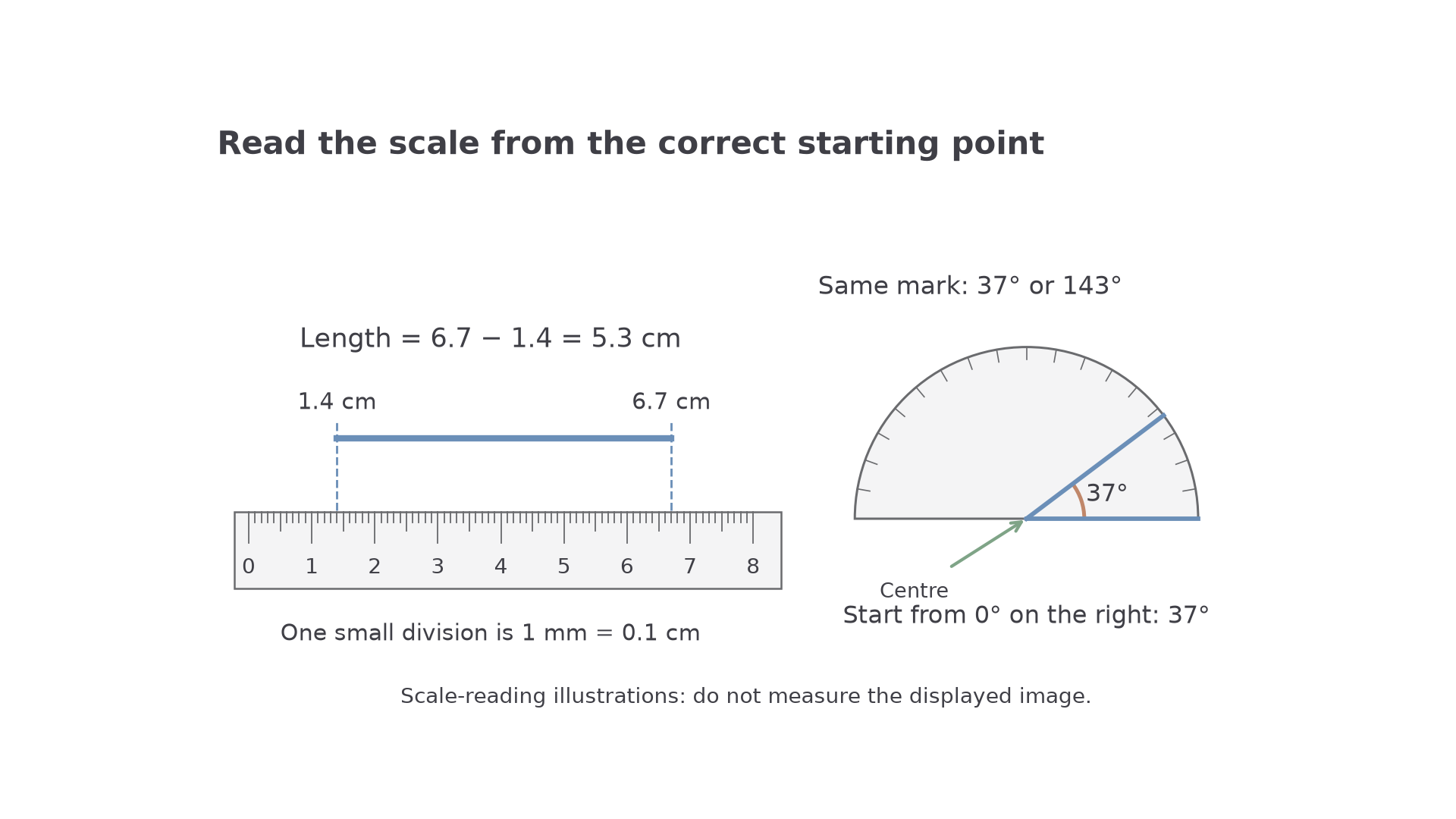
Worked example 3: endpoints away from zero
Question. A line segment's endpoints align with and on a ruler. Work out its length in millimetres. Non-calculator.
Plan. Subtract the endpoint readings, then convert centimetres to millimetres.
Why subtract? The before the segment is not part of its length.
Answer. .
Check. The segment is a little longer than , so is sensible.
Change the instrument from a ruler to a protractor. The starting point still decides which reading matters.
Worked example 4: choosing the angle scale
Question. One arm of an acute angle lies along the protractor's right-hand zero. The other arm crosses paired marks and . Write down the angle. Non-calculator.
Plan. Follow the scale beginning with zero on the right, then check the angle's size.
Why reject ? It is an obtuse angle measured from the opposite baseline direction.
Answer. .
Check. , as expected for paired protractor readings.
If an angle to be measured is reflex, first measure the smaller angle between its arms, then subtract from . A small sketch helps you choose the intended region.
Watch out
Wrong: select the first protractor number you see. Right: locate the vertex, align the baseline, and read from the correct zero. An obviously acute angle cannot be .
The next angle uses the same paired-scale decision, with an obtuse angle instead.
Compass and three-figure bearings
A bearing describes a direction from a named starting point, using north as the reference.
Three-figure bearing
An angle measured clockwise from north and written with three figures. For example, east is , south is , and a direction clockwise from north is . “The bearing of B from A” starts at A and looks towards B.
The eight compass points divide one full turn into eight equal angles. Each step is . North, east, south and west are separated by ; north-east sits halfway between north and east.
Continue this lesson.
You’re previewing NovaLearn without an account. Create a free account to read the rest.
Create free account