A22 - Quadratic inequalities, set notation and regions (Higher)
An inequality may select an interval, two separate ranges, or a region of a coordinate grid. You will use quadratic roots to find intervals, write solution sets clearly, and combine linear inequalities in two variables. Graphs make the difference between a boundary and a whole solution set visible.
Reading quadratic signs between roots (Higher)
A game allows scores when , and . Does qualify? What about ? We will describe the whole allowed region, including which edges count. First, use one-variable inequalities to practise choosing whole ranges rather than just boundary points.
You already know
Factorising solves a quadratic equation when the expression equals zero. An upward-opening parabola lies below the axis between two distinct roots and above it outside them. Strict inequalities exclude their boundaries; inclusive inequalities include them.
For , the roots are and . At , the product is , so the expression is negative between the roots. To the left, both factors are negative, so their product is positive. To the right, both are positive. A sign sketch is a picture of this product reasoning.
[DIAGRAM: asset_name: A quadratic's positive and negative intervals; asset_slug: aqa8300_a30_quadratic_signs; caption: The roots split the number line into intervals where the quadratic keeps the same sign; description: An upward-opening curve y equals x squared minus x minus 6 crossing at minus 2 and 3. The curve is clay below the axis and blue above. A sign strip beneath shows positive to the left of minus 2, negative between minus 2 and 3, positive to the right of 3, and zero at the roots.]
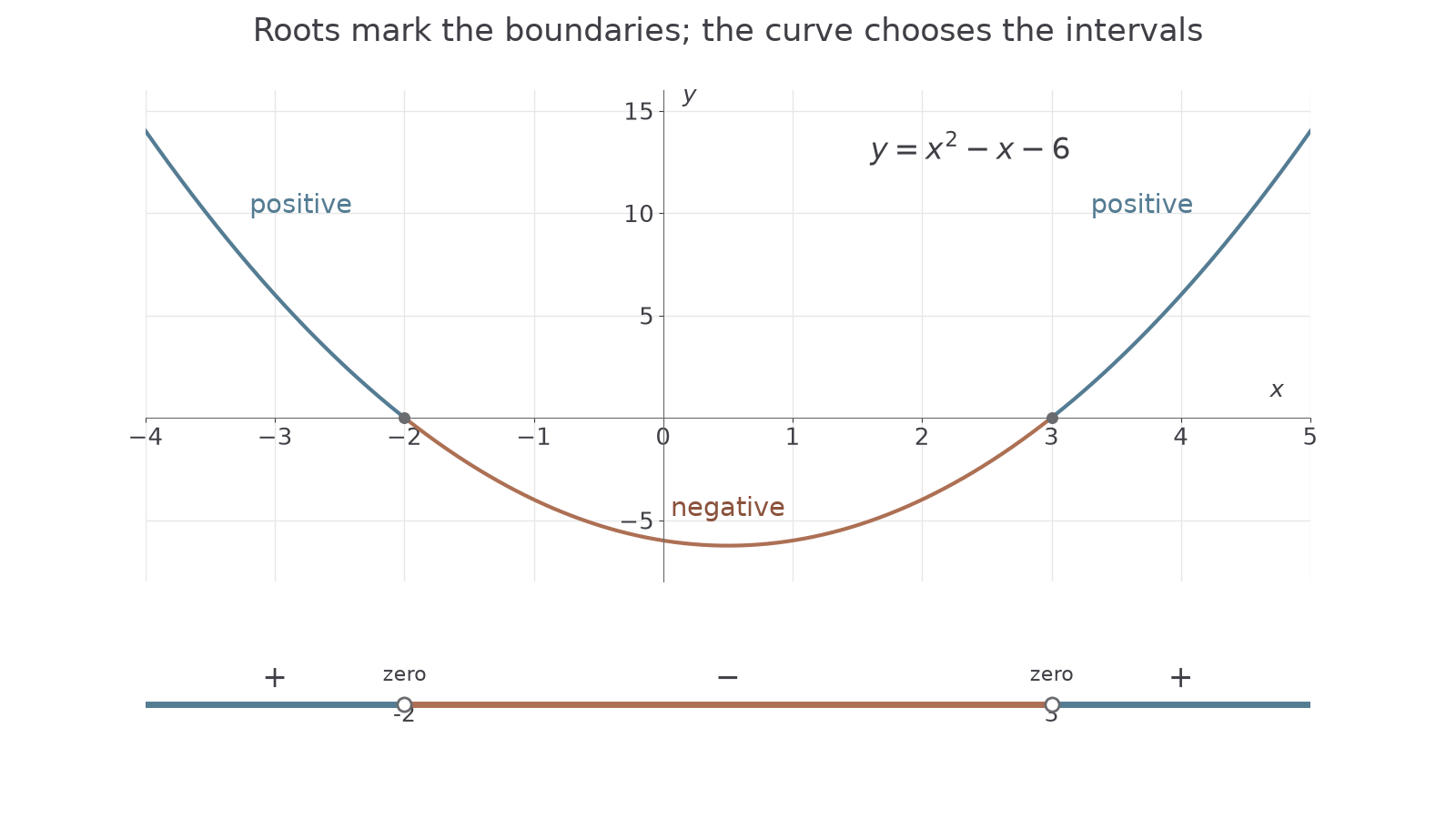
The equation finds only the boundaries. For an inequality, choose the intervals with the required sign. This method is not on the formulae sheet: learn it.
Worked example 1: negative between two roots
Question. Solve . Non-calculator.
Plan. Find the roots, then select where the upward-opening graph is below the axis.
Why this step? The roots are not the answer: the inequality asks for every input making the output negative.
Answer. . Use open circles at both ends of a number-line segment.
Check. gives . At each root the output is , so the strict sign excludes it.
Change only to . The roots stay fixed, but the chosen region moves outside them.
Worked example 2: positive outside two roots
Question. Solve . Non-calculator.
Plan. Use the same factorisation and select the two intervals above the axis.
Why this step? Either outside interval works. No number can be both less than and greater than , so join them with “or”.
Answer. or . Use open circles with arrows pointing outwards.
Check. At , the output is ; at , it is also . Both are positive.
With , include the roots in the inside interval. With , include them in the outside intervals. The root positions and signs between them do not change.
Watch out
Wrong: for the outside solution. This asks for an impossible number between endpoints in reverse order. Right: or .
Try new roots and an inclusive sign.
Rearranging a quadratic inequality (Higher)
Before choosing intervals, put every term on one side so that the other side is zero. You can then read the sign of one expression. Moving terms by addition or subtraction preserves the direction; multiplying the entire inequality by a negative number reverses it.
For , compare with zero. For , it is often easier to multiply by and compare with zero instead. These are applications of the inequality rules, not extra formulae on the sheet.
Worked example 3: terms on both sides
Question. Solve . Non-calculator.
Plan. Collect everything on the left, factorise, then choose where that expression is negative.
Why this step? A graph's axis corresponds to output zero. Comparing a quadratic with zero lets its roots separate positive and negative outputs.
Answer. .
Check. gives , true. gives , false.
Change only the presentation: write the same comparison with the quadratic subtracted on the other side. This creates a negative leading coefficient.
Worked example 4: a negative leading term
Question. Solve . Non-calculator.
Plan. Multiply by , reverse the sign, then use the upward-opening quadratic.
Why this step? Multiplying every term by changes the graph's sign. Reversing the inequality preserves the same allowed inputs.
Answer. .
Check. At , the original left side is , so the inside interval is correct.
A quadratic need not have two distinct roots. For , a square cannot be negative, so the only solution is . For , there is no real solution. For , every real works. Check the graph or the expression rather than forcing an “inside or outside” pattern where there are no two distinct roots.
Watch out
Wrong: becomes . That changes the solution. Right: reverse to when multiplying by .
The following inequality has its terms on both sides. Bring them together before using the roots.
Writing solution sets (Higher)
Set notation describes the same allowed values without a drawing. Read as “the set of values such that ”. The colon means “such that”. Unless a question states otherwise here, is real, so fractions and decimals are allowed too.
Union and intersection of solution sets
is the union: values in or , including values in both. is the intersection: values in both and . The symbol means “belongs to”, and denotes all real numbers. The empty set has no values.
A double inequality describes an intersection: both limits hold. Two outward intervals describe a union: either interval is enough. State any restriction such as “ is an integer” before selecting values. This notation is not on the formulae sheet: learn it.
Worked example 5: both limits must hold
Question. For real , let and . Write using a double inequality. Non-calculator.
Plan. Keep values satisfying the lower and upper limits together.
Why this step? Intersection means “and”, so a value failing either limit is excluded.
Answer. .
Check. satisfies both limits. fails the first; satisfies both.
Change only the operation from intersection to union. Now either condition can admit a value.
Worked example 6: either condition is enough
Question. For the same sets and , work out . Non-calculator.
Plan. Check whether any real number fails both conditions.
Why this step? These two cases cover the whole number line. The overlap does not create a gap.
Answer. .
Check. A far-left value such as belongs to , and a far-right value such as belongs to .
For two disjoint ranges, union does not fill the gap. For example, . Its intersection is , because no real number satisfies both. At the other extreme, has the solution set : one value, not an interval.
Watch out
Wrong: assuming a union always means every value between two boundaries. Right: take exactly the values belonging to either set. Draw their two number-line pictures if the symbols feel slippery.
Continue this lesson.
You’re previewing NovaLearn without an account. Create a free account to read the rest.
Create free account