G8 - Combined transformations and invariant points (Higher)
Track a shape through several movements and describe their combined effect. You will use column notation for translations, recognise when two movements equal one familiar transformation, and distinguish points that stay fixed from properties that stay unchanged.
Order and column translations (Higher)
Reflect a point in , then reflect its image in . Could the final result be a slide, even though neither instruction says “translate”? We will find the single movement behind the pair.
You already know
A reflection uses a mirror line. A rotation needs an angle, direction and centre. A translation moves every point by the same horizontal and vertical amounts. Each preserves lengths and angles.
For a combination, finish the first transformation before starting the second. The second acts on the image, rather than on the original shape. Label the intermediate vertices and the final vertices .
Column notation for a translation
The translation moves every point units horizontally and units vertically. The top entry is horizontal. A negative entry means left or down.
For example, means right and down. It is a movement, rather than the coordinates of a destination.
The column contains no comma between its entries. Adding the entries to a point's coordinates records the slide.
Translation followed by another transformation
Apply the next transformation to . If the order is reversed, start again with the original and reverse the operations; do not assume the final image stays the same.
Not on the formulae sheet: learn it.
[DIAGRAM: asset_name: Reversing the order changes the final image; asset_slug: aqa8300_g08_order; caption: The same translation and reflection produce different final triangles when their order changes; description: Two coordinate-grid panels show original triangle A minus2comma1 B0comma1 C minus2comma3 in blue. Left translation 3 right 1 down gives a clay intermediate triangle, followed by reflection in the y-axis giving a sage final triangle at minus1comma0 minus3comma0 minus1comma2. Right reflection first then the same translation gives final triangle 5comma0 3comma0 5comma2. Each panel labels the two steps.]
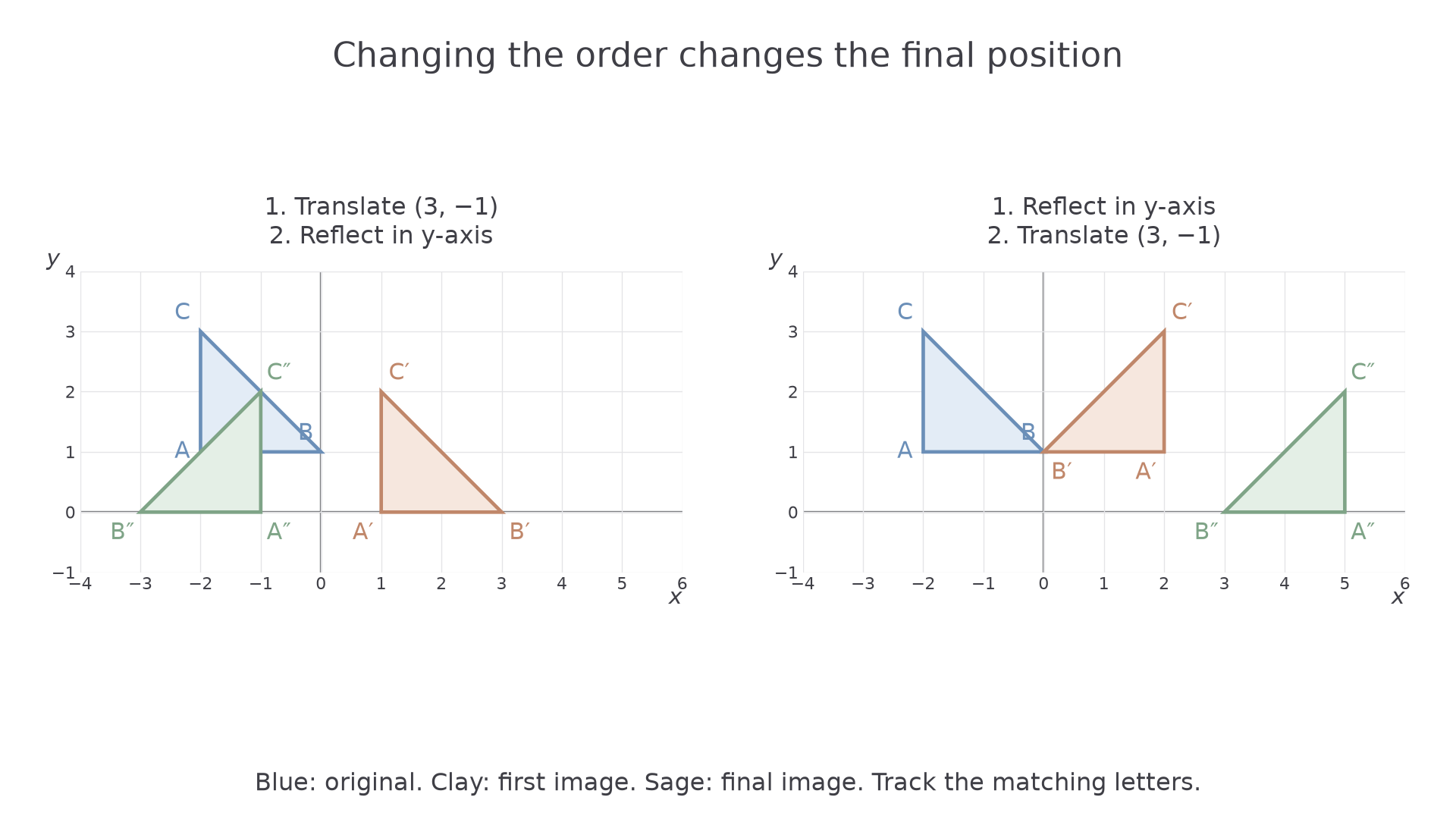
Worked example 1: translation then reflection
Question. Triangle , , is translated by , then reflected in the -axis. Write down its final vertices. Non-calculator.
Plan. Add the translation components first, then negate the new horizontal coordinates.
Why this step? The reflection acts on the already translated coordinates, including the that was added to each first coordinate.
Answer. , , .
Check. The two sides meeting at had lengths and . Their final images still have lengths and .
Change only the order. Every starting coordinate and both transformations stay the same.
Worked example 2: reflection then translation
Question. Reflect , , in the -axis, then translate the image by . Write down the final vertices. Non-calculator.
Plan. Negate the original horizontal coordinates, then add the translation components.
Why this step? The added is no longer reflected, because the translation comes last.
Answer. , , . This differs from the first result.
Check. The two final triangles are congruent, but occupy different positions. Congruence does not mean that a combination's order is irrelevant.
Some combinations do give the same result in either order. For two translations, add the horizontal movements and add the vertical movements: then gives , whichever comes first.
Watch out
Wrong: apply both instructions separately to the original triangle, then choose one image. Right: use the first image as the input for the second movement. An intermediate coordinate table keeps the order visible.
Follow the two steps with a new translation and a horizontal mirror.
Parallel mirrors give a translation (Higher)
Two reflections in different parallel lines act together as a translation perpendicular to the mirrors. Its distance is twice the gap between the mirrors.
Start with the horizontal coordinate . Reflecting in gives . Reflecting that result in gives . The final coordinate is more than the original, although the mirrors are only apart.
[DIAGRAM: asset_name: Parallel reflections produce twice the mirror gap; asset_slug: aqa8300_g08_parallel_mirrors; caption: Reflecting first in x equals minus1 and then in x equals 2 is a translation six units right; description: A coordinate grid shows triangle with vertices 0comma2 1comma2 0comma3, its first reflection with vertices minus2comma2 minus3comma2 minus2comma3, and its second reflection with vertices 6comma2 7comma2 6comma3. Vertical mirrors x equals minus1 and x equals2 are marked grey. A bracket labels their gap 3, and an arrow from original to final labels movement 6 right.]
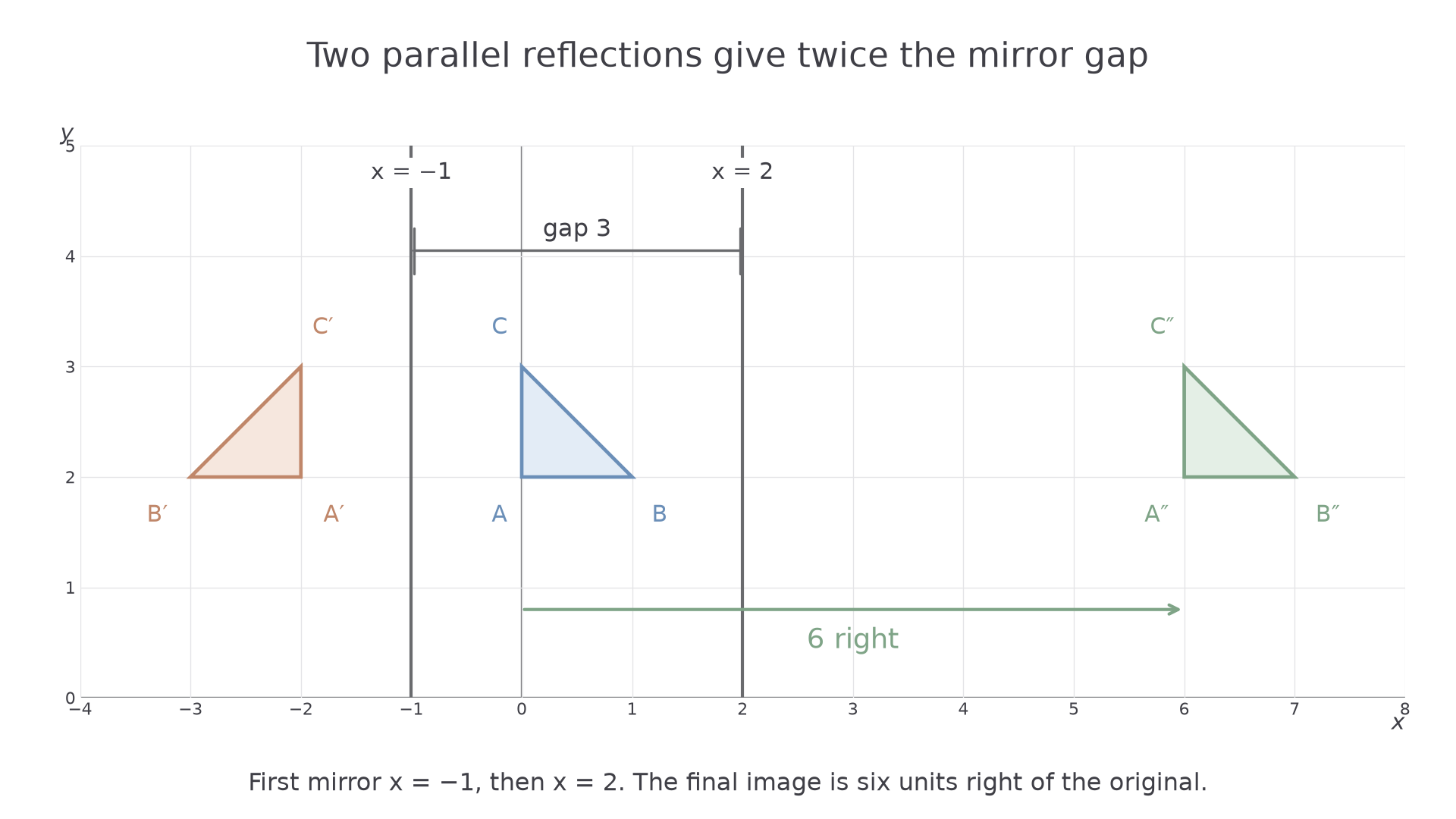
Two parallel reflections
Reflection in , followed by reflection in , gives
The equivalent translation is . For horizontal mirrors , then , the equivalent translation is .
Not on the formulae sheet: learn it.
The algebra uses an unspecified starting coordinate. It proves the same movement for every point, rather than only for one example. Sloping parallel mirrors follow the same perpendicular-distance rule.
Worked example 3: moving towards the second mirror
Question. A shape is reflected in , then in . Describe fully the single equivalent transformation. Non-calculator.
Plan. Double the mirror gap and use the direction from the first mirror to the second.
Why this step? Each reflection reverses the horizontal direction. Two reversals cancel, leaving one consistent slide for every point.
Answer. Translation by , or units right.
Check. A point with moves , a change of . Its height stays the same.
Reverse only the order of the two mirrors. The gap remains , but the translation's direction changes.
Worked example 4: reversing the two mirrors
Question. A shape is reflected in , then in . Describe fully the single equivalent transformation. Non-calculator.
Plan. Double the same gap and move from the first mirror towards the second.
Why this step? The mirrors' order chooses the translation's direction, even though their separation is unchanged.
Answer. Translation by , or units left.
Check. moves , a change of .
If the two mirror lines coincide, reflecting twice returns every point to its starting position. This is the identity transformation, with no overall change.
Watch out
Wrong: mirrors units apart give a translation of . Right: two reflections give twice the perpendicular separation, here . Reversing the order reverses the slide.
The opening mirrors , then , are apart. Their combined effect is a translation units right. Two mirror instructions really can hide a slide.
Intersecting mirrors and combined turns (Higher)
Two reflections in intersecting lines leave their intersection fixed and turn the rest of the plane. The equivalent rotation has that intersection as its centre.
If the mirror lines make an angle , their two reflections give a rotation through , in the corresponding direction from the first mirror line to the second. You can see why by following a ray: the first reflection reverses its angle about one line, and the second reverses it about the other, leaving twice the angle between the mirrors. Check a point to settle the direction.
Continue this lesson.
You’re previewing NovaLearn without an account. Create a free account to read the rest.
Create free account