G16, G17 - Volume and surface area of prisms
Volume measures the space inside a solid; surface area measures its exposed outside. In G16 you will calculate volumes of cuboids, other right prisms and cylinders. In G17 you will use familiar face areas to find their surface areas, including containers with an open end.
Cuboid volume and capacity
A cylindrical pot has radius and height . How much less material is needed if its lid is left off? Its capacity stays the same, but one exposed face disappears. By the end, you will calculate exactly which area is saved.
You already know
Rectangle area is length times width; circle area is . Surface area uses square units; volume uses cubic units. .
Picture a cuboid filled with cubes. A base by holds cubes in one layer. Three layers hold cubes. Multiplying by the height counts the layers, rather than another face.
Cuboid volume
For a cuboid with length , width and perpendicular height , in matching units,
The volume uses cubic units. For a cube of side , this becomes .
These forms are not printed separately on the formulae sheet: derive them from the prism formula, which is on the 2027 formulae sheet.
For a container's capacity, use its internal dimensions. Outside dimensions would include the thickness of its walls.
Worked example 1: counting layers in a box
Question. A cuboid has dimensions , and . Work out its volume. Non-calculator.
Plan. Find the rectangular base area, then multiply by height.
Why use all three lengths? A solid has depth as well as the two dimensions of a face.
Answer. .
Check. Three layers of unit cubes contain cubes.
Change the unknown from volume to height. The layer area still comes first, but now divide the volume by it.
Worked example 2: an unknown internal height
Question. A rectangular container has internal base by and capacity . Work out its internal height. Non-calculator.
Plan. Use , then divide by the base area.
Why divide by ? Each centimetre of height holds .
Answer. .
Check. , the supplied capacity.
The calculation can have fractional dimensions even though unit cubes helped explain the formula.
Watch out
Wrong: for a cuboid's volume. This adds a length to an area. Right: multiply the base area by the perpendicular height.
Treat the next capacity as a volume before solving for height.
Right-prism cross-sections
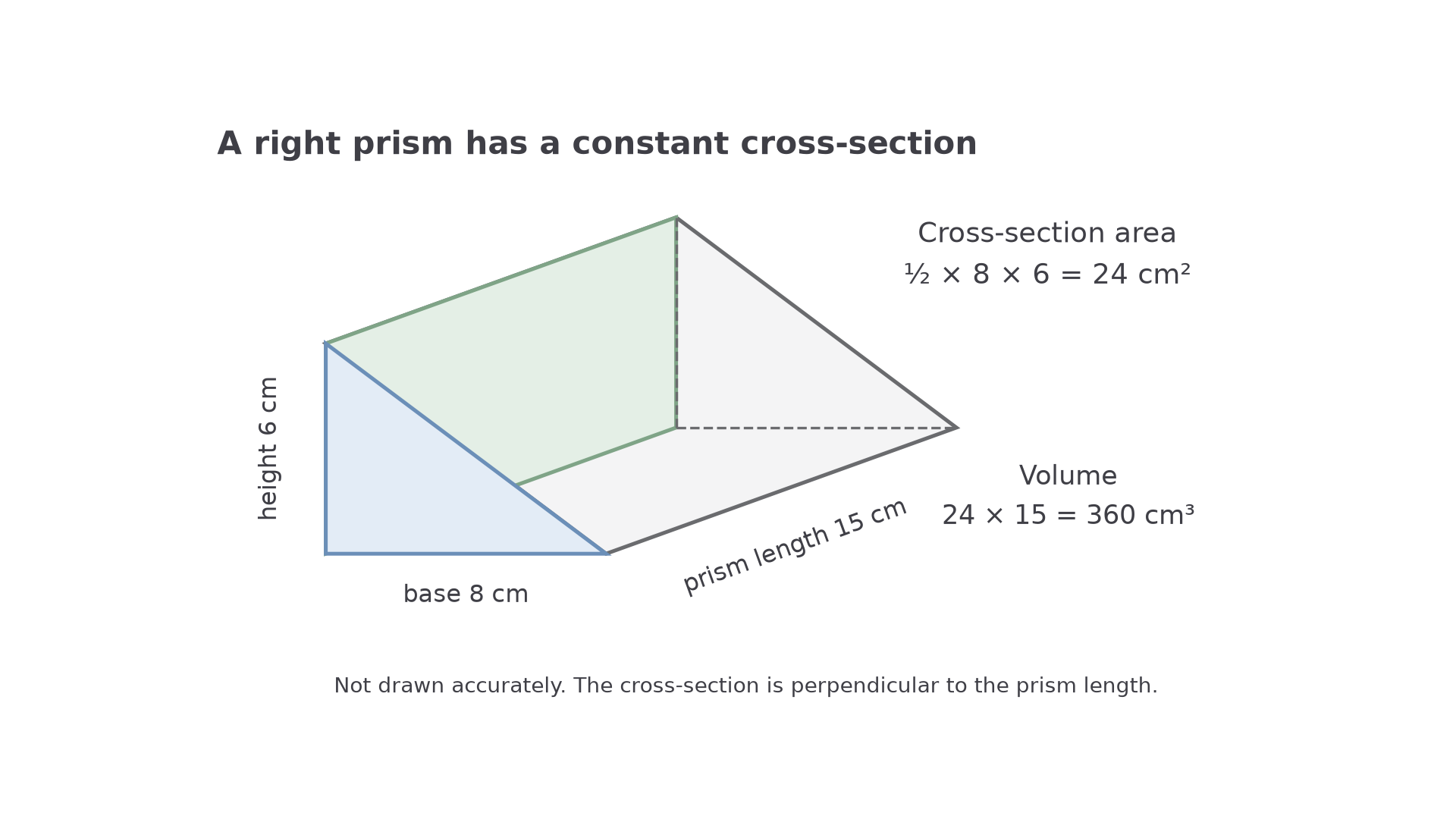
A right prism keeps the same cross-section all the way along its length, so its volume is the area of one slice multiplied by the length.
Right prism
A solid with equal, parallel polygonal end faces and a constant cross-section, with its joining edges perpendicular to the end faces. A cuboid and a triangular right prism are examples. A pyramid is not: its cross-sections shrink towards the top.
The cross-section may be a triangle, trapezium or composite polygon. Its height belongs inside the area calculation. The prism's length is a different measurement: the distance between its two ends.
[DIAGRAM: asset_name: Triangular right-prism cross-section and length; asset_slug: aqa8300_gd_prism_cross_section; caption: Find the triangular cross-section area before multiplying by the prism length; description: A triangular right prism has a highlighted blue end face with perpendicular base 8 cm and height 6 cm. The distance between the end faces is 15 cm. Text gives cross-section area 24 square centimetres and volume 360 cubic centimetres. Not drawn accurately.]
Prism volume
For a right prism with constant cross-section area and length ,
The length is perpendicular to the cross-section. Use matching units.
On the 2027 formulae sheet.
Writing the cross-section area on its own line makes the two stages much easier to follow.
Worked example 3: a triangular prism
Question. A right prism has triangular cross-section with base and perpendicular height . Its length is . Work out its volume. Non-calculator.
Plan. Find the area of the triangular end, then multiply by .
Why halve only once? The triangular cross-section is already accounted for before multiplying by length.
Answer. .
Check. The prism fills half an by by cuboid, whose volume is .
Change the cross-section to a trapezium. The prism length and cross-section height stay the same; only the end-face area calculation changes.
Worked example 4: a trapezoidal channel
Question. A right prism has a trapezium cross-section with parallel sides and , separated by . Its length is . Work out its volume. Non-calculator.
Plan. Use the trapezium area formula for the end, then the prism volume formula.
Why is not the prism length? Here it is the separation of the parallel sides within the end face. The ends are apart.
Answer. .
Check. The trapezium's mean width is , giving .
For a composite cross-section, add or subtract its component areas first. Once its area is known, the volume step is unchanged.
Watch out
Wrong: use the perimeter of the end face in . Right: is an area, measured in square units. Area times length gives cubic units.
Separate the end-face height from the prism length in this question.
Cylinder volume
A right cylinder uses the same constant-cross-section idea, with a circular end instead of a polygon.
Every slice perpendicular to its axis is the same circle. Its cross-section area is , so multiplying by the perpendicular height gives its volume. The curved side does not need to be measured to find the space inside.
Cylinder volume
For a right cylinder of radius and perpendicular height ,
Use matching length units. The answer is in cubic units.
This form is not printed separately: derive it from the circle area and prism volume formulae on the 2027 formulae sheet.
Read the given circle measurement first. A diameter must be halved before it enters the squared part of the formula.
Worked example 5: cylinder volume from radius
Question. A cylinder has radius and height . Work out its volume in terms of . Non-calculator.
Plan. Find the circular cross-section area, then multiply by height.
Why square but not ? The radius appears twice in the circle's area; height adds the third dimension once.
Answer. .
Check. Since is just over , the volume is just over .
Change only the supplied circle measurement: give the same cylinder's diameter instead of its radius.
Worked example 6: cylinder volume from diameter
Question. A cylinder has diameter and height . Work out its volume to significant figures. Calculator allowed.
Plan. Halve the diameter, then use without rounding intermediate values.
Why halve before squaring? Squaring the diameter would make the cross-section area four times too large.
Answer. to significant figures.
Check. The cylinder is the same size as in Worked example 5, and .
Continue this lesson.
You’re previewing NovaLearn without an account. Create a free account to read the rest.
Create free account