N16 - Upper and lower bounds (Higher)
When measured inputs are rounded, the calculated answer also has uncertainty. In N16 you will choose upper and lower bounds for sums, differences, products and quotients. You will then decide which digits of a final answer are actually guaranteed by the measurements.
Bounds of sums and differences (Higher)
Two lengths are labelled and , each correct to one decimal place. Their labelled difference is . Must the true difference round to too? We will find the range before trusting those digits.
You already know
A positive measurement of , rounded to the nearest , gives . The interval's upper endpoint is excluded.
To make a sum large, make both quantities large. To make a difference large, make large but small. Subtracting less leaves more.
Lower and upper bounds
Limiting values that a quantity cannot fall below or rise above. A bound need not be attainable. For example, in , is the lower bound and is the upper bound; there is no greatest possible real value of .
Write each input's bounds first. The operation then decides which ones you need.
Bounds for sums and differences
For quantities and that can vary separately, let and be their lower and upper bounds.
These give limiting values. Check whether each endpoint is included before writing a full error interval.
Not on the formulae sheet: learn it.
First use both small ends and both large ends for a sum.
Worked example 1: adding measured lengths
Question. Lengths and are and , each correct to one decimal place. Work out the lower and upper bounds of . Non-calculator.
Plan. Find the two input intervals, then add matching ends.
Why use matching ends? Increasing either length increases their sum.
Answer. Lower bound ; upper bound . The full interval is .
Check. The labelled sum lies midway between the limits.
Change only the operation to subtraction. The second input must now move in the opposite direction.
Worked example 2: subtracting measured lengths
Question. For the same measurements, work out the lower and upper bounds of . Non-calculator.
Plan. Subtract the largest from the smallest for the lower limit; reverse the choices for the upper limit.
Why not subtract both lower bounds? A smaller amount being subtracted makes the result larger, not smaller.
Answer. Lower bound ; upper bound . Here , because reaching either limit would need an excluded input endpoint.
Check. The labelled difference is between the limits, but the interval is too wide to guarantee that value to one decimal place.
Subtraction can make relative uncertainty strikingly large. Numbers labelled and , each to one decimal place, have a difference between and . The apparent difference does not deserve the same trust as an exact calculation with exact inputs.
Watch out
Wrong: the upper bound of is . Right: it is . Ask what each individual change does to the final expression.
For a positive exact multiplier, multiply both limits by that same number. For example, the bounds of are and ; the exact count has no rounding allowance.
Bounds of products and powers (Higher)
For positive quantities, a product grows when either factor grows.
If a first factor lies between and , and a second lies between and , the smallest product comes from the two small ends. The largest limiting product comes from the two large ends.
[DIAGRAM: asset_name: Choosing bounds for a positive product; asset_slug: aqa8300_n18_product_bounds; caption: A positive product is smallest when both factors are smallest and largest at the two upper limits; description: Axes labelled first factor a and second factor b show the rectangular range 3.15 to 3.25 and 4.55 to 4.65. Its lower left corner is filled sage and labelled lower product 3.15 times 4.55 equals 14.3325. Its upper right corner is hollow clay and labelled upper product 3.25 times 4.65 equals 15.1125. A diagonal arrow points towards larger positive products. The upper and right edges are dashed because those input limits are excluded.]
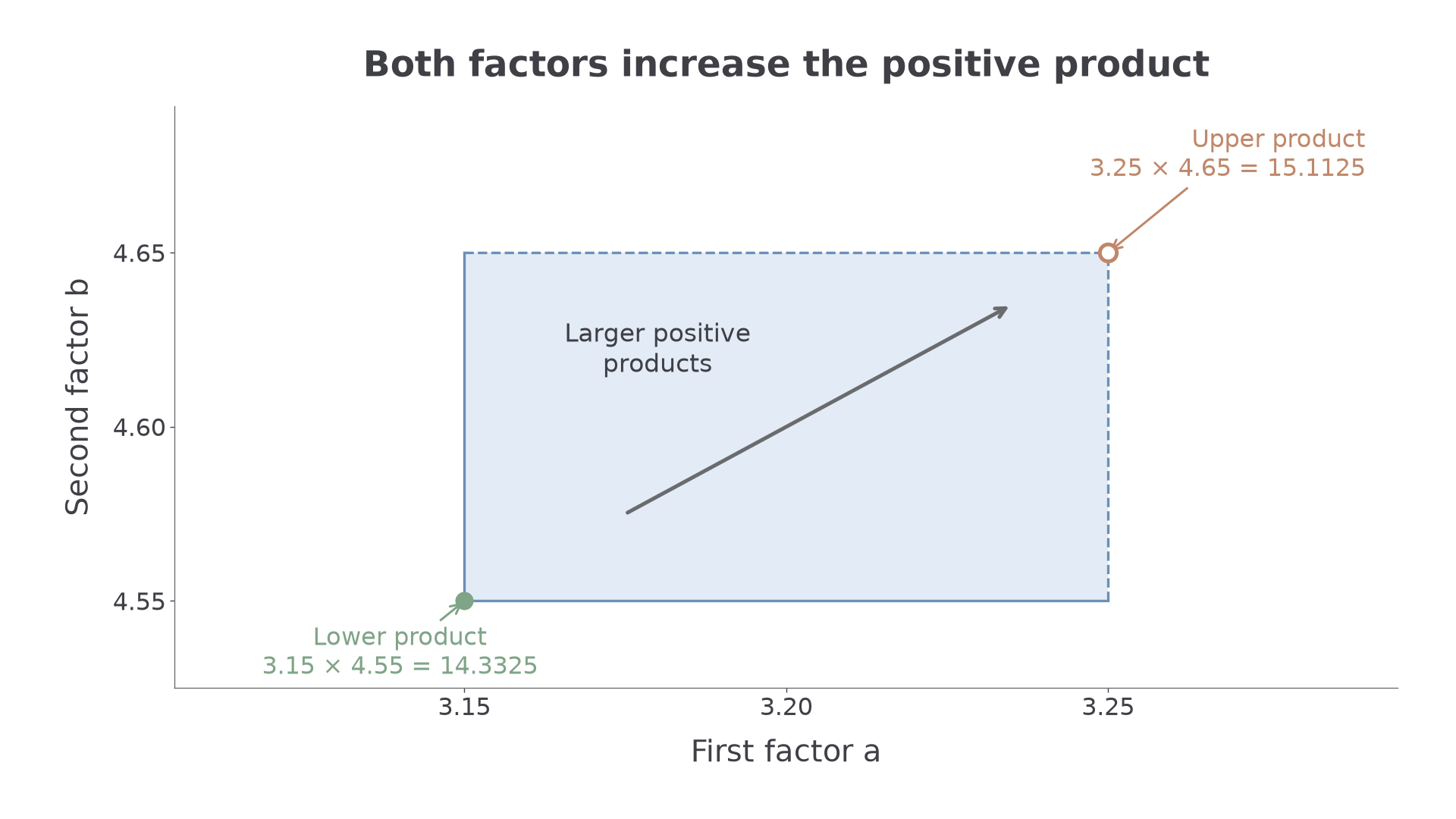
Positive product and power bounds
If and are positive and can vary separately, then
For a positive quantity raised to a positive whole-number power, raise each bound to that power. For example, and .
Not on the formulae sheet: learn it.
The positivity condition matters: increasing a negative factor does not always increase a product. For intervals involving negative values, inspect the endpoint products rather than using this positive-only shortcut. For example, if and , the limiting products are and , obtained from opposite ends.
Worked example 3: multiplying two measurements
Question. Positive quantities and are and , each correct to one decimal place. Work out the lower and upper bounds of . Calculator allowed.
Plan. Write both intervals, then multiply the matching ends without rounding.
Why use the same ends? Both factors are positive, so increasing either factor increases the product.
Answer. Lower bound ; upper bound .
Check. The labelled product is , between the limits.
Now replace the second factor by the first quantity again. This makes a square, so the same actual value appears twice.
Worked example 4: squaring a positive measurement
Question. The positive quantity is , correct to one decimal place. Work out the lower and upper bounds of . Calculator allowed.
Plan. Square each endpoint of .
Why square the endpoints? Squaring increases with the input when the input is positive.
Answer. Lower bound ; upper bound .
Check. , which lies inside the range.
The uncertainty changes too; it is not a fixed allowance that can be attached to every answer.
Watch out
Wrong: square , then add for its upper bound. Right: square , giving . The uncertainty belongs to the input before the operation.
Apply the same square method to a new measurement.
Bounds of quotients (Higher)
For a positive quotient, making the numerator larger increases the answer, but making the denominator larger decreases it.
Think of . Keep fixed and change the divisor to : the answer becomes . A larger divisor fits fewer times. That is why quotient bounds use opposite ends.
Bounds of a positive quotient
If and are positive, can vary separately, and , then
To make the result large: large numerator, small denominator. To make it small: small numerator, large denominator. These rules need reconsidering if the denominator can be zero or negative.
Not on the formulae sheet: learn it.
Use exact endpoint values, not a rounded version of a bound obtained in an earlier calculation.
Worked example 5: an upper bound for a quotient
Question. Positive quantities and are and , each correct to one decimal place. Work out the upper bound of . Give your answer as an exact fraction. Non-calculator.
Plan. Use the upper bound of and the lower bound of .
Why not divide by ? Increasing the denominator would reduce the quotient.
Answer. Upper bound .
Check. The labelled quotient is . Since , it is below .
Change only the requested bound. The numerator now needs to be small and the divisor large.
Worked example 6: a lower bound for a quotient
Question. For the same measurements, work out the lower bound of . Give your answer as an exact fraction. Non-calculator.
Plan. Use the lower bound of and the upper bound of .
Why use a denominator of ? A larger positive divisor makes the quotient smaller.
Answer. Lower bound .
Check. , so , as expected.
An excluded input endpoint can still supply a limiting bound. It just means the limiting quotient may not itself be attainable.
Watch out
Wrong: divide upper by upper to get an upper quotient. Right: use upper divided by lower, when both inputs are positive. Also check repeated quantities: for every non-zero ; you cannot choose two different values for the same .
The next question has new inputs. Decide the directions before doing the arithmetic.
Reliable final accuracy (Higher)
A calculator can display many digits that the original measurements do not justify.
To guarantee a rounded answer, every allowed result must round to that same value. Find the output interval and see whether it fits inside a single rounding interval. If two allowed values round differently, that accuracy is not guaranteed.
This test for reliable rounding is not on the formulae sheet: learn it. Do not round the calculated bounds before using them to make the decision.
Worked example 7: one-decimal inputs, whole-number certainty
Question. Positive quantities and are and , each correct to one decimal place. Is guaranteed to be to one decimal place? Give a reliable rounded answer. Calculator allowed.
Plan. Calculate both quotient bounds and compare their range with the rounding interval for .
Why compare whole intervals? Dividing just the labels gives , but allowed inputs can produce results below or above .
Answer. No: one decimal place is not guaranteed. The result is to the nearest whole number, because every possible quotient lies between and .
Check. Allowed inputs , give , which rounds to , not .
Now change only the measurement precision: both inputs are known to two decimal places. This narrows the range enough to support an extra decimal in the answer.
Worked example 8: more precise measurements
Question. Positive quantities and are and , each correct to two decimal places. Is guaranteed to be to one decimal place? Calculator allowed.
Plan. Use half-units of , then compare the quotient interval with .
Why does the answer improve? The more precise input measurements reduce the possible variation in the quotient.
Answer. Yes. Every possible result rounds to at one decimal place.
Check. Two decimal places are still not guaranteed: allowed inputs , give , which rounds to , while the labels give exactly .
The opening subtraction has the same issue. Allowed values and give a difference of , which rounds to , although the labelled difference is .
Watch out
Wrong: inputs written to one decimal place always give an answer correct to one decimal place. Right: use the range of possible outputs. The operation and the input sizes both affect the uncertainty.
When asked whether a result is definitely within a limit, compare the relevant bound with that limit and state a conclusion. A displayed calculator value alone does not settle a “definitely” question.
Quick Recap
- Write the input bounds before choosing a calculation.
- Sums use matching ends; differences use opposite ends.
- Positive products use lower times lower or upper times upper.
- Positive quotients use lower divided by upper or upper divided by lower.
- A rounded answer is guaranteed only if all allowed output values round the same way.
The opening difference need not round to : an allowed true difference is , which rounds to .