N10 - Converting fractions and decimals
A fraction and a decimal can name exactly the same number. You will change terminating decimals into fractions and back, then compare numbers written in different forms. You will also learn how a repeating decimal can be written exactly as a fraction in the Higher part.
Terminating decimals as fractions
Two bottles hold the same amount: one says , the other says . Can both labels be exact? And would changing the first label to still describe exactly the same amount? Keep these questions in mind as you connect the two ways of writing a number.
You already know
The first three decimal places are tenths, hundredths and thousandths. Equivalent fractions name the same number; divide the numerator and denominator by the same common factor to simplify.
Start with . It means hundredths, so it is . Simplifying gives . The decimal has not been rounded: all three forms are exactly equal.
Terminating decimal
A decimal that ends after a finite number of decimal places. For example, , and terminate. A decimal whose digits continue forever without ending is not terminating.
The last decimal place tells you the denominator. One decimal place uses tenths, two use hundredths and three use thousandths. This works for numbers above too: .
A terminating decimal as a fraction
Write the digits without the decimal point over the place value of the final digit, then simplify. For example,
This method applies to any terminating decimal, including decimals with zero placeholders. Keep any minus sign in front of the fraction.
Not on the formulae sheet: learn it.
Use the place value first. Simplifying is a separate step, so you do not have to guess the final denominator.
Worked example 1: hundredths to a fraction
Question. Write as a fraction in its simplest form. Do not use a calculator.
Plan. Write hundredths, then divide both numbers by their highest common factor.
Why this step? The denominator is because the last digit is in the hundredths column, not because the decimal has two non-zero digits.
Answer.
Check. .
The next example changes just the place value: the same digits move one column right. The fraction must become ten times smaller.
Worked example 2: a zero placeholder
Question. Write as a fraction in its simplest form. Do not use a calculator.
Plan. Write thousandths and simplify.
Why this step? The zero after the decimal point holds the tenths column. It makes this thousandths rather than hundredths.
Answer.
Check. is one tenth of , just as is one tenth of .
A final zero has a different job from a zero before the first non-zero digit.
Watch out
Wrong: . This ignores the tenths placeholder. Right: . In contrast, : a zero added at the end changes no value.
Try the same method with a different number of thousandths.
Fractions as terminating decimals
A fraction bar means division: asks for .
You can divide on a calculator when one is allowed. On Paper , use a written division or an equivalent fraction with denominator , , and so on. The number line below shows why and meet at exactly the same point.
[DIAGRAM: asset_name: Eighths and their exact decimals; asset_slug: aqa8300_n08_eighths_decimals; caption: Three of eight equal parts reach 0.375 exactly; description: A horizontal bar from 0 to 1 is divided into eight equal sections, with its first three sections blue. Below it a number line has matching ticks labelled 0, 0.125, 0.25, 0.375, 0.5, 0.625, 0.75, 0.875 and 1. A blue vertical guide links the right edge of the third shaded section to 0.375, labelled three eighths. A note states one eighth equals 0.125.]
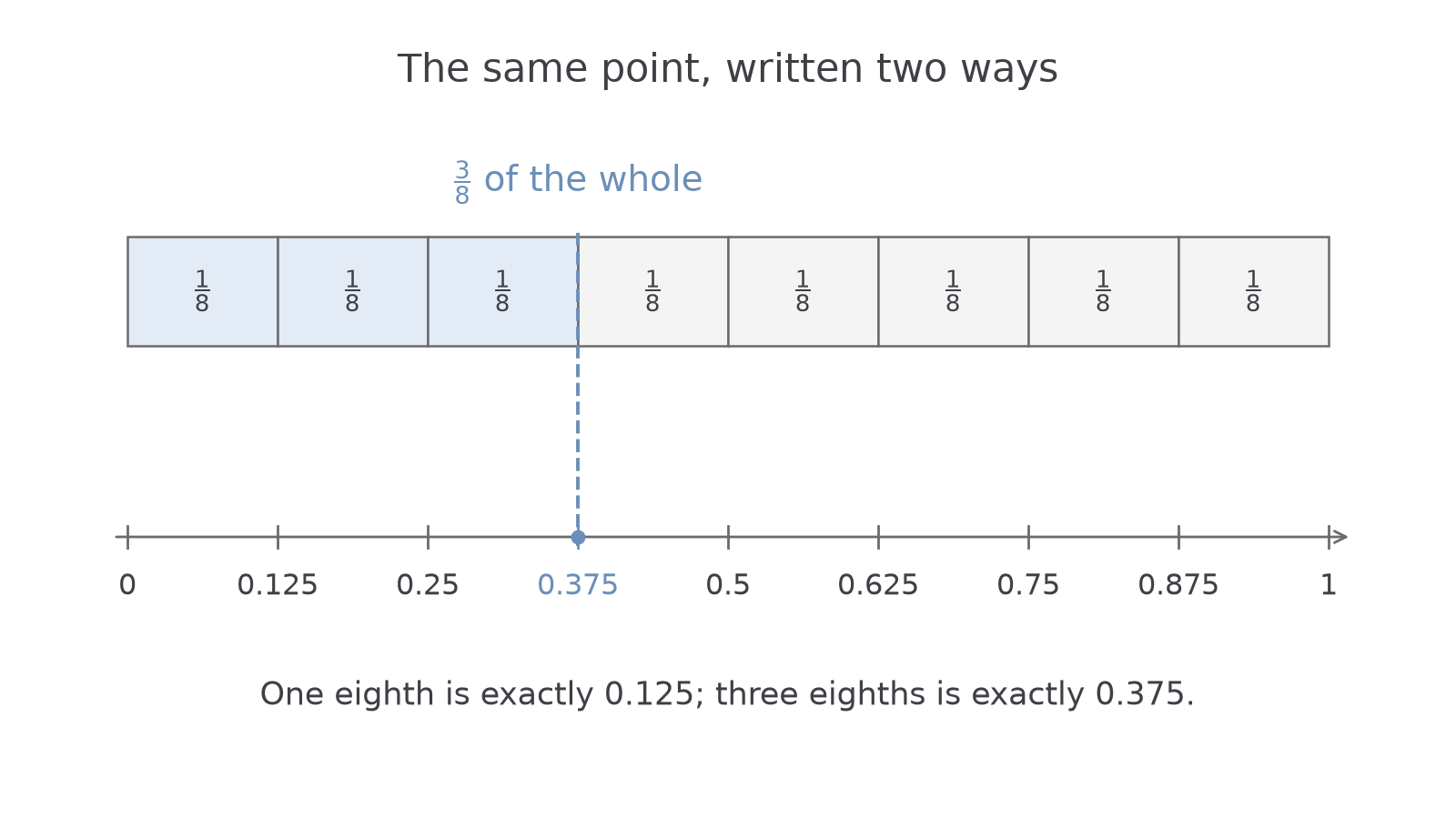
The decimal can be much longer than the fraction looks. For example, exactly: a four-digit denominator gives ten decimal places. Decimal length is not a measure of how complicated the value is.
A fraction as a decimal
For ,
For a terminating answer, divide until the remainder is zero. Zeros may be added after the decimal point without changing the dividend.
Not on the formulae sheet: learn it.
In written division, each remainder is regrouped into the next smaller place. The following working records those regroupings rather than hiding them in a calculator display.
Worked example 3: dividing to get a decimal
Question. Write as a decimal. Do not use a calculator.
Plan. Divide by , continuing until there is no remainder.
Why this step? The remainder ones becomes tenths. Each later remainder is also multiplied by when you move to the next column.
Answer.
Check. . Alternatively, .
The next numerator is larger. This changes only the whole-number part; the fractional remainder is still eighths.
Worked example 4: a fraction greater than one
Question. Write as a decimal. Do not use a calculator.
Plan. Separate the whole and use the same division for the remainder.
Why this step? is greater than . Keeping its whole-number part stops you giving the decimal , which describes only the remainder.
Answer.
Check. , and the answer lies between and .
Always divide in the order shown by the fraction.
Watch out
Wrong: . The numerator is the number being divided. Right: , which is less than , as a proper fraction must be.
For the next fraction, only the remainder after taking out one whole changes.
Ordering fractions and decimals
To compare a fraction and a decimal, write them in the same form first, then compare their values.
For example, , while . The tenths match, but the hundredths differ: hundredths is less than hundredths. So . The bottles in the opening question hold the same amount with the exact labels and . A label of would give a different exact amount, although it is rounded to two decimal places.
If all the fractions convert easily, decimals are convenient. If they share simple denominators, equivalent fractions may be quicker. Keep an exact conversion until the comparison is settled: two nearby values can round to the same decimal.
Worked example 5: ordering a mixed list
Question. Write these numbers in order of size. Start with the smallest number. Do not use a calculator.
Plan. Convert the fractions to terminating decimals, then line up the decimal places.
Why this step? The first and fourth numbers are equal. Give both a place in the answer; neither is smaller than the other.
Answer. , , , , with the first two interchangeable.
Check. is only above , so rounding it to two decimal places would lose useful information.
The next example changes just the sign of every number. Negating values reverses their order; their equalities stay equalities.
Worked example 6: negative mixed forms
Question. Write these numbers in order of size. Start with the smallest number. Do not use a calculator.
Plan. Use the exact positive decimal values, then reverse the order for the negatives.
Why this step? is further below zero than . Comparing the digits without their signs would give the reverse order.
Answer. , , , , with the last two interchangeable.
Check. The smallest number has the greatest distance below zero. The final two are both .
A rounded conversion can make unequal numbers appear equal.
Watch out
Wrong: . Right: exactly and to two decimal places. Use the exact value when ordering close numbers.
Keep the original forms in your ordered answer so that every number in the question is accounted for.
Recurring decimals and fractions (Higher)
A division does not always end: sometimes the same digits repeat forever, and dot notation records the exact value without writing every digit.
Recurring decimal
A decimal with a digit or block of digits that repeats forever. A dot over one digit marks a one-digit repeat: . Dots over the first and last digits of a longer block mark the whole repeat: . In , only the repeats.
In long division there are only finitely many possible remainders. Once a remainder repeats, the following division steps repeat too. This explains why a fraction either terminates or recurs. A calculator's last displayed digit is not the end of a recurring decimal.
Converting recurring decimals
To change a fraction to a recurring decimal, divide the numerator by the denominator and identify the repeating block.
To change a recurring decimal to a fraction, call it . Multiply by powers of so that two expressions have identical decimal tails. Subtract to cancel those tails, solve for , then simplify the fraction.
Not on the formulae sheet: learn it.
First follow the remainders in a division. Repeated digits should be shown with dots, not cut off as a terminating decimal.
Worked example 7: a fraction with a repeating block
Question. Write as a recurring decimal. Do not use a calculator.
Plan. Divide by and stop once a remainder repeats.
Why this step? Returning to remainder means the digits , will now be produced again, forever.
Answer.
Check. , slightly below . The extra recurring digits supply the missing amount.
The next numerator is larger. Only the whole-number part changes; the remainder still generates the repeating block .
Worked example 8: a recurring decimal above one
Question. Write as a recurring decimal. Do not use a calculator.
Plan. Take out one whole, then divide the remaining by .
Why this step? Taking out one whole leaves the same remainder as before, so there is no need to invent a new repeating pattern.
Answer.
Check. Subtracting gives , as required.
Now reverse the process. Multiplying by a suitable power of slides a complete repeating block to the left of the decimal point. The identical endless tails can then be subtracted exactly.
Worked example 9: cancelling a repeating tail
Question. Write as a fraction in its simplest form. Do not use a calculator.
Plan. Multiply by because the repeating block has two digits, then subtract the original number.
Why this step? The decimal parts of and are exactly the same, so their difference is the whole number , with no approximation.
Answer.
Check. Dividing by gives successive digits , , then the same remainder again.
The next example changes only where the repeat begins: a non-repeating digit comes first. Match the tails after that digit, using and .
Worked example 10: a non-repeating start
Question. Write as a fraction in its simplest form. Do not use a calculator.
Plan. Multiply by and , then subtract to remove the repeating sevens.
Why this step? Subtracting from would leave a decimal difference. Using lines up the recurring tails and leaves an integer difference.
Answer.
Check. begins ; the remainder after the repeats, giving .
Where the dots sit is part of the value, not decoration.
Watch out
Wrong: . That fraction is , where both digits repeat. Right: , because the initial does not repeat.
For the final check, the repeating digit changes. Show the cancellation so the fraction follows from exact working.
Quick Recap
- For a terminating decimal, use the final place value as the denominator, then simplify.
- To change a fraction to a decimal, divide its numerator by its denominator.
- Compare exact values in the same form. Equal values may be written in either order.
The opening labels and are exactly equal. is more; it can describe the first amount only as a rounded value.