4.8 - Key Ideas in Biology
Biology can look huge: molecules, cells, organs, organisms, ecosystems and evolution all seem to sit at different scales. AQA 4.8 pulls those details together into a small set of key ideas that apply across the course. This lesson is a synoptic review, so it focuses on making correct links between ideas rather than adding new topic content.
What key ideas do
A key idea is a big biological principle that can be used in many different topics. For example, the link between structure and function appears in enzymes, exchange surfaces, specialised cells and organs. The link between organisms and their environment appears in ecology, homeostasis, inheritance, variation and evolution.
AQA says these key ideas are embedded throughout the subject content and underpin many aspects of the science assessment. That means a strong answer often needs more than one isolated fact. It may need a chain such as molecule -> cell process -> organism function, or environment -> selection pressure -> population change.
[DIAGRAM: asset_name: key-ideas-synoptic-map - diagram 1; asset_slug: 118_4_8_key_ideas_in_biology_diagram1; file: diagram_assets/imagegen_regen_all/118_4_8_key_ideas_in_biology_diagram1_imagegen.png; recommended_method: codex_image_gen; description: Monochrome concept map for AQA 4.8 showing the nine official key ideas grouped into four linked clusters: molecules/cells/organ systems, populations/communities/ecosystems/interdependence/adaptations, photosynthesis/respiration/chemical cycling, and genome/environment/natural selection/biodiversity/relatedness. Include a central note that 4.8 is synoptic and does not add disconnected new content.]
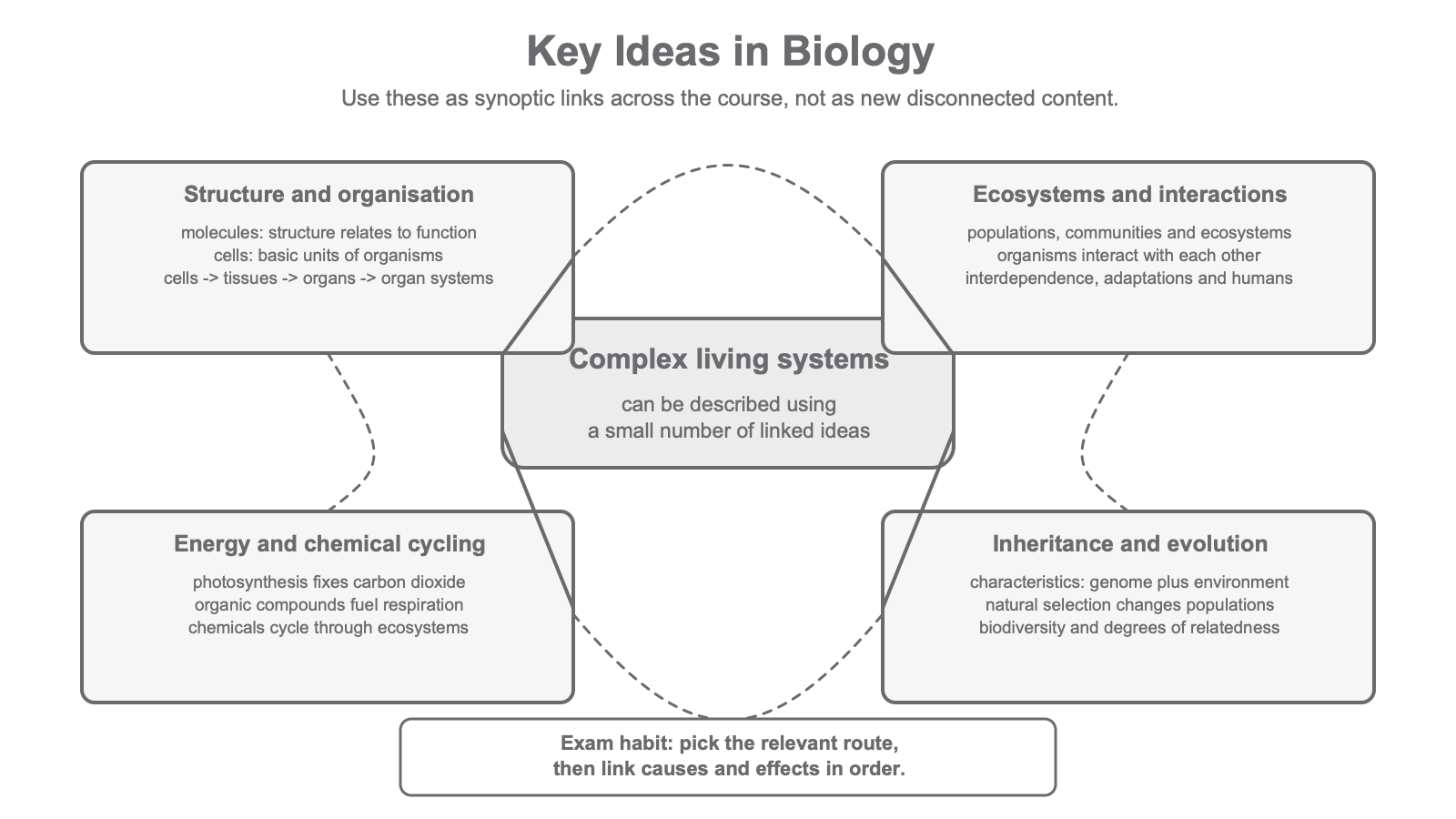
The diagram is a map for thinking, not a list to copy into every answer. In an exam-style explanation, choose the key ideas that fit the question and connect them in a clear biological order.
Molecules, cells and systems
Life processes depend on molecules whose structure is related to their function. This is a biology-wide pattern. DNA has a structure that allows genetic information to be stored and copied, enzymes have active sites related to their substrates, and membrane molecules help control movement into and out of cells. You do not need extra molecular detail here; the key idea is the relationship between structure and function.
Structure-function relationship
A structure-function relationship means that the shape, arrangement or properties of something help it carry out its role.
Cells are the fundamental units of living organisms. A single-celled organism carries out all life processes within one cell, while a multicellular organism uses many specialised cells. Specialised cells can form tissues, tissues can form organs, and organs can work together in organ systems.
| Level | Meaning | Example of the key idea |
|---|---|---|
| Cell | Basic unit of a living organism | A root hair cell is adapted for uptake. |
| Tissue | Group of cells with a similar function | Muscle tissue contracts. |
| Organ | Different tissues working together | The heart pumps blood. |
| Organ system | Organs working together | The circulatory system transports substances. |
This hierarchy explains how small-scale structure supports large-scale function. If cells are damaged, or if a molecule does not have the right structure, the effect can be seen at tissue, organ, organ system or whole-organism level.
Ecosystems and interdependence
Living organisms do not exist in isolation. A population is one species in an area, a community is all the different species in an area, and an ecosystem includes the community plus the non-living environmental conditions.
Population, community and ecosystem
A population is all the organisms of one species in an area. A community is all the populations of different species in an area. An ecosystem is a community interacting with the non-living environment.
Organisms interact with each other, with the environment and with humans. These interactions include feeding relationships, competition, disease, pollination, decomposition, farming, habitat change and conservation. For this key-ideas lesson, the exact example matters less than the biological link: organisms affect each other and are affected by abiotic and biotic factors.
Interdependence means organisms rely on other organisms and on environmental conditions. Adaptations are features that help organisms survive and reproduce in their environment. A good synoptic answer might connect these ideas like this:
environmental condition -> adaptation or interaction -> effect on survival and reproduction -> effect on population or community
Photosynthesis, respiration and cycling
Life on Earth depends on photosynthesis. Green plants and algae trap light from the Sun and use it to fix carbon dioxide. In AQA's key-idea wording, they combine carbon dioxide with hydrogen from water to make organic compounds and oxygen.
Continue this lesson.
You’re previewing NovaLearn without an account. Create a free account to read the rest.
Create free account