4.6.1.2 - Meiosis
Meiosis is the cell division that makes gametes for sexual reproduction. The key GCSE idea is a number-control idea: meiosis halves the chromosome number in gametes, and fertilisation restores the full chromosome number. You need the overall sequence and outcome, not the named stages of meiosis.
Why meiosis is needed
Most cells that grow and repair the body need the normal full set of chromosomes. Gametes are different because they are made for fertilisation. A gamete needs a single set of chromosomes so it can join with another gamete without doubling the chromosome number every generation.
Gamete
A gamete is a sex cell, such as a sperm cell or egg cell in animals.
Cells in reproductive organs divide by meiosis to form gametes. In a model organism, if a cell in a reproductive organ starts with four chromosomes arranged as two pairs, each gamete made by meiosis has two chromosomes: one from each pair.
Meiosis
Meiosis is cell division in reproductive organs that forms gametes with half the normal number of chromosomes.
This is why meiosis is sometimes described as halving chromosome number. In AQA answers, be specific: say the number of chromosomes is halved in gametes, not just that the amount of DNA changes.
Copy and two divisions
When a cell divides to form gametes, copies of the genetic information are made first. The cell then divides twice. The result is four gametes, each with a single set of chromosomes.
The word single is important. A body cell has chromosomes in pairs, but a gamete has one chromosome from each pair. This keeps the chromosome number ready for fertilisation.
[DIAGRAM: asset_name: meiosis-chromosome-number-model: Meiosis halves chromosome number to form gametes - diagram 1; asset_slug: 071_4_6_1_2_meiosis_diagram1; file: diagram_assets/imagegen_regen_all/071_4_6_1_2_meiosis_diagram1_imagegen.png; recommended_method: codex_image_gen; description: Monochrome deterministic chromosome model showing one reproductive-organ cell with two chromosome pairs, copied genetic information, two divisions, and four gametes each with a single set of chromosomes. The diagram uses a simple 2n = 4 to n = 2 model and avoids named meiosis stages.]
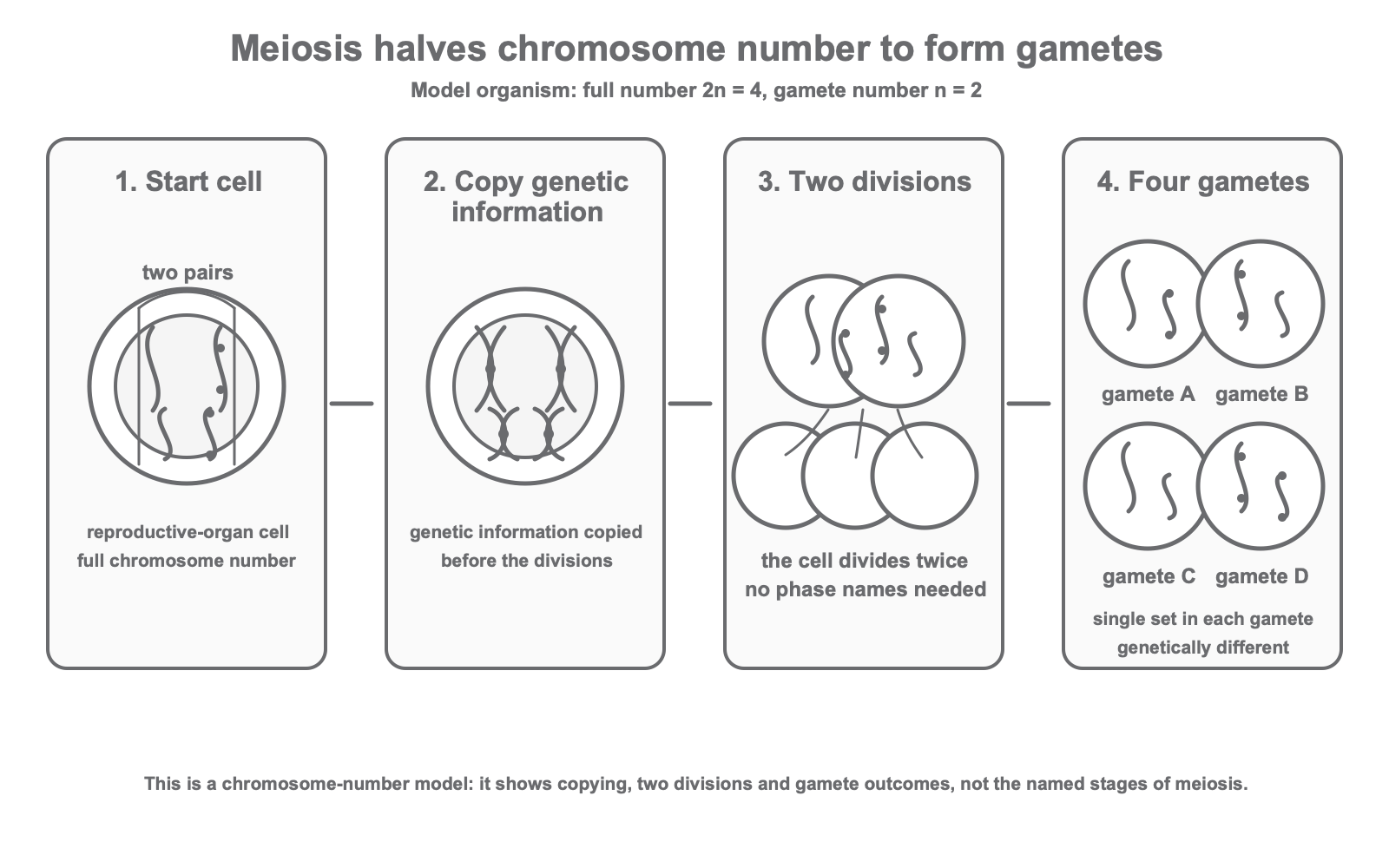
In this model, the starting cell has the full number, 2n = 4. After meiosis, each gamete has n = 2. The diagram is a model of chromosome behaviour, not a list of phase names.
Meiosis copies genetic information, then uses two divisions to produce four gametes, each with a single set of chromosomes.
Genetically different gametes
The gametes produced by meiosis are genetically different from each other. For this lesson, you only need the GCSE outcome and a simple model of how chromosome pairs behave: a random chromosome from each pair can go into a gamete, so gametes can receive different combinations of chromosomes.
Do not turn this into an inheritance cross. You are not working out offspring ratios or a Punnett square here. The assessable idea is that meiosis forms gametes with a single set of chromosomes, and the gametes are genetically different.
The common marking trap is to say only "four cells are made". That is too vague. Add that they are gametes, they have a single set of chromosomes, and they are genetically different.
Fertilisation restores the number
Fertilisation is when gametes join. Because each gamete has a single set of chromosomes, joining two gametes restores the normal full number of chromosomes in the new cell.
Continue this lesson.
You’re previewing NovaLearn without an account. Create a free account to read the rest.
Create free account