4.4.2.2 - Response to Exercise
During exercise, muscle cells contract more often, so they need energy transferred by respiration at a faster rate. The body responds by moving more oxygenated blood to the muscles, but vigorous exercise can still leave the muscles short of oxygen. This lesson follows the AQA boundary for response to exercise: heart and breathing changes, anaerobic respiration in muscles, lactic acid, oxygen debt, muscle fatigue and a simple investigation into exercise responses.
Metabolic demand during exercise
Muscle contraction needs energy. The useful GCSE wording is that respiration transfers energy; do not write that cells "make" or "produce" energy. During exercise, muscle cells contract more frequently and often more forcefully, so the rate of respiration in those cells increases.
This is the in-scope metabolic change: the muscles need more respiration to supply energy for movement. More aerobic respiration requires more oxygen and glucose to reach the muscle cells. It also produces more carbon dioxide, which must be removed from the body.
Metabolic change in exercise
An in-scope change in the rate or type of reactions in muscle cells during exercise, especially an increased rate of respiration and possible anaerobic respiration if oxygen supply is insufficient.
This lesson does not teach the full metabolism topic. It only uses metabolism to explain why exercising muscles need a faster supply of oxygenated blood.
Heart and breathing response
The body reacts to the increased demand for energy by changing the circulatory and breathing systems.
| Change during exercise | Meaning | Why it helps the muscles |
|---|---|---|
| Heart rate increases | The heart beats more times per minute | More oxygenated blood is pumped to the muscles each minute |
| Breathing rate increases | More breaths are taken per minute | More oxygen can enter the lungs each minute |
| Breath volume increases | More air is moved in and out with each breath | More oxygen can be taken in per breath |
These changes work together. Breathing changes increase the amount of oxygen entering the blood at the lungs. The increased heart rate moves that oxygenated blood to the respiring muscle cells faster.
[DIAGRAM: asset_name: exercise-response-and-recovery - diagram 1; asset_slug: 049_4_4_2_2_response_to_exercise_diagram1; file: diagram_assets/imagegen_regen_all/049_4_4_2_2_response_to_exercise_diagram1_imagegen.png; recommended_method: codex_image_gen; description: Monochrome flow diagram showing exercise causing increased muscle contraction and respiration rate, increased heart rate, breathing rate and breath volume supplying more oxygenated blood, insufficient oxygen leading to anaerobic respiration, lactic acid build-up, muscle fatigue, and recovery with continued raised breathing and heart rate. A clearly marked Higher-tier-only box shows lactic acid carried in blood to the liver and converted back into glucose.]
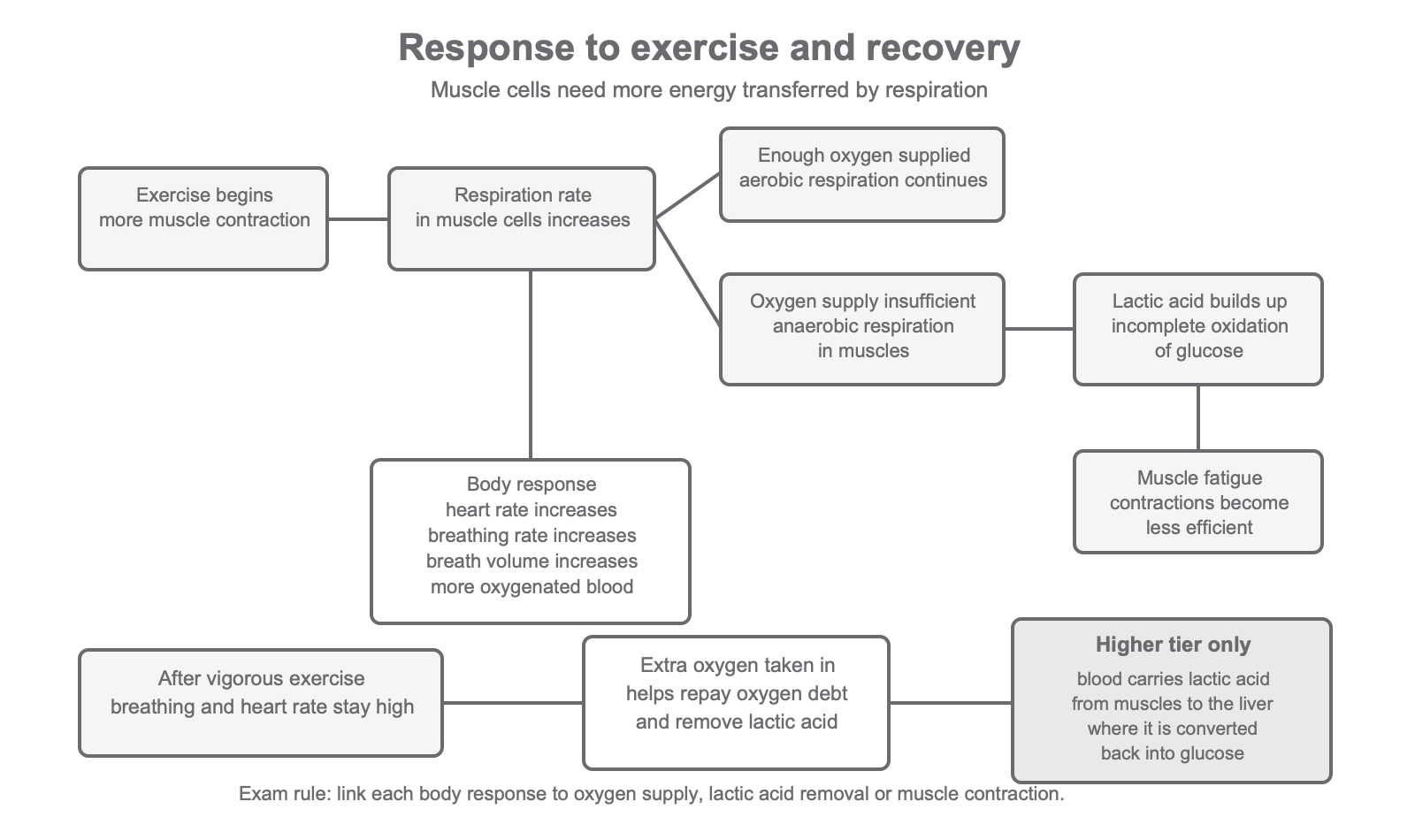
A weak answer says "the heart rate goes up" and stops. A stronger answer links the change to oxygen supply: the heart rate increases so more oxygenated blood is supplied to muscles for respiration.
Anaerobic respiration and lactic acid
If the muscles cannot get enough oxygen for the energy demand, anaerobic respiration takes place in muscle cells. Anaerobic respiration transfers energy without oxygen, but it transfers much less energy than aerobic respiration.
In muscles, anaerobic respiration is represented by:
glucose -> lactic acid
The glucose is not completely oxidised. This incomplete oxidation causes a build-up of lactic acid in the muscles.
Lactic acid
The substance formed in muscle cells during anaerobic respiration when glucose is incompletely oxidised.
During long periods of vigorous activity, lactic acid builds up and muscles become fatigued. Muscle fatigue means the muscles stop contracting efficiently. In an exam answer, "muscle fatigue" or "weaker contractions" is more precise than vague phrases such as "the muscles hurt".
Oxygen debt and recovery
When lactic acid builds up during anaerobic respiration, an oxygen debt is created. After vigorous exercise, breathing rate and heart rate may stay high for a while. This brings extra oxygen into the blood and transports it to the tissues, helping the body recover from the lactic acid build-up.
For all students, the key link is:
anaerobic respiration -> lactic acid builds up -> oxygen debt -> recovery needs extra oxygen
The next definition is Higher-tier-only in this scaffold.
Oxygen debt - HT only
The amount of extra oxygen the body needs after exercise to react with the accumulated lactic acid and remove it from the cells.
For Higher tier, blood flowing through the muscles transports lactic acid to the liver. In the liver, the lactic acid is converted back into glucose. This is why recovery is not just "catching your breath"; it is also a chemical recovery from the lactic acid made during anaerobic respiration.
Continue this lesson.
You’re previewing NovaLearn without an account. Create a free account to read the rest.
Create free account