4.7.2.2 - Water and carbon cycles
Ecosystems keep working because materials are recycled. Carbon, water and mineral ions move between living organisms and the non-living environment, so future organisms can use the same building blocks. In this AQA lesson, the focus is the carbon cycle, the water cycle, and the role of microorganisms; the nitrogen cycle is not required.
Why materials cycle
An ecosystem contains living parts and non-living parts. The living parts are the biotic components, such as plants, animals and microorganisms. The non-living physical and chemical parts are the abiotic components, such as water, carbon dioxide in the air, mineral ions in the soil and the soil itself.
Biotic component
A living part of an ecosystem, such as a plant, animal or microorganism.
Materials do not disappear when an organism dies, produces waste or is eaten. The atoms and ions in its body can be transferred into other organisms or returned to the environment. This recycling provides the building blocks for future organisms.
Abiotic component
A non-living part of an ecosystem, such as water, carbon dioxide, light, soil or mineral ions.
The important exam phrase is cycle through the abiotic and biotic components of an ecosystem. That means the same material can be in the air, soil or water at one stage, then inside living organisms at another stage.
The carbon cycle
Carbon is needed by living organisms because it is part of many biological molecules and the biomass of organisms. In the carbon cycle, carbon dioxide in the atmosphere is taken into plants during photosynthesis. Plants use this carbon to make glucose and other substances that become plant biomass.
Animals obtain carbon when they feed on plants or on other animals. Carbon is returned from organisms to the atmosphere as carbon dioxide when plants, animals and microorganisms respire. Carbon is also returned when dead organisms and waste are broken down by microorganisms during decay.
[DIAGRAM: asset_name: carbon-cycle-materials - diagram 1; asset_slug: 101_4_7_2_2_water_and_carbon_cycles_diagram1; file: diagram_assets/imagegen_regen_all/101_4_7_2_2_water_and_carbon_cycles_diagram1_imagegen.png; recommended_method: codex_image_gen; description: Monochrome carbon-cycle and material-recycling diagram showing atmospheric carbon dioxide taken into plants by photosynthesis, carbon transfer to animals by feeding, respiration returning carbon dioxide from organisms, and microorganisms decomposing dead material and waste to return carbon dioxide to the atmosphere and mineral ions to soil.]
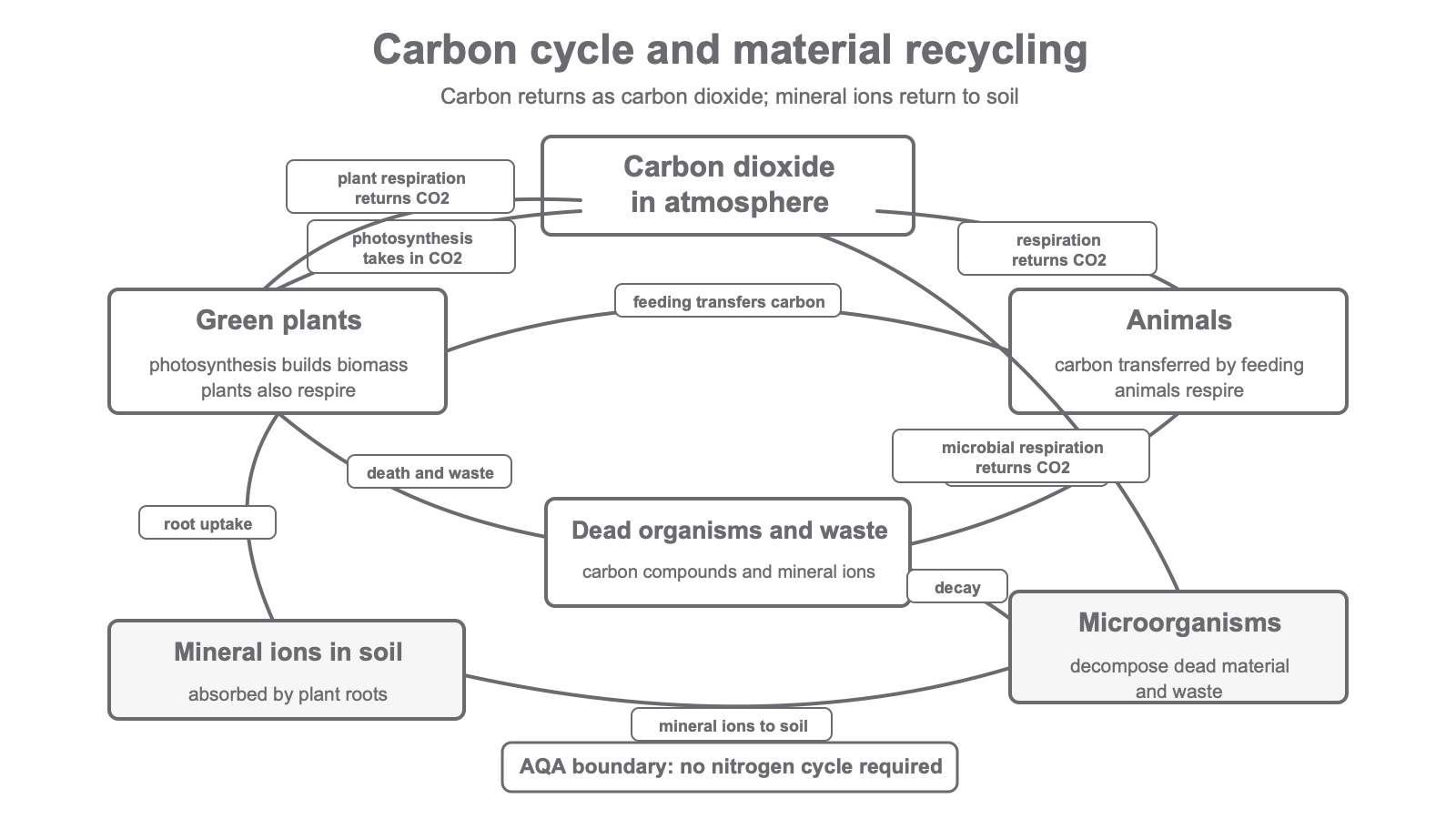
The link to photosynthesis matters. The carbon cycle returns carbon dioxide to the atmosphere so plants can use it again in photosynthesis. This is why carbon cycling helps provide building blocks for future organisms.
Do not turn this lesson into a detailed climate-change or fossil-fuel lesson. AQA 4.7.2.2 only needs the cycling of carbon through organisms and the atmosphere, with microorganisms returning carbon dioxide during material cycling.
The water cycle
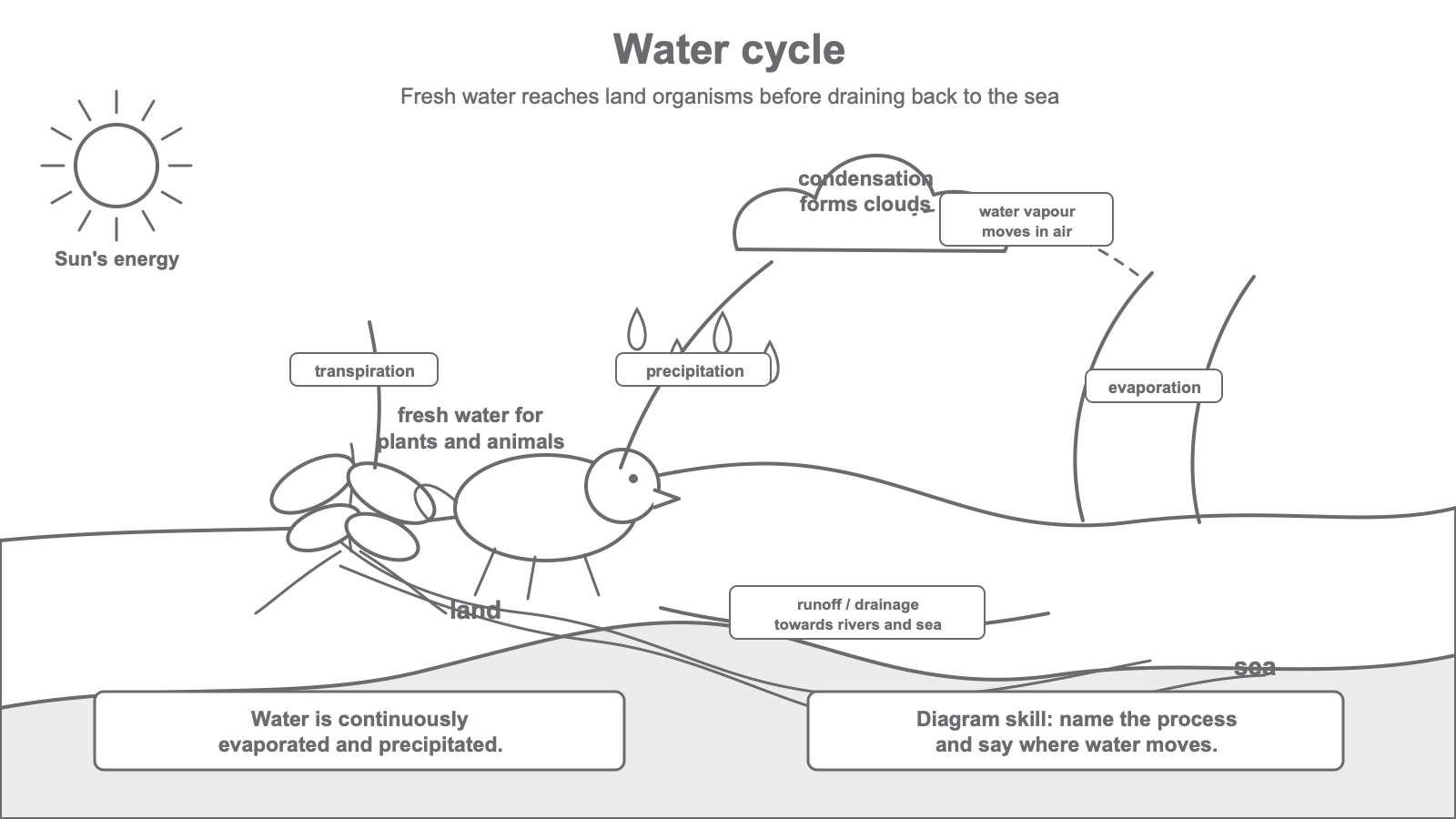
The water cycle moves water between the sea, land, living organisms and the atmosphere. AQA's key idea is that the water cycle provides fresh water for plants and animals on land before the water drains back into the seas.
Water evaporates from bodies of water, especially when energy from the Sun warms the surface. Water vapour cools and condenses to form clouds. Water then falls as precipitation, such as rain, giving fresh water to land ecosystems.
[DIAGRAM: asset_name: water-cycle-fresh-water - diagram 2; asset_slug: 101_4_7_2_2_water_and_carbon_cycles_diagram2; file: diagram_assets/imagegen_regen_all/101_4_7_2_2_water_and_carbon_cycles_diagram2_imagegen.png; recommended_method: codex_image_gen; description: Monochrome water-cycle diagram showing evaporation from sea and surface water, condensation in clouds, precipitation on land, fresh water available to plants and animals, transpiration from plants, and runoff/drainage returning water to rivers and the sea.]
Continue this lesson.
You’re previewing NovaLearn without an account. Create a free account to read the rest.
Create free account