4.4.1.3 - Uses of Glucose from Photosynthesis
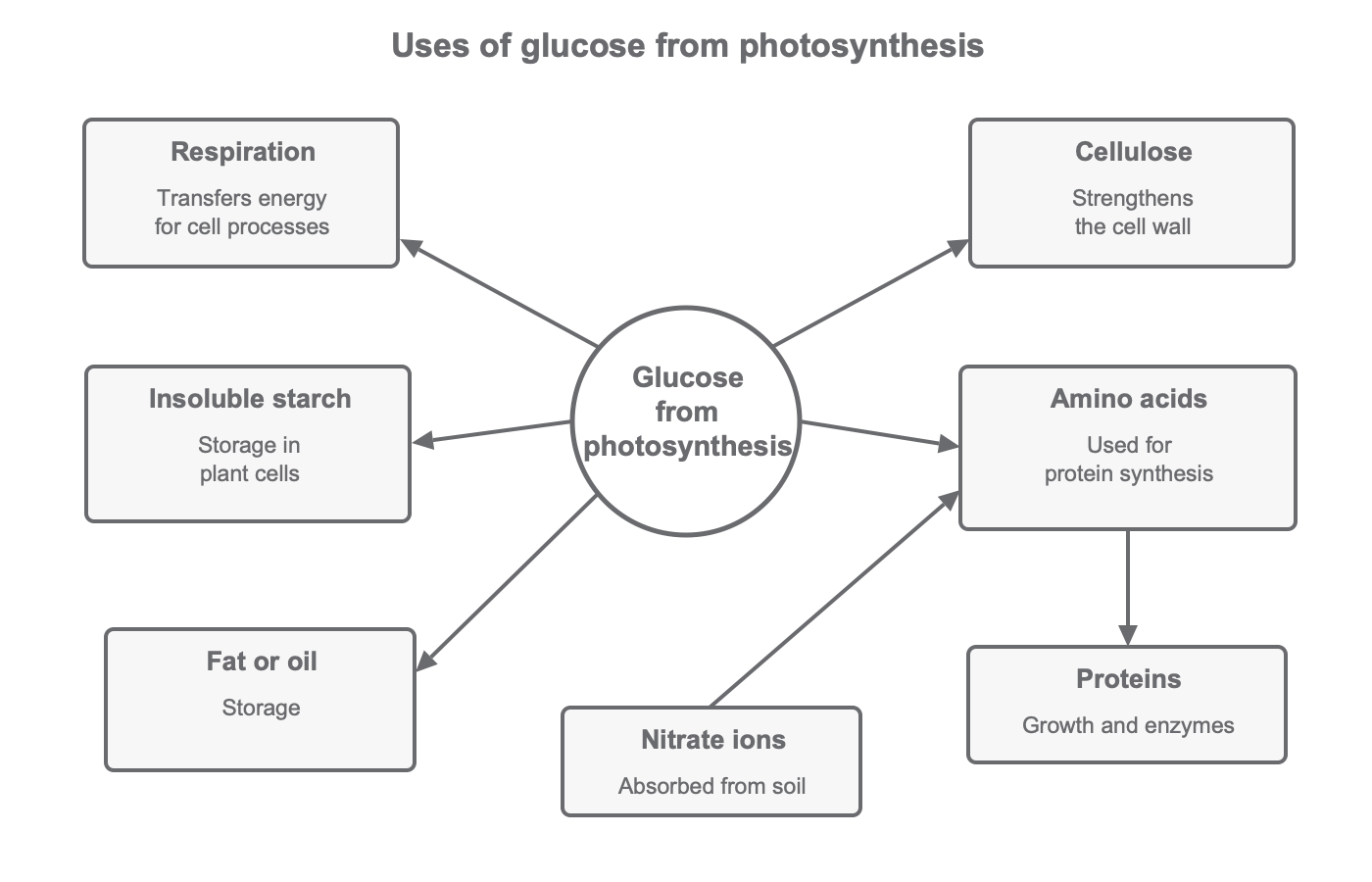
Photosynthesis makes glucose, but a plant does not use that glucose in just one way. Some glucose is used as a fuel in respiration, while some is changed into larger molecules for storage, strength and growth. In this lesson, keep the list exact: respiration, starch, fats or oils, cellulose, and amino acids for protein synthesis with nitrate ions from the soil.
Glucose as a raw material
Glucose is a simple sugar made during photosynthesis. It is useful because plant cells can either break it down in respiration or build it into larger biological molecules.
Glucose
A simple sugar produced in photosynthesis and used by plant cells as a fuel and as a starting material for other substances.
The AQA list for this specification point has five uses. The glucose produced in photosynthesis may be:
| Use of glucose | Main GCSE idea |
|---|---|
| Respiration | Glucose is broken down to transfer energy for cell processes. |
| Insoluble starch | Glucose is converted to starch for storage. |
| Fat or oil | Glucose is used to produce fat or oil for storage. |
| Cellulose | Glucose is used to produce cellulose, which strengthens cell walls. |
| Amino acids | Glucose is used to produce amino acids for protein synthesis, with nitrate ions from the soil. |
[DIAGRAM: asset_name: glucose_fates_flow - diagram 1; asset_slug: 046_4_4_1_3_uses_of_glucose_from_photosynthesis_diagram1; file: diagram_assets/imagegen_regen_all/046_4_4_1_3_uses_of_glucose_from_photosynthesis_diagram1_imagegen.png; recommended_method: codex_image_gen; description: Monochrome flow diagram with glucose from photosynthesis in the centre branching to respiration, insoluble starch storage, fat or oil storage, cellulose strengthening the cell wall, and amino acids to proteins. Show nitrate ions absorbed from soil feeding into the amino acid/protein branch.]
Respiration and starch storage
Plant cells respire. In respiration, glucose is broken down so energy is transferred for cell processes. A strong GCSE answer says energy is transferred or released in respiration, not that energy is made from nothing.
Respiration is needed in plant cells for processes such as making larger molecules, growth and active cell functions. Plants can respire in the light and in the dark because respiration is a cell process, not the same thing as photosynthesis.
Some glucose is converted into insoluble starch for storage. Insoluble means it does not dissolve easily in water. This makes starch a useful storage molecule because it can stay stored in plant cells until the plant needs it.
Starch
An insoluble storage carbohydrate made from glucose.
Starch can later be broken back down to glucose when the plant needs a soluble sugar for respiration or for making other substances.
Cellulose, fats and oils
Glucose is also a building material. Plant cells use glucose to make cellulose, a carbohydrate found in plant cell walls.
Cellulose
A carbohydrate made from glucose that strengthens plant cell walls.
Cellulose is not just another storage molecule. Its main role here is structural: it strengthens the cell wall. Be precise in exam answers and write cell wall, not cell membrane.
Continue this lesson.
You’re previewing NovaLearn without an account. Create a free account to read the rest.
Create free account