4.7.1.2 - Abiotic factors
Abiotic factors are the non-living conditions in an environment. In AQA GCSE Biology, the key skill is not just naming these factors, but explaining how a change in one of them could affect organisms in a given community. You should also be able to use data in charts, graphs and tables to support that explanation.
Abiotic factors and communities
A community is all the populations of different species living together in a habitat. An abiotic factor is a non-living physical or chemical part of the environment that can affect those organisms.
Abiotic factor
A non-living factor in an environment that can affect organisms in a community.
Abiotic factors include conditions such as light, temperature, water availability and oxygen concentration. These factors can affect whether organisms survive, grow and reproduce successfully.
Keep the boundary clear. A predator, pathogen or food source is a living factor, so it is a biotic factor, not an abiotic factor. This lesson focuses only on the non-living factors from AQA section 4.7.1.2.
Named abiotic factors
AQA names seven abiotic factors that can affect a community. Learn the list, but also learn how each one could link to survival, growth or reproduction.
[DIAGRAM: asset_name: abiotic-factor-map - diagram 1; asset_slug: 096_4_7_1_2_abiotic_factors_diagram1; file: diagram_assets/imagegen_regen_all/096_4_7_1_2_abiotic_factors_diagram1_imagegen.png; recommended_method: codex_image_gen; description: Monochrome concept map showing a community in a habitat affected by the seven AQA abiotic factors: light intensity, temperature, moisture levels, soil pH and mineral content, wind intensity and direction, carbon dioxide levels for plants, and oxygen levels for aquatic animals.]
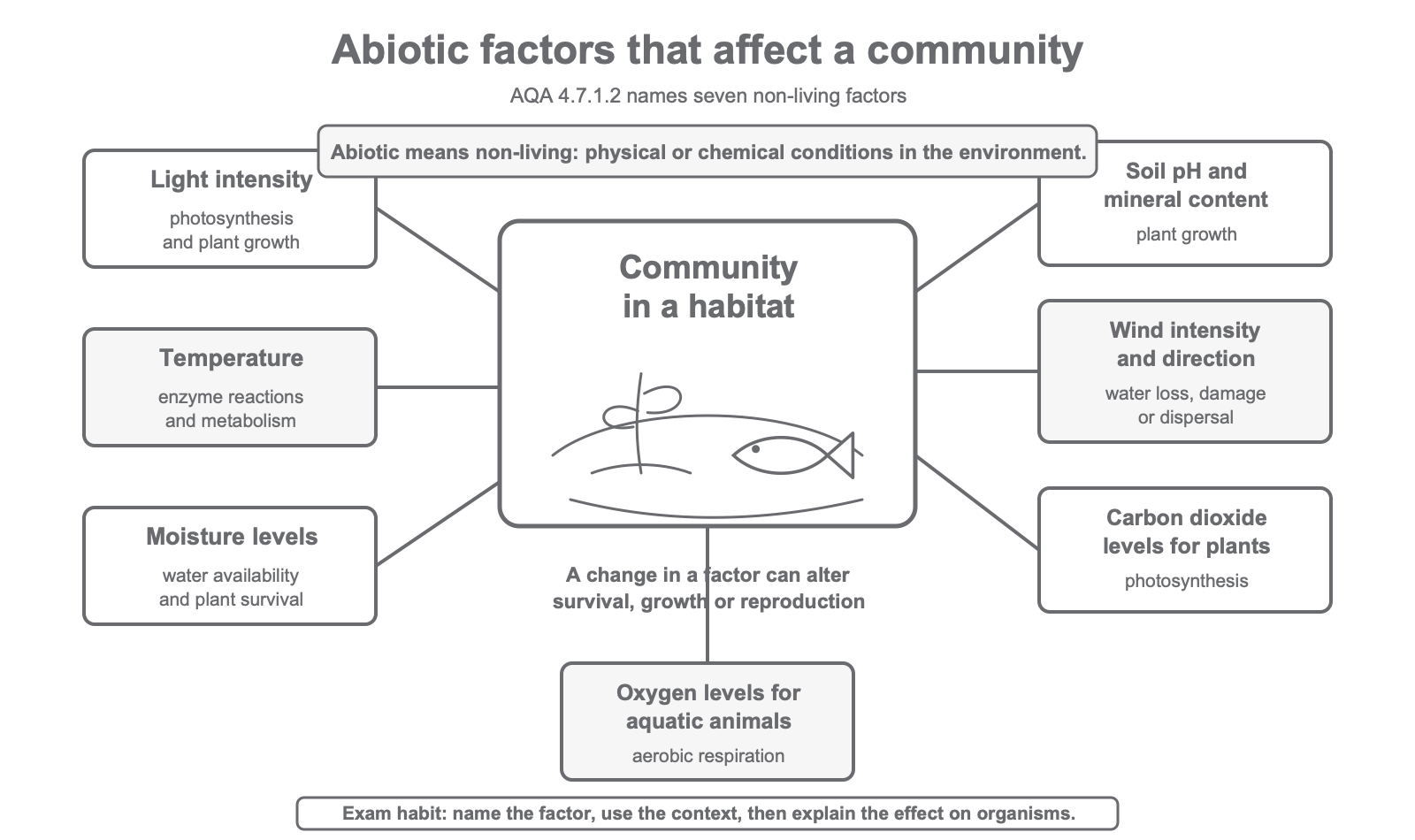
| Abiotic factor | How it could affect organisms |
|---|---|
| Light intensity | Affects the rate of photosynthesis in plants, so it can affect plant growth and abundance. |
| Temperature | Affects enzyme-controlled reactions and metabolic rate, so very low or high temperatures can reduce survival or reproduction. |
| Moisture levels | Affects water availability; low moisture can reduce plant growth and survival. |
| Soil pH and mineral content | Affects plant growth because mineral ions are needed for healthy growth, and soil pH can affect which plants grow well. |
| Wind intensity and direction | Can increase water loss from plants, damage exposed plants, or affect where pollen and seeds are carried. |
| Carbon dioxide levels for plants | Carbon dioxide is needed for photosynthesis, so low carbon dioxide can limit plant growth. |
| Oxygen levels for aquatic animals | Aquatic animals need dissolved oxygen for aerobic respiration, so low oxygen can reduce their survival. |
Notice the exam wording: oxygen levels for aquatic animals and carbon dioxide levels for plants. Do not swap them by accident.
Explaining community effects
To explain an abiotic change, build a chain of reasoning. Start with the factor, link it to a biological need or process, then say how this changes the population or community.
A useful answer chain is:
- The abiotic factor changes.
- This affects a process or resource needed by organisms.
- Survival, growth or reproduction changes.
- The population size or distribution of one or more species changes.
- The community changes because the relative abundance of species is different.
For example, if light intensity decreases under a dense tree canopy, some low-growing plants may photosynthesise less. They may grow more slowly and produce fewer seeds, so their population may decrease. Shade-tolerant plants might become more common if the context or data shows that they grow better in lower light.
In a pond, a decrease in dissolved oxygen can affect aquatic animals because they need oxygen for aerobic respiration. If oxygen becomes too low, fewer fish or invertebrates may survive, so the animal community changes.
Continue this lesson.
You’re previewing NovaLearn without an account. Create a free account to read the rest.
Create free account