4.7.1.1 - Communities and Interdependence
Ecology studies how organisms live with each other and with their environment. In this lesson, the important move is scale: a single organism is not the same as a population, a community is not the same as an ecosystem, and an ecosystem includes both living and non-living parts. Once those levels are clear, competition and interdependence become easier to explain in AQA-style answers.
Levels of organisation
Ecologists describe living things at different levels. Each level includes the one before it, but adds something new.
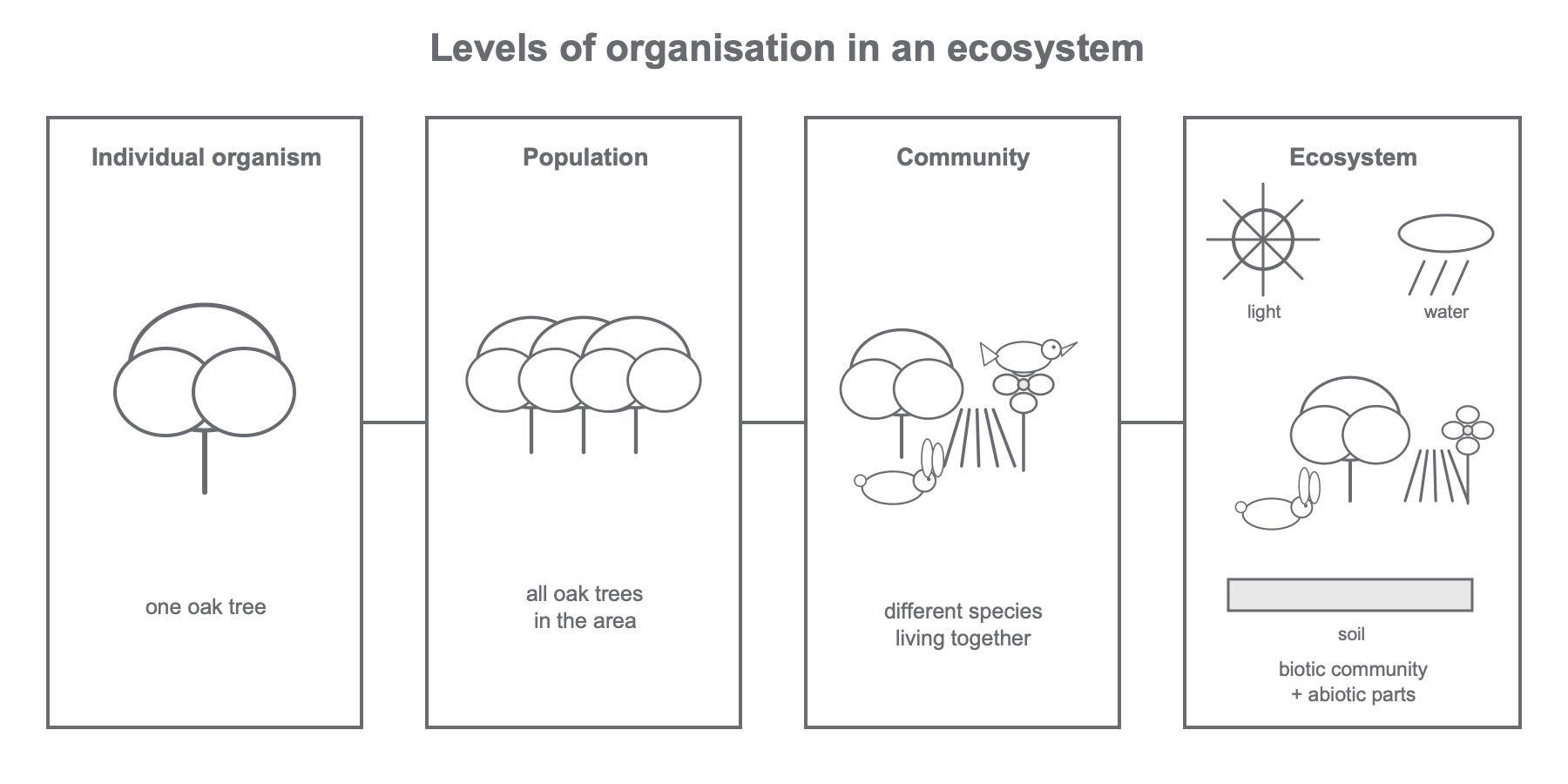
Individual organism
One single living thing, such as one oak tree, one bee or one rabbit.
A population is all the organisms of one species living in the same area at the same time. For example, all the oak trees in a woodland are one population of oak trees.
A community is all the populations of different species living and interacting in the same habitat. A woodland community could include oak trees, grasses, fungi, insects, birds and mammals.
Ecosystem
An ecosystem is the interaction of a community of living organisms with the non-living parts of their environment.
The living parts of an ecosystem are called biotic parts. The non-living parts are called abiotic parts, such as light, water, soil and temperature. A whole ecosystem therefore includes the community and the physical conditions around it.
[DIAGRAM: asset_name: levels_of_organisation; title: Levels of organisation in an ecosystem - diagram 1; asset_slug: 095_4_7_1_1_communities_and_interdependence_diagram1; file: diagram_assets/imagegen_regen_all/095_4_7_1_1_communities_and_interdependence_diagram1_imagegen.png; recommended_method: codex_image_gen; description: Four linked panels showing an individual organism, a population, a community and an ecosystem with biotic and abiotic parts labelled.]
Competition for resources
Organisms need materials and conditions from their surroundings to survive and reproduce. When a resource is limited, organisms that need the same resource compete for it.
Competition
Competition is the interaction between organisms that need the same limited resource.
Plants often compete with each other for:
- light
- space
- water from the soil
- mineral ions from the soil
Animals often compete with each other for:
- food
- mates
- territory
In an exam, a question may give you a habitat and ask what the organisms are competing for. Use the information in the stem. If plants are growing close together under a tree canopy, the likely competition is for light and space. If animals defend an area where they nest or feed, the likely competition is for territory, food or mates.
Worked example:
Several small plants are growing close together on a dry sand dune. Their leaves overlap and the soil contains very little water. Suggest two resources these plants may be competing for.
Good answer:
The plants may compete for light because their leaves overlap. They may also compete for water because the soil is dry.
That answer earns credit because each resource is linked to evidence in the question.
Interdependence in a community
Species in a community do not live as separate, independent units. They depend on each other for resources or services. This dependence between species is called interdependence.
Examples of interdependence include:
- one species using another species as a source of food
- animals using plants or other organisms for shelter
- insects pollinating flowering plants
- animals dispersing seeds after eating fruit
Continue this lesson.
You’re previewing NovaLearn without an account. Create a free account to read the rest.
Create free account