4.3.1.3 - Bacterial Diseases
Bacterial diseases are infectious diseases caused by bacteria. This lesson focuses on the two named examples in this specification point: Salmonella food poisoning and gonorrhoea. The exam skill is to connect each disease to its bacterium, route of spread, symptoms and control method without drifting into other pathogen examples.
Two named examples
A bacterium is one bacterial cell. Bacteria is the plural word. In this lesson, both diseases are caused by bacteria, but they spread in different ways and are controlled in different ways.
| Disease | What causes it? | Main route of spread in this lesson |
|---|---|---|
| Salmonella food poisoning | Salmonella bacteria | Bacteria are ingested in food, or on food prepared in unhygienic conditions |
| Gonorrhoea | A bacterium | Sexual contact |
The key exam habit is to name the disease and then write the matching detail. Do not write that all bacterial diseases spread by food, and do not write that all bacterial diseases are sexually transmitted.
Bacterial disease
An infectious disease caused by bacteria.
Use that definition first, then add the named disease details around it.
Salmonella food poisoning
Salmonella food poisoning is spread when Salmonella bacteria are ingested, which means swallowed. This can happen when food contains the bacteria, or when food is prepared in unhygienic conditions so bacteria are transferred onto it.
The required symptom list is precise: fever, abdominal cramps, vomiting and diarrhoea. These symptoms are caused by the bacteria and by the toxins the bacteria secrete. A toxin is a poison made by a living organism.
Toxin
A poison produced by a living organism, such as a bacterium.
The disease route and the symptom cause are linked: the bacteria are swallowed, then bacteria and toxins cause the illness.
In the UK, poultry are vaccinated against Salmonella to control the spread. For this lesson, the important idea is the purpose of vaccination in the food chain: fewer Salmonella bacteria in poultry means a lower chance of Salmonella reaching food that humans eat. The detailed mechanism of vaccination is taught in a later specification point.
Gonorrhoea symptoms and spread
Gonorrhoea is a sexually transmitted disease, or STD. It is caused by a bacterium and is spread by sexual contact.
The required symptoms are a thick yellow or green discharge from the vagina or penis and pain on urinating. Keep these symptoms separate from vomiting, fever and abdominal cramps, which belong to Salmonella food poisoning, not gonorrhoea.
Sexually transmitted disease
An infectious disease that can be spread by sexual contact.
[DIAGRAM: asset_name: bacterial-diseases-comparison - diagram 1; asset_slug: 032_4_3_1_3_bacterial_diseases_diagram1; file: diagram_assets/imagegen_regen_all/032_4_3_1_3_bacterial_diseases_diagram1_imagegen.png; recommended_method: codex_image_gen; description: Monochrome two-column flowchart comparing Salmonella food poisoning and gonorrhoea using only the specification details: bacterial cause, spread route, key symptoms and spread-control methods.]
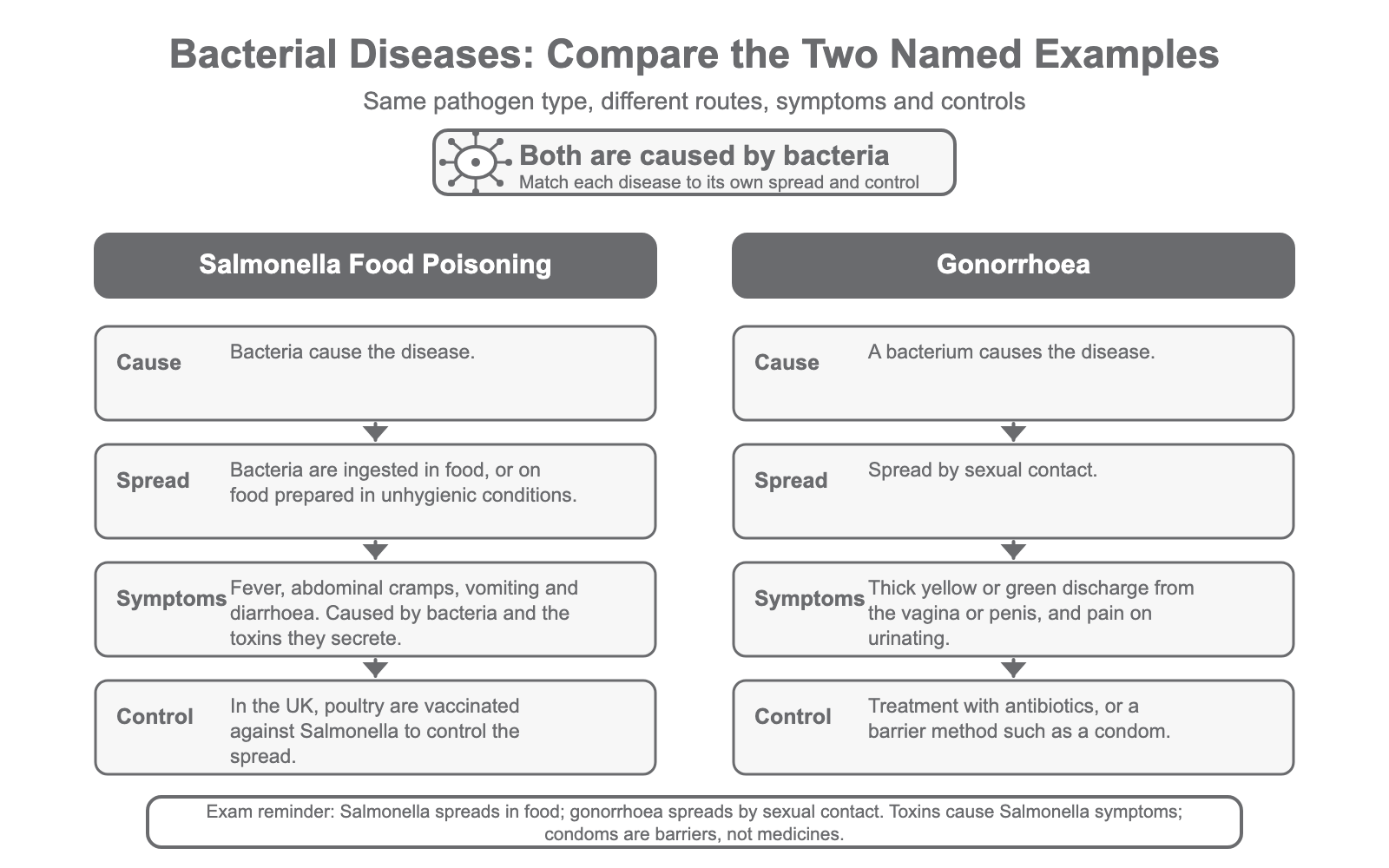
Use the comparison to keep the bacterial cause the same, but the spread route and symptoms different.
Continue this lesson.
You’re previewing NovaLearn without an account. Create a free account to read the rest.
Create free account