4.6.1.7a - Inherited Disorders
Some disorders are inherited because particular alleles are passed from parents to offspring. In this lesson, the two AQA examples are polydactyly and cystic fibrosis. The main job is to connect each disorder to the correct allele pattern: dominant for polydactyly, recessive for cystic fibrosis.
Disorders and alleles
An inherited disorder is a disorder that can be caused by alleles inherited from parents. An allele is a different form of a gene. If an allele affects a characteristic or body process, inheriting that allele can affect the phenotype.
Inherited disorder
A disorder caused by the inheritance of certain alleles.
AQA names two examples in this specification point:
| Inherited disorder | AQA description | Allele pattern |
|---|---|---|
| Polydactyly | Having extra fingers or toes | Caused by a dominant allele |
| Cystic fibrosis | A disorder of cell membranes | Caused by a recessive allele |
This lesson deliberately keeps the medical description short. For GCSE Biology, the assessed idea is how the allele is inherited, not broader clinical detail.
Polydactyly and dominant inheritance
Polydactyly is caused by a dominant allele. A dominant allele is expressed even if only one copy is present. In a simple GCSE genetic cross, you can use P for the dominant polydactyly allele and p for the allele for not having polydactyly.
Dominant allele
An allele that is expressed in the phenotype even if only one copy is present.
This gives three possible genotypes:
| Genotype | Phenotype |
|---|---|
PP | polydactyly |
Pp | polydactyly |
pp | no polydactyly |
The key point is that Pp has polydactyly because the dominant P allele is present. In this simple GCSE model, a person does not silently "carry" a dominant polydactyly allele without showing the dominant phenotype.
[DIAGRAM: asset_name: polydactyly-dominant-cross - diagram 1; asset_slug: 077_4_6_1_7a_inherited_disorders_diagram1; file: diagram_assets/077_4_6_1_7a_inherited_disorders_diagram1.png; recommended_method: deterministic_drawn; description: Monochrome Punnett-style grid showing a heterozygous parent with polydactyly, Pp, crossed with a parent without polydactyly, pp. Gametes P and p are crossed with p and p. Offspring genotypes are Pp, Pp, pp and pp, giving 50 percent polydactyly and 50 percent no polydactyly.]
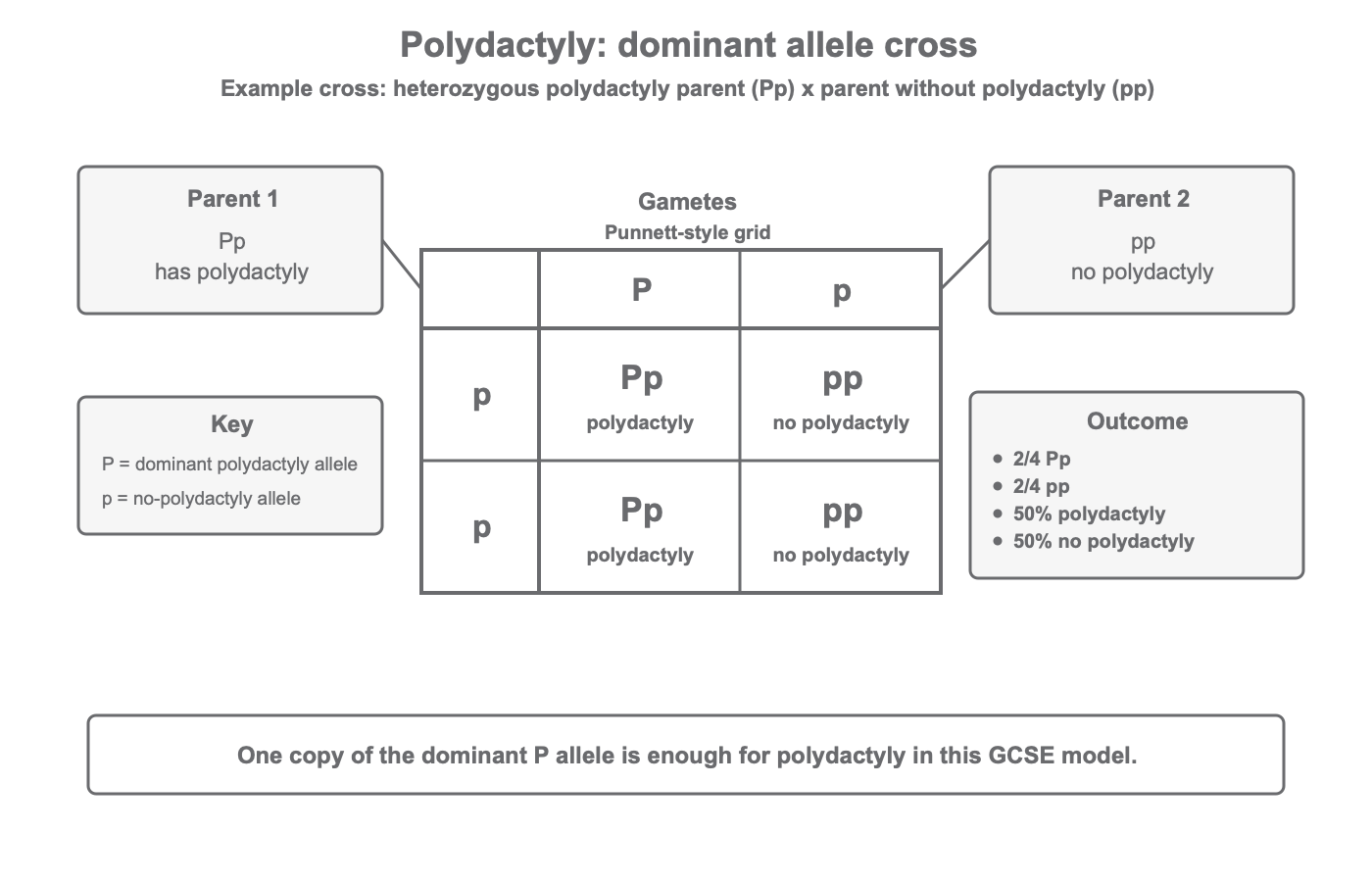
Worked example:
A parent with polydactyly has genotype Pp. The other parent does not have polydactyly, so has genotype pp.
The first parent can pass on P or p. The second parent can only pass on p. The possible offspring genotypes are Pp, Pp, pp and pp. Two out of four outcomes show polydactyly, so the probability is 2/4 = 1/2 = 50%.
Cystic fibrosis and recessive inheritance
Cystic fibrosis is caused by a recessive allele. A recessive allele is only expressed if two copies are present and no dominant allele is present. In a simple GCSE genetic cross, you can use F for the dominant allele for not having cystic fibrosis and f for the recessive cystic fibrosis allele.
Recessive allele
An allele that is expressed in the phenotype only when two copies are present and no dominant allele is present.
This gives three possible genotypes:
| Genotype | Phenotype |
|---|---|
FF | does not have cystic fibrosis |
Ff | carrier; does not have cystic fibrosis |
ff | has cystic fibrosis |
A carrier has one recessive cystic fibrosis allele but does not have cystic fibrosis because the dominant F allele is present. Carriers matter in recessive inheritance because two carrier parents can have a child who inherits f from both parents.
[DIAGRAM: asset_name: cystic-fibrosis-recessive-cross - diagram 2; asset_slug: 077_4_6_1_7a_inherited_disorders_diagram2; file: diagram_assets/077_4_6_1_7a_inherited_disorders_diagram2.png; recommended_method: deterministic_drawn; description: Monochrome Punnett-style grid showing two cystic fibrosis carrier parents, Ff and Ff. Gametes F and f from each parent produce offspring genotypes FF, Ff, Ff and ff, giving 25 percent unaffected non-carrier, 50 percent unaffected carrier and 25 percent cystic fibrosis.]
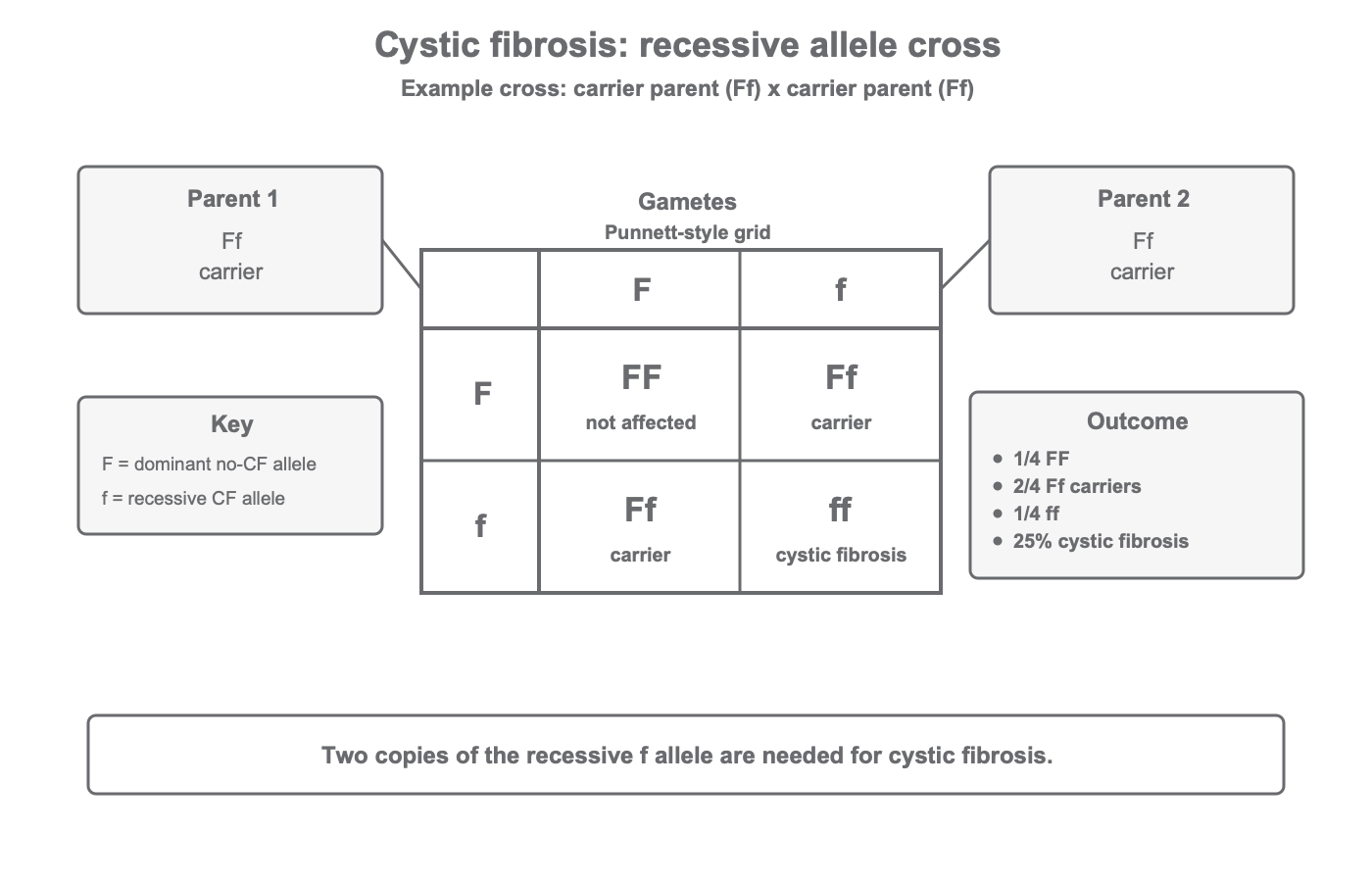
Worked example:
Continue this lesson.
You’re previewing NovaLearn without an account. Create a free account to read the rest.
Create free account