4.7.3.5 - Global warming
Global warming means a rise in the average temperature of the Earth. For AQA GCSE Biology, the key cause to know is that levels of carbon dioxide and methane in the atmosphere are increasing, and these gases contribute to global warming. The biology in this lesson is about consequences for living organisms, ecosystems and scientific evidence, not about memorising detailed climate models.
What global warming means
Global warming is the increase in the Earth's average temperature. It is linked to the greenhouse effect: some gases in the atmosphere absorb infrared radiation that would otherwise escape from Earth to space.
Global warming
Global warming is the rise in the average temperature of the Earth, linked to increased levels of greenhouse gases in the atmosphere.
Carbon dioxide and methane are greenhouse gases. AQA names them because their levels in the atmosphere are increasing and they contribute to global warming. A stronger greenhouse effect means more energy is retained in the Earth system, so average temperatures rise.
Do not write that greenhouse gases "make heat" or "destroy the ozone layer". In this GCSE Biology point, the safer wording is: carbon dioxide and methane are increasing, they trap more infrared radiation, and this contributes to global warming.
From gases to consequences
The exam often rewards a clear chain of cause and effect. Start with the named gases, then link them to warming, then describe a biological consequence.
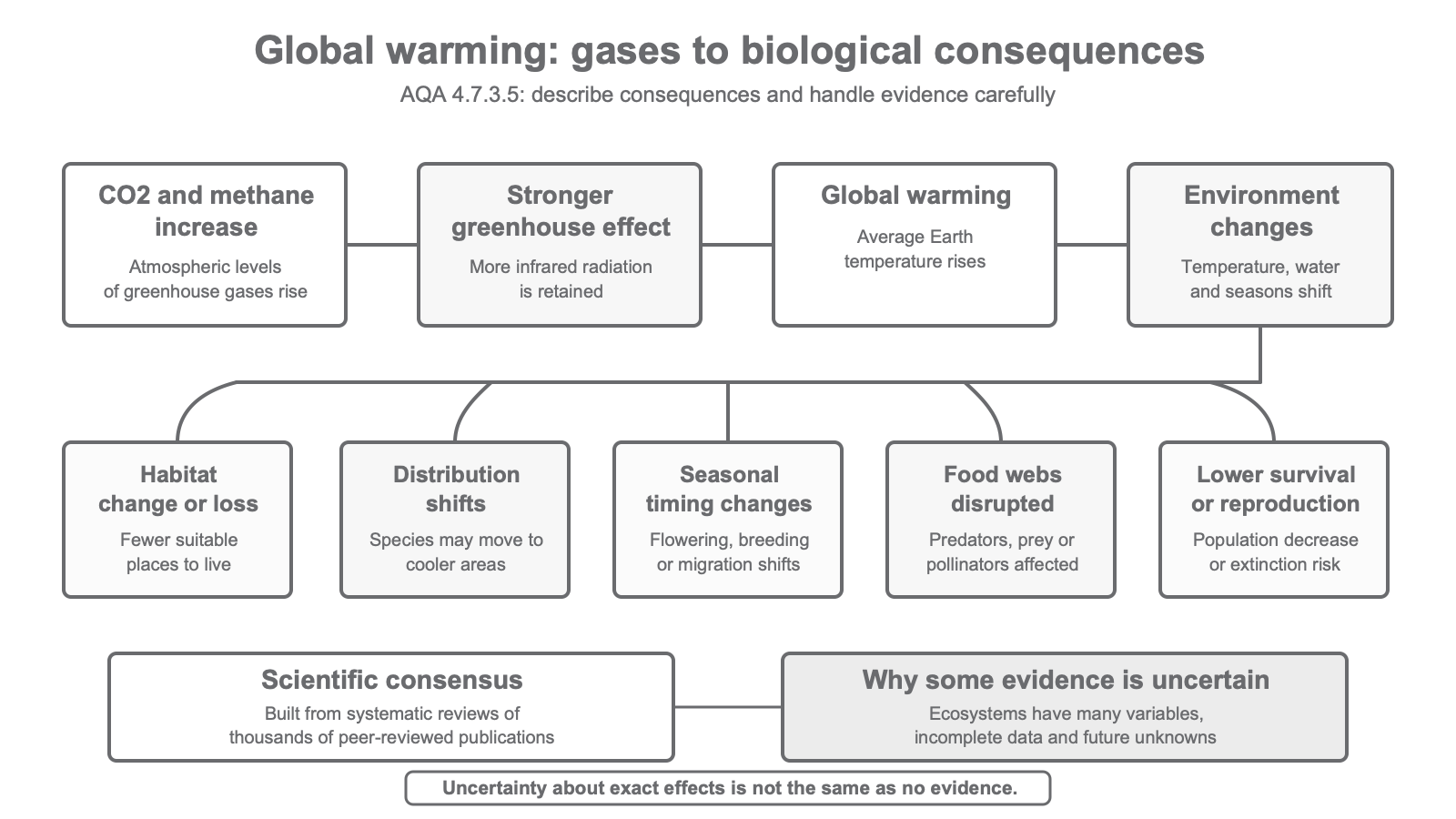
[DIAGRAM: asset_name: greenhouse-gases-to-biological-consequences - diagram 1; asset_slug: 109_4_7_3_5_global_warming_diagram1; file: diagram_assets/imagegen_regen_all/109_4_7_3_5_global_warming_diagram1_imagegen.png; recommended_method: codex_image_gen; description: Monochrome flow diagram showing increasing atmospheric carbon dioxide and methane strengthening the greenhouse effect, causing global warming, then leading to biological consequences including habitat change or loss, shifts in species distribution, changed seasonal timing, disrupted food webs or pollination, reduced survival or reproduction, and possible extinction risk. Include a note that scientific consensus comes from reviewed evidence while exact effects can be uncertain in complex ecosystems.]
The biological consequence must involve living things. For example, "sea level rises" is a climate or physical consequence by itself. It becomes a biological consequence when you link it to flooding of coastal habitats, loss of nesting sites, death of plants that cannot tolerate salt water, or reduced survival of organisms in that habitat.
For this specification point, the useful exam chain is: increasing carbon dioxide and methane -> stronger greenhouse effect -> global warming -> consequences for organisms and ecosystems.
A good answer does not need to name every possible consequence. It needs a few accurate biological consequences and clear cause-effect links.
Biological consequences
Global warming can affect organisms because temperature, water availability and seasonal conditions are part of an organism's environment. If the environment changes faster than a population can survive, move or reproduce successfully, the population may decrease.
Some biological consequences you can safely describe are:
| Consequence | Biological link |
|---|---|
| Habitats change or are lost | Organisms may lose shelter, nesting sites, food sources or suitable conditions for survival. |
| Species distributions shift | Some species may move towards cooler regions or higher altitudes if those habitats are available. |
| Seasonal timing changes | Flowering, breeding, migration or insect emergence may happen earlier or later, so interacting species may no longer match. |
| Food webs are disrupted | If one population decreases, predators, prey, pollinators or food plants linked to it may also be affected. |
| Extinction risk increases | Species that cannot survive, reproduce, move or adapt quickly enough may disappear from an area or become extinct. |
The word distribution means where a species is found. In this lesson you only need broad description of consequences; the detailed Higher-tier skill of evaluating distribution changes from given data belongs to a different specification point.
Warmer conditions can also increase heat stress, drought stress, wildfire risk and damage to marine ecosystems. These are useful only when you connect them to survival, reproduction, population size, biodiversity or habitat.
Continue this lesson.
You’re previewing NovaLearn without an account. Create a free account to read the rest.
Create free account