4.6.3.7 - Resistant Bacteria
Bacteria can evolve rapidly because they reproduce quickly. In this lesson, the key idea is natural selection in a bacterial population: a mutation can produce a strain that is not killed by an antibiotic, so that strain survives, reproduces and spreads. The lesson also covers MRSA and the ways antibiotic-resistant strains can be slowed down, while keeping clinical treatment detail out of scope.
Rapid bacterial evolution
Evolution means a change in the inherited characteristics of a population over time. Bacteria can evolve rapidly because they reproduce at a fast rate, so there can be many bacterial generations in a short time.
Fast reproduction matters because any inherited change that helps a bacterium survive can be copied into many offspring quickly. One bacterium with a useful mutation can produce many descendants carrying the same useful change.
Mutation
A mutation is a change in genetic material that can produce a new characteristic.
In this specification point, the mutation is important because it can produce a new strain of a bacterial pathogen. A strain is a type or variety within a species of bacterium. Different strains may not respond to the same antibiotic in the same way.
Resistant strains
Mutations of bacterial pathogens can produce new strains. Some strains might be resistant to an antibiotic, meaning the antibiotic does not kill them.
Antibiotic-resistant strain
An antibiotic-resistant strain is a strain of bacteria that is not killed by an antibiotic that would normally kill susceptible bacteria.
Be precise about the cause. The antibiotic does not make a bacterium deliberately change because it needs to survive. Instead, mutation produces variation. When an antibiotic is used, susceptible bacteria are killed, but bacteria with a resistance mutation are not killed.
[DIAGRAM: asset_name: resistant-bacteria-selection-flow - diagram 1; asset_slug: 093_4_6_3_7_resistant_bacteria_diagram1; file: diagram_assets/imagegen_regen_all/093_4_6_3_7_resistant_bacteria_diagram1_imagegen.png; recommended_method: codex_image_gen; description: Monochrome flow diagram showing a mixed bacterial population with mostly susceptible bacteria and one resistant mutant, antibiotic treatment killing susceptible bacteria, resistant bacteria surviving, surviving resistant bacteria reproducing so the resistant strain population rises, and the resistant strain spreading because people are not immune and there is no effective treatment. Keep the visual within AQA 4.6.3.7 and do not include detailed molecular resistance mechanisms.]
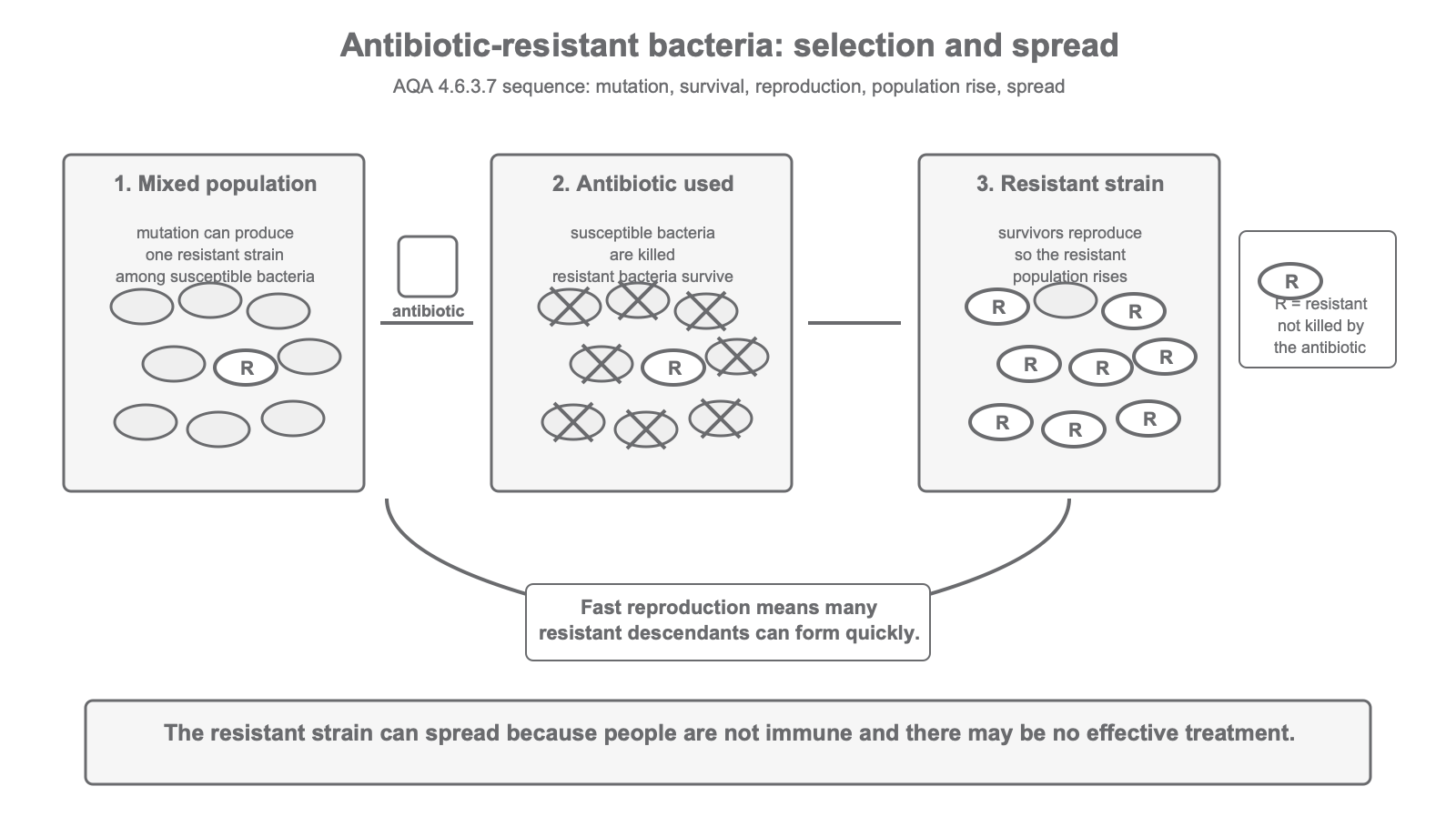
This is natural selection. The antibiotic is a selection pressure because it changes which bacteria are most likely to survive and reproduce. The resistant bacteria have the advantage in the antibiotic-treated environment.
After explaining it, check that your answer has the order: mutation, antibiotic selection, survival, reproduction, population rise.
Spread and MRSA
Once the population of a resistant strain rises, the strain can spread. AQA gives two reasons why this is especially serious: people are not immune to the resistant strain, and there may be no effective treatment.
MRSA is the named example in this specification point. For GCSE Biology, the key point is simple: MRSA is resistant to antibiotics.
MRSA is an example of an antibiotic-resistant bacterial strain.
Do not write that the person is resistant to antibiotics. The bacteria are resistant. If resistant bacteria cause disease, the usual antibiotic may not kill them, so the infection can be harder to treat and the resistant strain can spread to other people.
Continue this lesson.
You’re previewing NovaLearn without an account. Create a free account to read the rest.
Create free account