4.3.1.8 - Antibiotics and Painkillers
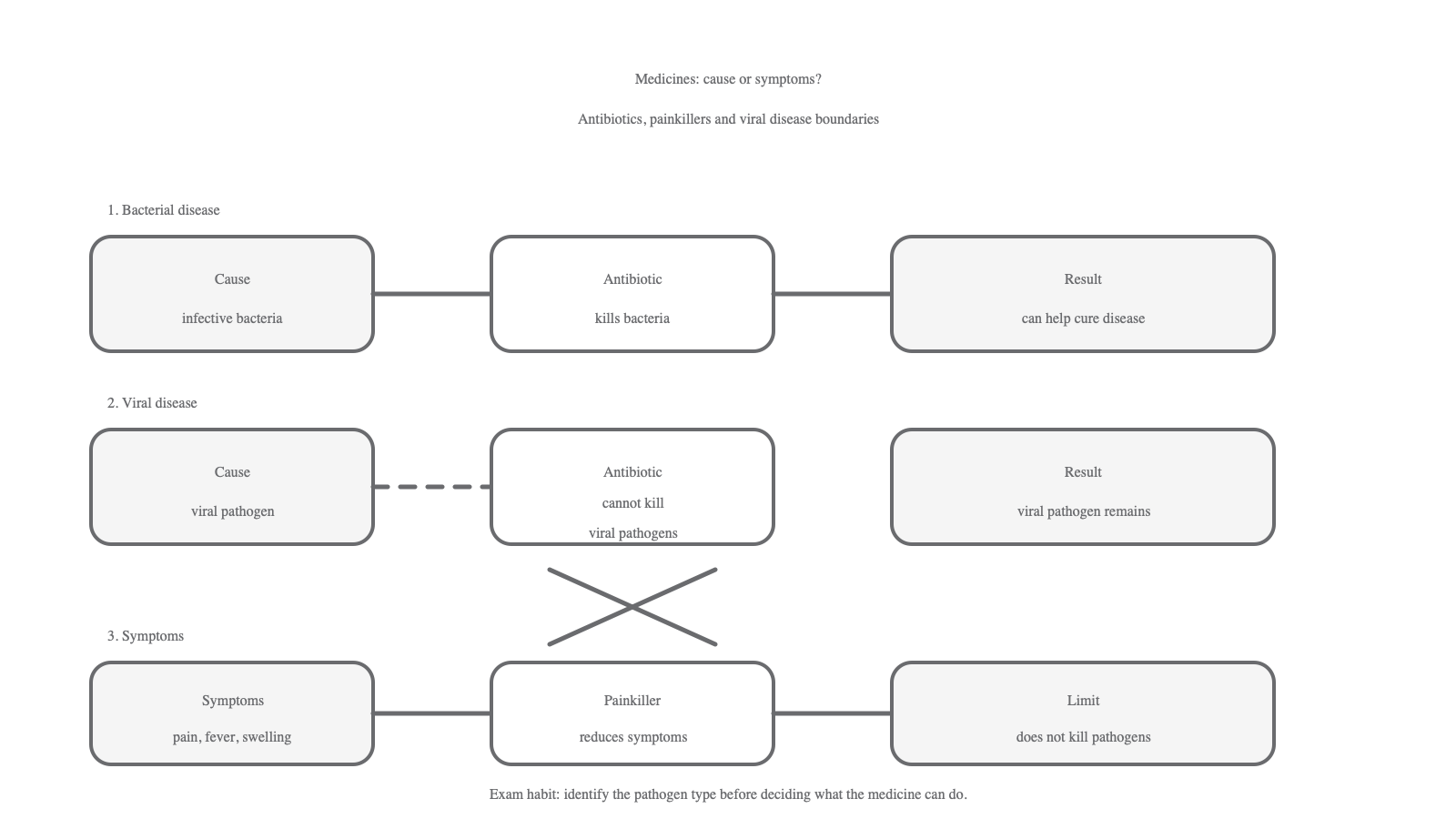
Medicines can help with disease in different ways. Some medicines act on the cause of a disease, while others reduce symptoms so the person feels better. In this lesson, keep the boundary precise: antibiotics act on bacterial disease, painkillers act on symptoms, and viral pathogens are not killed by antibiotics.
Treating the cause or the symptoms
A disease can have a cause and it can have symptoms. In communicable disease, the cause is the pathogen. Symptoms are the effects the person notices or measures, such as pain, fever or inflammation.
Pathogen
A microorganism that causes infectious disease.
Some medicines help to treat the cause of disease by acting on the pathogen. Other medicines treat symptoms. This distinction is one of the most important ideas in this specification point.
Painkillers are used to reduce pain and some other symptoms. For example, ibuprofen is a painkiller that can help relieve pain, inflammation and fever. Painkillers do not kill the pathogen causing the disease.
Treating symptoms can make a person feel better, but it does not automatically remove the pathogen causing the disease.
[DIAGRAM: asset_name: medicine-targets-boundary - diagram 1; asset_slug: 037_4_3_1_8_antibiotics_and_painkillers_diagram1; file: diagram_assets/imagegen_regen_all/037_4_3_1_8_antibiotics_and_painkillers_diagram1_imagegen.png; recommended_method: codex_image_gen; description: Monochrome boundary map comparing bacterial disease, viral disease and symptoms: antibiotics kill infective bacteria in bacterial disease; antibiotics do not kill viral pathogens; painkillers reduce symptoms but do not kill pathogens.]
Antibiotics kill infective bacteria
Antibiotics are medicines used to help cure bacterial disease. AQA gives penicillin as an example. In this lesson, the key wording is that antibiotics help cure bacterial disease by killing infective bacteria inside the body.
Antibiotic
A medicine that helps to cure bacterial disease by killing infective bacteria inside the body.
Antibiotics are not all interchangeable. It is important that specific bacteria are treated by specific antibiotics. If the wrong antibiotic is used, it may not kill the bacteria causing the infection.
This is why an exam answer should not just say "give medicine". A stronger answer names the type of medicine and the type of pathogen it acts on: an antibiotic can be used for a bacterial disease because it kills infective bacteria.
Benefits and resistant strains
The use of antibiotics has greatly reduced deaths from infectious bacterial diseases. This is a major technological application of biology: understanding bacteria has allowed medicines to be used to treat diseases that were once much more dangerous.
There is also a serious concern. Some strains of bacteria are resistant to antibiotics. A resistant strain is a type of bacterium that is not killed by an antibiotic that would normally be used against that bacterial disease.
Continue this lesson.
You’re previewing NovaLearn without an account. Create a free account to read the rest.
Create free account