4.6.3.6 - Extinction
Extinction is the end point for a species: there are no living individuals of that species left. In this lesson, the key GCSE skill is not to list random disasters, but to describe how a factor can reduce survival or successful breeding until a population reaches zero.
What extinction means
AQA defines extinction very precisely. A species is extinct when there are no remaining individuals of that species still alive. A species that is rare, endangered or hard to find is not extinct if at least one living individual remains.
Extinction
Extinction occurs when there are no remaining individuals of a species still alive.
The word species matters because extinction is about a whole species, not just one local population. If a plant disappears from one woodland but still survives elsewhere, that is not extinction of the species. If every living individual of that species has died, the species is extinct.
In exam answers, avoid vague phrases such as "nearly gone" or "there are not many left". Those phrases describe a species at risk, not a species that is already extinct.
How factors lead to extinction
A factor contributes to extinction if it makes the number of living individuals in a species fall and not recover. The usual route is that more individuals die, fewer individuals survive to reproduce, or fewer offspring survive. If this continues, the population becomes smaller over generations.
The final step is extinction only when the number of living individuals reaches zero. This is why strong GCSE answers link a factor to survival or breeding, rather than just naming the factor.
[DIAGRAM: asset_name: extinction-factor-flow - diagram 1; asset_slug: 092_4_6_3_6_extinction_diagram1; file: diagram_assets/imagegen_regen_all/092_4_6_3_6_extinction_diagram1_imagegen.png; recommended_method: codex_image_gen; description: Monochrome flow diagram showing factors such as environmental change, habitat loss, new predators or disease, stronger competition, over-exploitation and catastrophic events leading to reduced survival or successful breeding, then falling population size, then no living individuals of the species.]
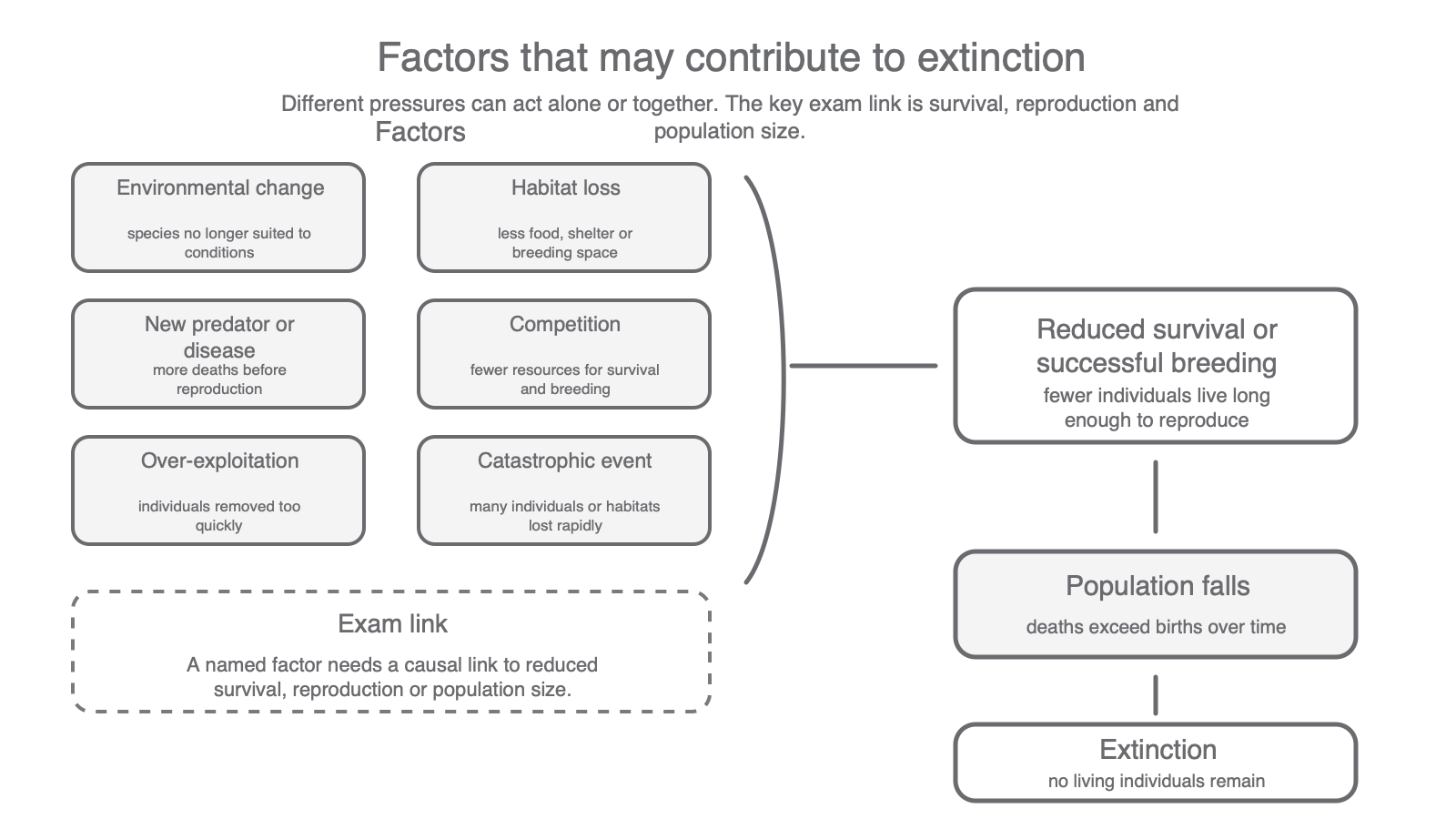
Several factors can act together. For example, habitat loss may leave fewer places to feed and breed, and a new disease may then spread through the small remaining population. AQA asks for factors which may contribute to extinction, so the answer can describe more than one pressure.
After explaining it, check that your answer links the factor to population size. That link is what turns a named factor into a description.
Natural and biological factors
Some extinction factors are natural or biological. They do not have to be caused by humans, although human activity can make some of them worse.
| Factor | How it may contribute to extinction |
|---|---|
| Environmental change | A change in temperature, rainfall, sea level or another abiotic factor may mean the species is no longer suited to its habitat. |
| New predator | If a new predator appears, more individuals may be eaten before they can reproduce. |
| New disease or pathogen | A disease may kill individuals or reduce their ability to survive and breed. |
| Stronger competition | Another species may compete more successfully for food, space, mates or other resources. |
| Catastrophic event | A sudden event, such as a major asteroid impact, volcanic eruption, fire or flood, may destroy habitats or kill many individuals quickly. |
Notice the wording: may contribute. A single factor does not always cause extinction by itself. It contributes when it reduces the species' chance of maintaining a living population.
Continue this lesson.
You’re previewing NovaLearn without an account. Create a free account to read the rest.
Create free account