4.6.3.1 - Theory of evolution
Charles Darwin proposed the theory of evolution by natural selection after observations on a round-the-world expedition, followed by years of experimentation, discussion and links with geology and fossils. This Biology-only lesson explains the theory at AQA GCSE depth, why Darwin's ideas were gradually accepted, and how Lamarck's idea of inherited acquired characteristics differs. A study of creationism or detailed later evolution-and-inheritance content is outside this lesson boundary.
Darwin and a developing theory
Darwin did not produce the theory of evolution by natural selection from one observation. AQA describes it as a theory that developed over time. Darwin made observations during a round-the-world expedition, then linked those observations with years of experimentation and discussion.
The theory was also linked to developing knowledge of geology and fossils. Geology suggested that Earth had changed over long periods of time, and fossils showed that organisms from the past were not always the same as organisms living today.
Darwin published his ideas in On the Origin of Species in 1859. For AQA, the important science-history point is that the theory developed from information gathered over time, including information from many scientists, rather than appearing as a finished idea all at once.
[DIAGRAM: asset_name: darwin-theory-development-timeline - diagram 1; asset_slug: 087_4_6_3_1_theory_of_evolution_diagram1; file: diagram_assets/imagegen_regen_all/087_4_6_3_1_theory_of_evolution_diagram1_imagegen.png; recommended_method: codex_image_gen; description: Monochrome timeline showing Darwin's round-the-world observations, years of experimentation and discussion linked to geology and fossils, publication of On the Origin of Species in 1859, and gradual acceptance as more evidence and inheritance knowledge developed. Keep the visual within the 4.6.3.1 theory-of-evolution boundary.]
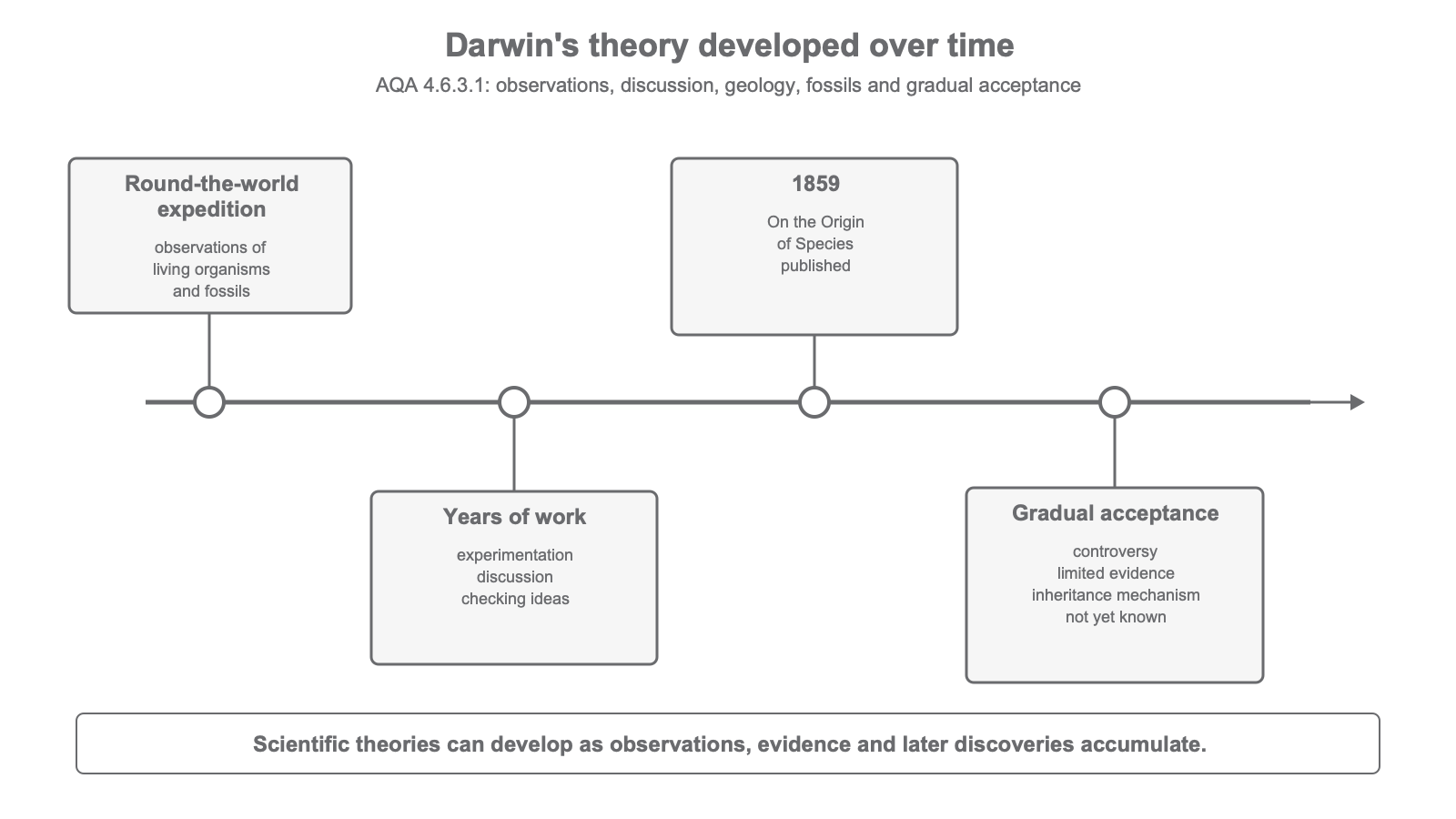
The word theory here means a scientific explanation supported by evidence and reasoning. It does not mean a casual guess. Darwin's explanation was controversial, but it was still a scientific proposal based on observations and evidence.
Natural selection process
Natural selection explains how inherited characteristics can become more common in a species over generations. The starting point is variation: individual organisms within a particular species show a wide range of differences for a characteristic.
Variation
Differences between individual organisms within a species.
Some individuals have characteristics that are more suited to the environment. These individuals are more likely to survive and breed successfully. If the helpful characteristic can be passed on, their offspring are more likely to inherit it.
Over many generations, the characteristic that helped survival and successful breeding may become more common in the species. The individual organisms do not choose to change during their lifetime; selection acts on variation that already exists among individuals.
[DIAGRAM: asset_name: natural-selection-sequence - diagram 2; asset_slug: 087_4_6_3_1_theory_of_evolution_diagram2; file: diagram_assets/imagegen_regen_all/087_4_6_3_1_theory_of_evolution_diagram2_imagegen.png; recommended_method: codex_image_gen; description: Monochrome flow diagram of the AQA natural selection sequence: variation within a species, some individuals have characteristics more suited to the environment, these individuals are more likely to survive and breed successfully, and the useful characteristics are passed to the next generation.]
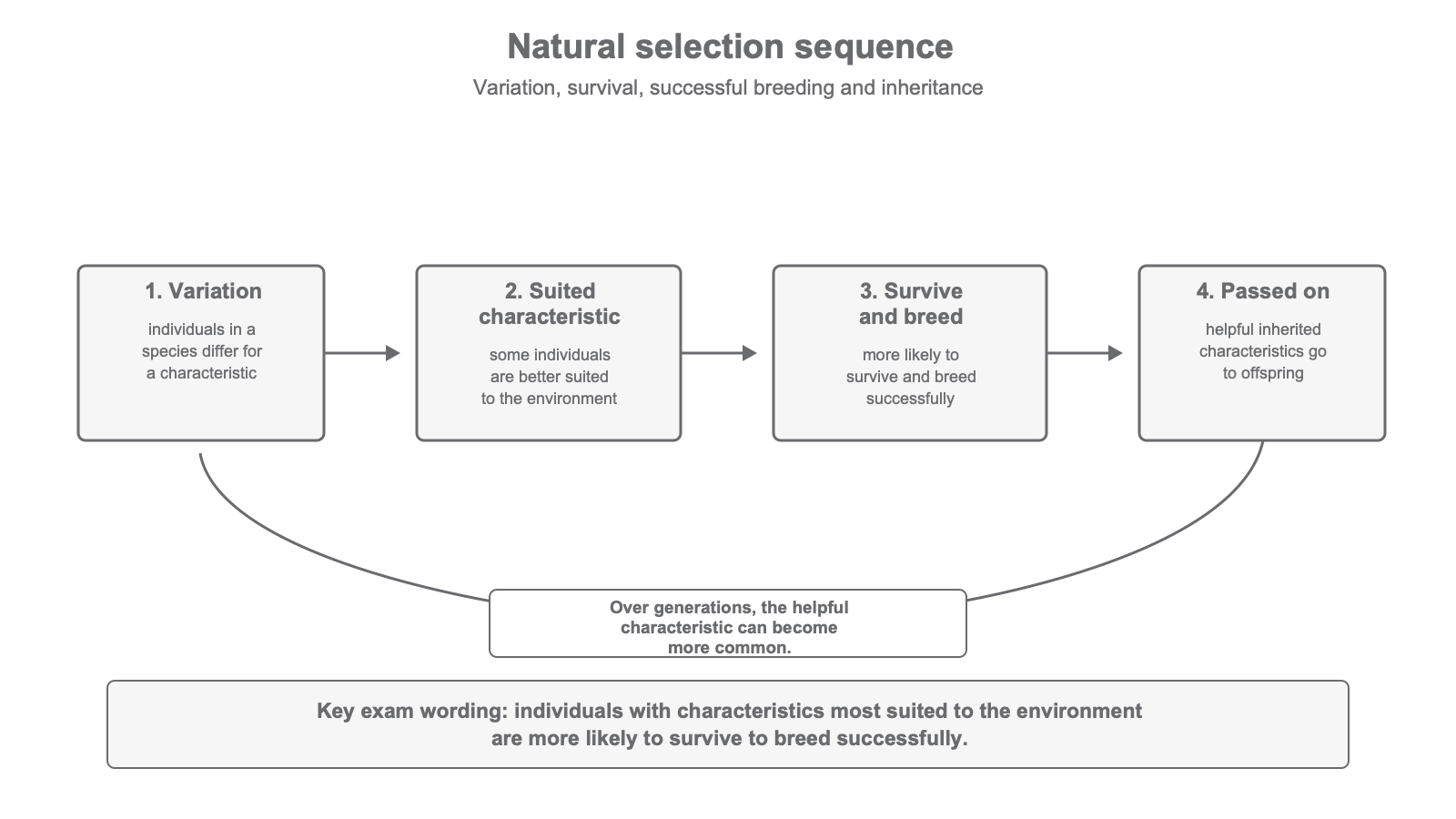
In exam answers, the phrase survive to breed successfully matters. Survival alone is not enough for natural selection to affect the next generation. The characteristic must be passed on through reproduction.
After explaining it, check that your answer starts with variation and ends with inheritance. That order is the backbone of AQA natural-selection explanations.
What selection does not mean
Natural selection is often misunderstood. It does not mean that an individual organism decides to change because it needs to survive. It also does not mean that the "strongest" organism always survives; the selected characteristic is whichever inherited characteristic makes survival and successful breeding more likely in that environment.
For example, an organism may be better suited because of camouflage, disease resistance, a feeding structure or tolerance of dry conditions. The exact example can change, but the mark-scheme pattern stays the same: variation, environmental suitability, survival and successful breeding, then inheritance.
The characteristic must also be inherited. A scar, a larger muscle from training, or a damaged body part may affect an individual during its life, but these changes are not usually passed on to offspring. That distinction prepares you for Lamarck's theory later in the lesson.
Natural selection acts on inherited variation between individuals; it does not describe an individual deliberately changing during its lifetime.
Use precise wording. Better adapted or better suited to the environment is stronger than vague answers such as "better" or "more evolved".
Continue this lesson.
You’re previewing NovaLearn without an account. Create a free account to read the rest.
Create free account