4.3.1.5 - Protist Diseases - Malaria
Some communicable diseases are caused by protists. In this specification point, the named example is malaria. The key exam idea is not the detailed biology of the malaria parasite: it is that malaria is caused by a protist pathogen, spread using a mosquito vector, and controlled by reducing mosquito bites and mosquito breeding.
Malaria is caused by a protist
Malaria is a communicable disease caused by a protist pathogen. Protists are eukaryotic organisms; some protists can cause disease. For this lesson, you only need the example that the pathogens which cause malaria are protists.
Protist pathogen
A disease-causing protist.
The mosquito is not the pathogen. The mosquito is involved in spreading the pathogen from one human host to another. A strong answer separates the cause of the disease from the organism that spreads it: malaria is caused by a protist, and mosquitoes act as vectors.
The mosquito vector
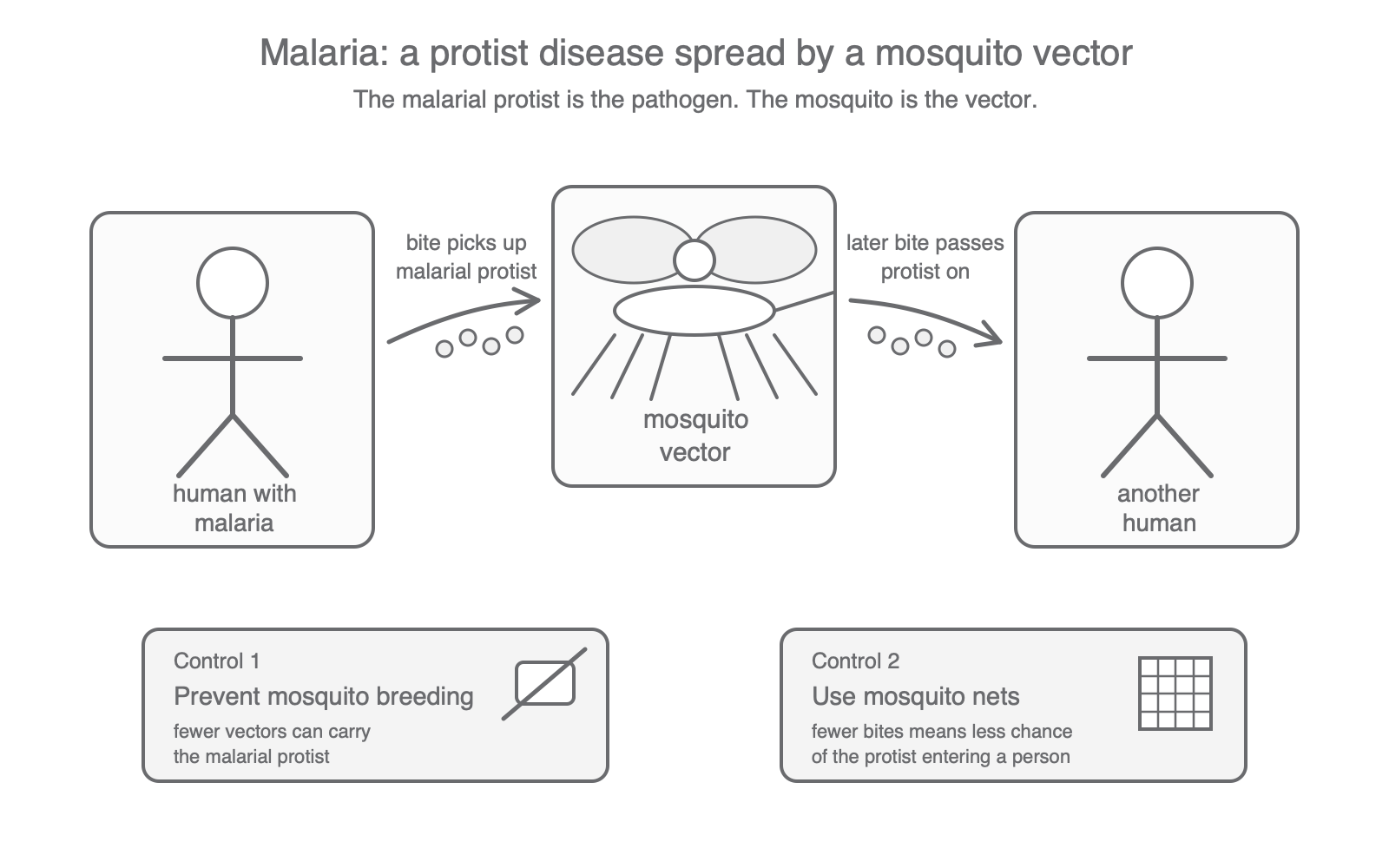
A vector is an organism that carries a pathogen from one host to another. In malaria, the mosquito is the vector because the malarial protist has a life cycle that includes the mosquito.
Vector
An organism that spreads a pathogen from one host to another.
A simple GCSE pathway is:
- A mosquito bites a person who has malaria.
- The mosquito takes in the malarial protist.
- Later, the mosquito bites another person.
- The malarial protist is passed into that person, so the disease can spread.
Malaria is therefore not spread like a cold or flu by casual contact or cough droplets. The assessed route here is through a mosquito vector.
[DIAGRAM: asset_name: malaria-vector-lifecycle - diagram 1; asset_slug: 034_4_3_1_5_protist_diseases_diagram1; file: diagram_assets/imagegen_regen_all/034_4_3_1_5_protist_diseases_diagram1_imagegen.png; recommended_method: codex_image_gen; description: Monochrome flow diagram showing the malarial protist moving between an infected human, a mosquito vector and another human, with control points for mosquito nets and preventing mosquito breeding.]
Fever and fatal disease
Malaria causes recurrent episodes of fever. Recurrent means the episodes come back repeatedly rather than happening just once.
Recurrent
Happening repeatedly or returning again after a period of time.
The specification also says malaria can be fatal. That means malaria can cause death. At GCSE level, this is enough medical detail for this row: you do not need to learn the detailed organ damage, diagnostic tests or drug treatments for malaria.
Continue this lesson.
You’re previewing NovaLearn without an account. Create a free account to read the rest.
Create free account