4.6.4 - Classification of living organisms
Classification is the system scientists use to organise living things into groups. In this lesson, the important GCSE idea is not just learning a list of groups; it is understanding that classification systems change when biological evidence improves. You will meet the traditional Linnaean system, the binomial naming system, Carl Woese's three-domain system, and evolutionary trees.
Classifying by shared features
Living things can be grouped by their structure and characteristics. Structure means what an organism or its cells are like; characteristics are features the organism shows, such as body plan, cell type, feeding method or other observable features.
Traditionally, living things were classified using a system developed by Carl Linnaeus. Linnaeus grouped organisms by similarities and differences that could be observed. This gave scientists a common way to organise organisms and communicate about them.
Classification
The organisation of living things into groups based on shared features.
Classification is useful because it reduces confusion. Instead of treating every organism as a separate fact to memorise, scientists can ask which group it belongs to and what features members of that group usually share.
Linnaean system and binomial names
The Linnaean system is hierarchical. That means it is arranged in levels, from very broad groups to very specific groups.
The order required for this specification is:
| Broad to specific | Linnaean group |
|---|---|
| 1 | kingdom |
| 2 | phylum |
| 3 | class |
| 4 | order |
| 5 | family |
| 6 | genus |
| 7 | species |
[DIAGRAM: asset_name: linnaean-hierarchy-and-binomial-name - diagram 1; asset_slug: 094_4_6_4_classification_of_living_organisms_diagram1; file: diagram_assets/imagegen_regen_all/094_4_6_4_classification_of_living_organisms_diagram1_imagegen.png; recommended_method: codex_image_gen; description: Monochrome hierarchy diagram showing kingdom, phylum, class, order, family, genus and species from broadest to most specific, with a side callout that the binomial name uses genus plus species, for example Homo sapiens.]
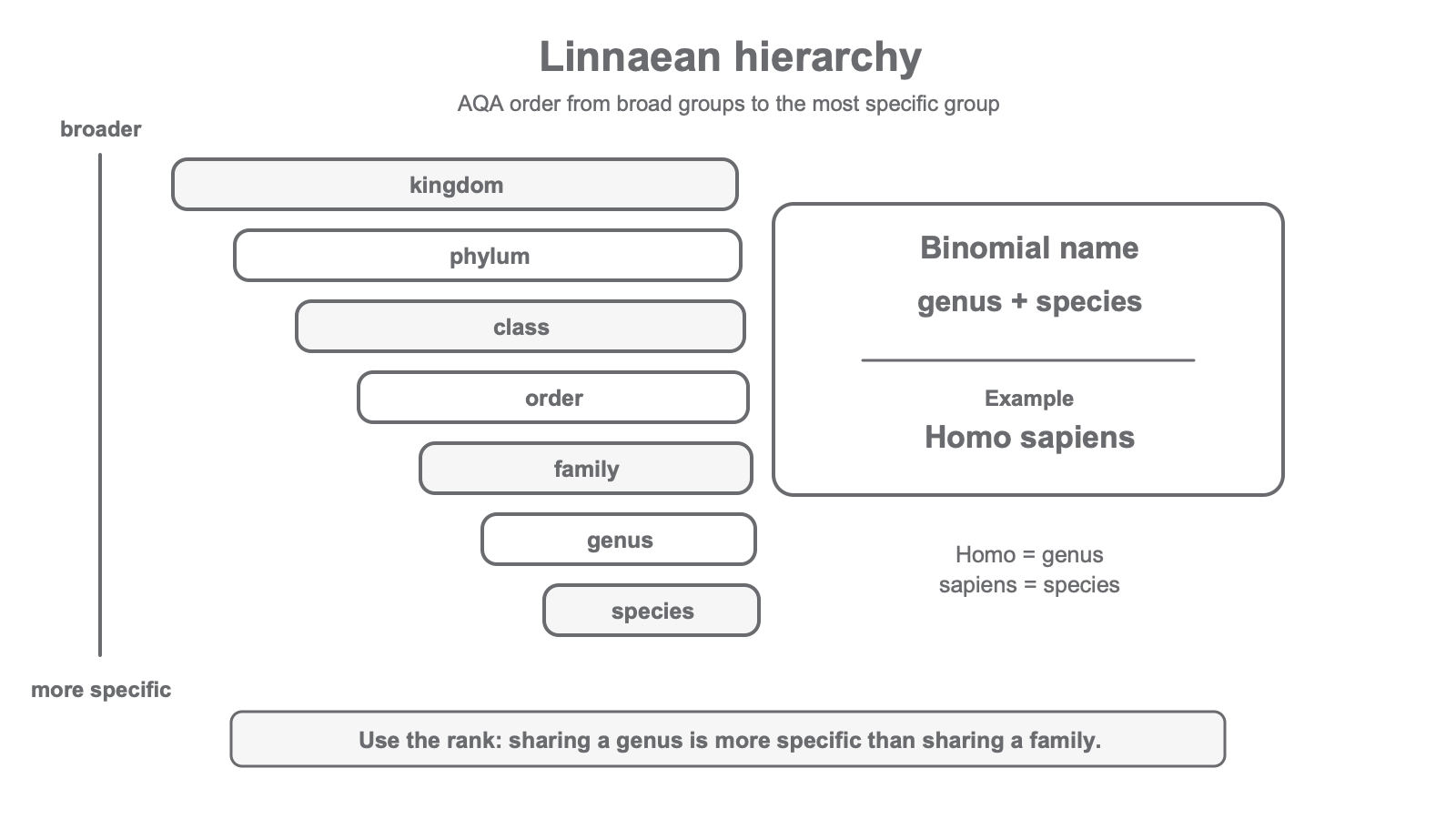
The final two levels are especially important for naming organisms. In the binomial system, an organism is named using its genus and species. For example, the scientific name Homo sapiens uses Homo as the genus and sapiens as the species name.
Binomial system
A naming system where each organism is given a two-part scientific name made from its genus and species.
In printed scientific writing, the genus usually starts with a capital letter and the species name starts with a lower-case letter. For AQA answers, the key point is simpler: binomial names are made from genus and species.
Using Linnaean information
You may be given classification information and asked to show understanding of the Linnaean system. Usually, that means using the hierarchy correctly.
Imagine three organisms are classified as follows:
| Organism | Family | Genus | Species |
|---|---|---|---|
| Organism A | Felidae | Panthera | leo |
| Organism B | Felidae | Panthera | pardus |
| Organism C | Felidae | Felis | catus |
Organisms A and B are in the same genus, Panthera, so they are classified more closely together than organism C, which is in the same family but a different genus. All three are in the same family, so they still share a broader classification group.
Do not just count matching letters in names. Use the rank. Sharing a genus is a more specific similarity than sharing a family, because genus is closer to species in the Linnaean hierarchy.
The lower down the Linnaean hierarchy two organisms are grouped together, the more specific their shared classification is.
This is a classification lesson, so avoid drifting into detailed genetics unless the question gives you genetic or biochemical evidence. The skill here is to use the information provided.
Classification changes with evidence
Classification systems are scientific models. They are useful ways of organising evidence, but they can change when better evidence becomes available.
The traditional Linnaean system used structure and characteristics. Later developments in biology gave scientists more evidence:
Continue this lesson.
You’re previewing NovaLearn without an account. Create a free account to read the rest.
Create free account