4.5.1 - Homeostasis
Homeostasis is how cells and organisms keep their internal conditions close to the best level for life processes. In humans, this means automatic control systems are constantly detecting changes and making responses. This lesson is about the general control model: what is kept stable, why it matters, and how receptors, coordination centres and effectors work together.
What Homeostasis Means
Homeostasis is the regulation of the internal conditions of a cell or organism. The aim is to maintain optimum conditions for function in response to internal and external changes.
Homeostasis
Homeostasis is the regulation of internal conditions of a cell or organism to maintain optimum conditions for function, in response to internal and external changes.
Internal conditions are conditions inside the body or inside cells. External changes happen outside the body, such as a hot room or cold weather. Internal changes happen inside the body, such as blood glucose concentration rising after a meal.
The important word is optimum. It does not mean conditions never change. It means the body keeps conditions within a suitable range so enzymes and cells can work properly.
Homeostasis maintains optimal conditions for:
- enzyme action
- all cell functions
- tissues and organs that depend on cells working normally
Enzymes are especially important because many cell reactions depend on them. If temperature, water balance or chemical conditions move too far from the optimum, enzyme activity and cell function can be disrupted.
Conditions Controlled
The human body controls many internal conditions. In this specification point, the named examples are:
- blood glucose concentration
- body temperature
- water levels
Blood glucose concentration must be controlled because glucose is needed for respiration, but very high or very low glucose can disrupt body function. Body temperature must be controlled because temperature affects enzyme-controlled reactions. Water levels must be controlled because too much or too little water can affect how well cells function.
These examples are taught in more detail in later homeostasis lessons. Here, use them to understand the general model. In each case, the body detects a change and produces a response that helps restore the internal condition towards its optimum level.
Homeostasis is not only about body temperature. AQA also names blood glucose concentration and water levels as internal conditions controlled in humans.
A common exam error is to say that homeostasis "keeps everything the same". A stronger answer says it regulates internal conditions to maintain optimum conditions. The levels may rise or fall slightly, but control systems act to keep them within a suitable range.
Automatic Control Systems
Homeostasis uses automatic control systems. Automatic means the system does not need conscious effort. You do not decide every moment how much your blood glucose concentration, body temperature or water level should change.
All control systems include three key components:
- receptors: cells that detect stimuli, which are changes in the environment
- coordination centres: places such as the brain, spinal cord or pancreas that receive and process information from receptors
- effectors: muscles or glands that bring about responses
[DIAGRAM: asset_name: homeostasis_control_loop - diagram 1; asset_slug: 051_4_5_1_homeostasis_diagram1; file: diagram_assets/imagegen_regen_all/051_4_5_1_homeostasis_diagram1_imagegen.png; recommended_method: codex_image_gen; description: Monochrome control-loop model showing an internal or external change detected by receptors, information sent to a coordination centre, effectors producing a response, and the response restoring the condition towards its optimum level.]
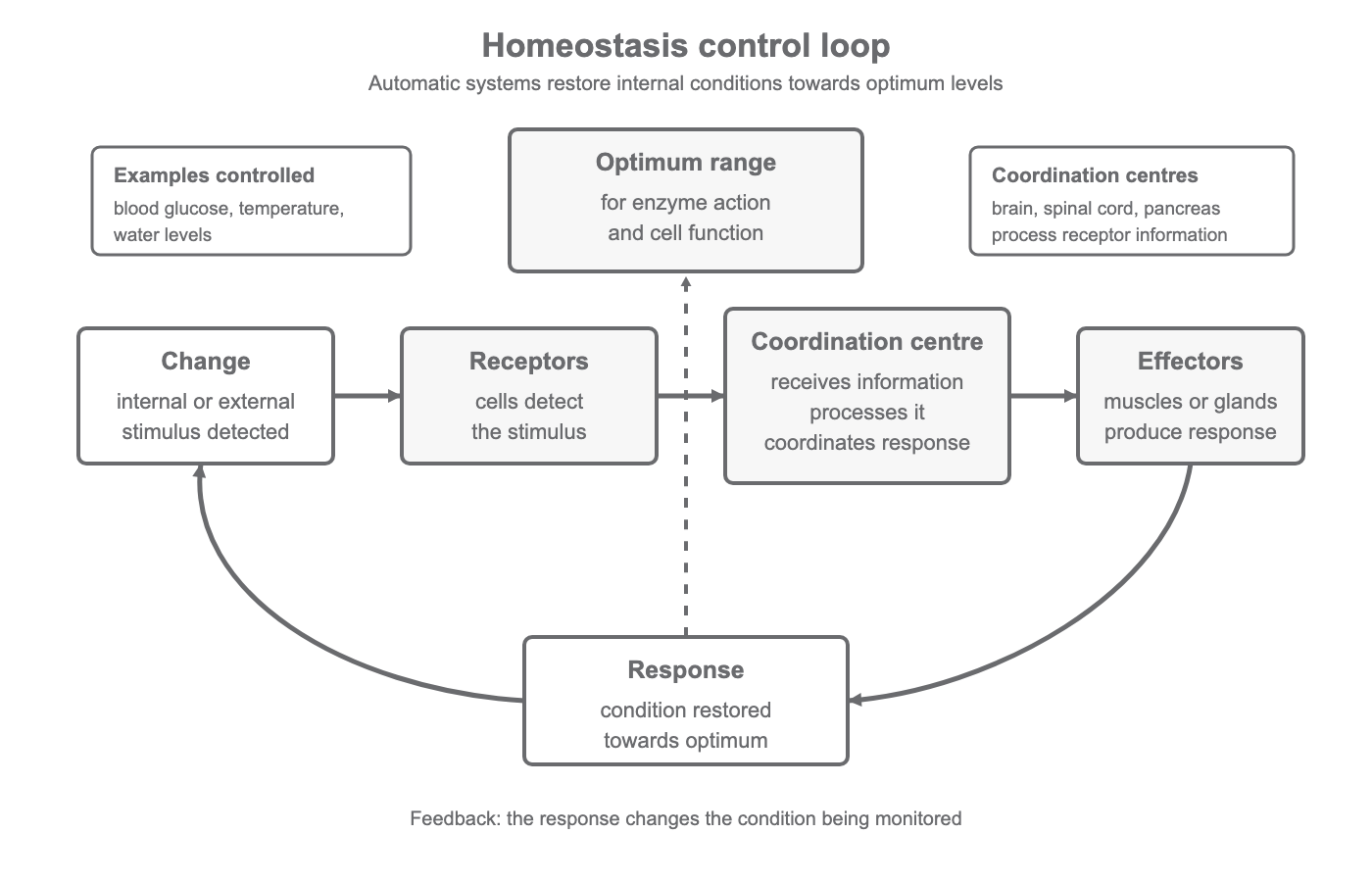
A stimulus is a change that can be detected. For example, a temperature change is a stimulus. The receptor detects the stimulus and sends information to a coordination centre. The coordination centre processes the information and coordinates a response. The effector then brings about the response.
Effectors are usually muscles or glands. A muscle can contract, and a gland can secrete a chemical. At this point in the course, you do not need the detailed pathways for each named condition, but you do need the control-system roles.
Continue this lesson.
You’re previewing NovaLearn without an account. Create a free account to read the rest.
Create free account