4.3.1.1 - Communicable Diseases
Communicable diseases are diseases that can spread between organisms. In AQA Biology, this lesson is about the microorganisms that cause infectious disease, the main routes by which they spread in animals and plants, and how those routes can be interrupted. The important exam habit is to link a prevention method to the route of spread it blocks.
Communicable means infectious
A communicable disease is an infectious disease that can spread from one organism to another. The organism might be an animal, including a human, or a plant. Communicable diseases are caused by pathogens.
Pathogen
A microorganism that causes infectious disease.
Not every microorganism is a pathogen. Some microorganisms live on or in organisms without causing disease. In exam answers, the word pathogen means the disease-causing microorganism, not just any microscopic organism.
Communicable disease
A disease caused by a pathogen that can be spread between organisms.
AQA also uses the word infectious for this idea. If a pathogen infects a host, it has entered the organism and can cause disease.
Four pathogen groups
For this specification point, pathogens may be viruses, bacteria, protists or fungi. These groups can cause disease in animals and in plants.
| Pathogen group | GCSE description needed here | Scale of detail to avoid here |
|---|---|---|
| Viruses | Pathogens that live and reproduce inside cells | Detailed viral life cycles and named viral diseases |
| Bacteria | Living cells that may reproduce rapidly inside the body | Antibiotics, culturing bacteria and named bacterial diseases |
| Protists | Single-celled eukaryotic organisms; some are pathogens | Vector life cycles and named protist diseases |
| Fungi | Some fungi can infect animals or plants; many spread as spores | Detailed plant disease treatment or fungal structures |
The table is not asking you to identify every feature of each group. It is giving you the four names that AQA expects you to use accurately.
If the question asks for types of pathogen, the safe AQA list is viruses, bacteria, protists and fungi.
How pathogens spread
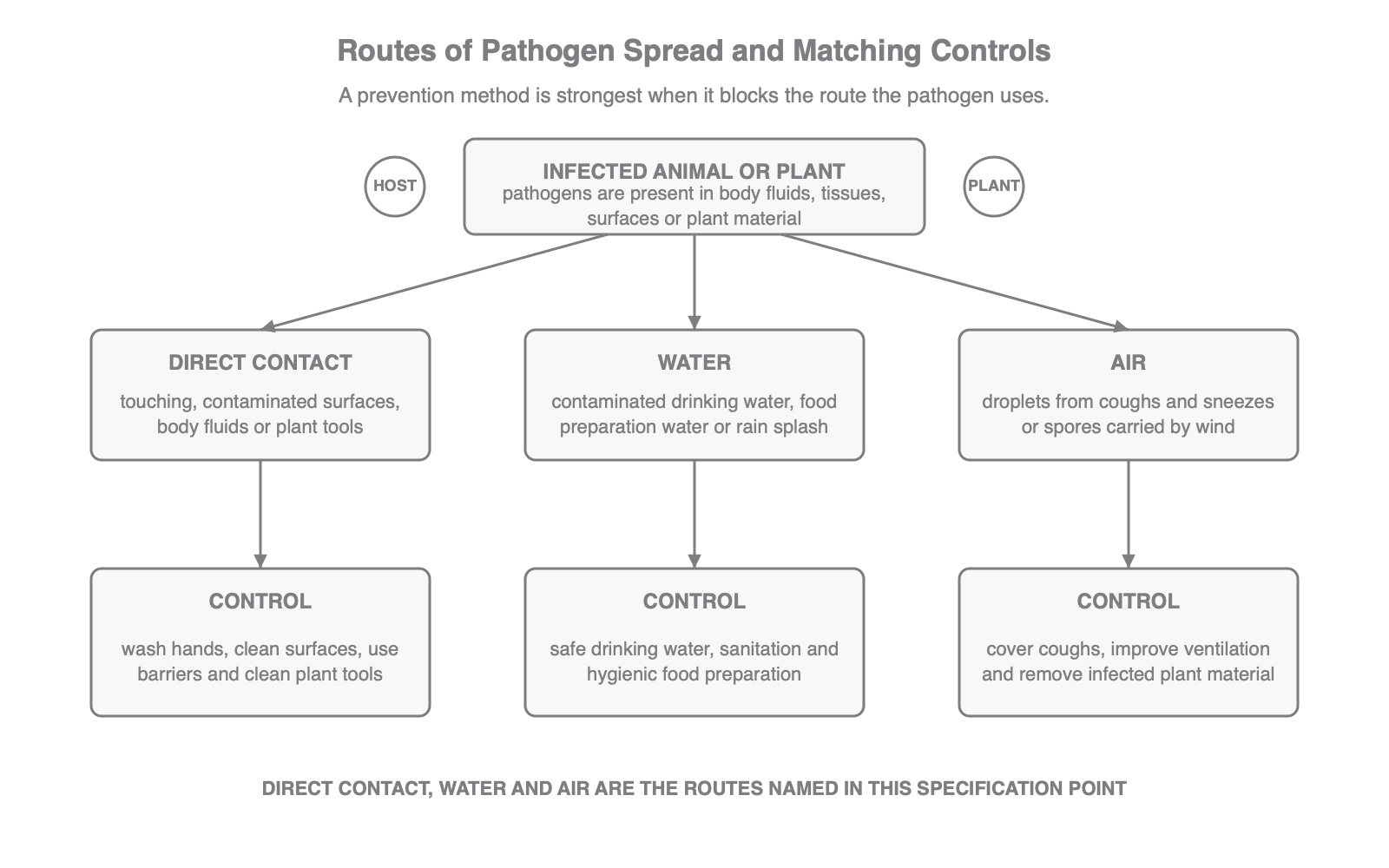
Pathogens can spread by direct contact, by water or by air. These routes apply to animal diseases and plant diseases, although the examples can look different.
Direct contact means the pathogen is passed when infected and uninfected organisms, tissues or contaminated surfaces come into contact. In animals this could involve touching infected skin, body fluids or a contaminated surface. In plants it could involve infected leaves rubbing against healthy leaves, or tools carrying pathogens from one plant to another.
Water can spread pathogens when water is contaminated and then reaches a new host. In animals, this can include drinking or preparing food with contaminated water. In plants, rain splash or irrigation water can move pathogens from infected plant material onto healthy plant tissue.
Air can spread pathogens in particles carried through the air. In animals, pathogens may be carried in droplets from coughs and sneezes. In plants, some fungal spores can be carried by moving air.
[DIAGRAM: asset_name: routes-and-controls - diagram 1; asset_slug: 030_4_3_1_1_communicable_diseases_diagram1; file: diagram_assets/imagegen_regen_all/030_4_3_1_1_communicable_diseases_diagram1_imagegen.png; recommended_method: codex_image_gen; description: Monochrome concept diagram showing a pathogen spreading from an infected animal or plant by direct contact, water and air, with a matching control example for each route.]
How pathogens cause illness
Bacteria and viruses can both reproduce rapidly inside the body, but they do not cause illness in exactly the same way.
Continue this lesson.
You’re previewing NovaLearn without an account. Create a free account to read the rest.
Create free account