4.5.2.3a - The Eye and Accommodation
The eye is a sense organ that detects light and helps the nervous system form a visual response. In this biology-only AQA lesson, the main skill is to connect named eye structures with their functions, then explain how the lens changes shape to focus on near or distant objects. Vision defects and their correction are covered in the next split lesson, so this lesson stops at normal focusing.
The eye as a sense organ
A sense organ contains receptors that detect a stimulus. The eye detects light. In AQA wording, the eye contains receptors sensitive to light intensity and colour.
Receptor
A cell or group of cells that detects a stimulus and can start a response in the nervous system.
In the eye, light-sensitive receptors are found in the retina at the back of the eye. When light is focused on the retina, these receptors produce electrical impulses. The optic nerve carries impulses from the retina to the brain.
The basic pathway is:
- light enters the eye
- the cornea and lens refract the light
- the light is focused on the retina
- impulses travel along the optic nerve to the brain
Clear vision depends on light being focused on the retina, where light-sensitive receptors are found.
Eye structures and functions
Students should be able to identify the required structures on a diagram of the eye and explain how each structure is related to its function. The diagram below is a simplified cross-section: it is not to scale, but it shows the positions and relationships that matter for GCSE answers.
[DIAGRAM: asset_name: Main eye structures - diagram 1; asset_slug: 055_4_5_2_3a_the_eye_and_accommodation_diagram1; file: diagram_assets/055_4_5_2_3a_the_eye_and_accommodation_diagram1.png; recommended_method: deterministic_drawn; description: Monochrome labelled cross-section of the eye showing retina, optic nerve, sclera, cornea, iris, ciliary muscles, suspensory ligaments, pupil and lens, with light rays focused on the retina.]
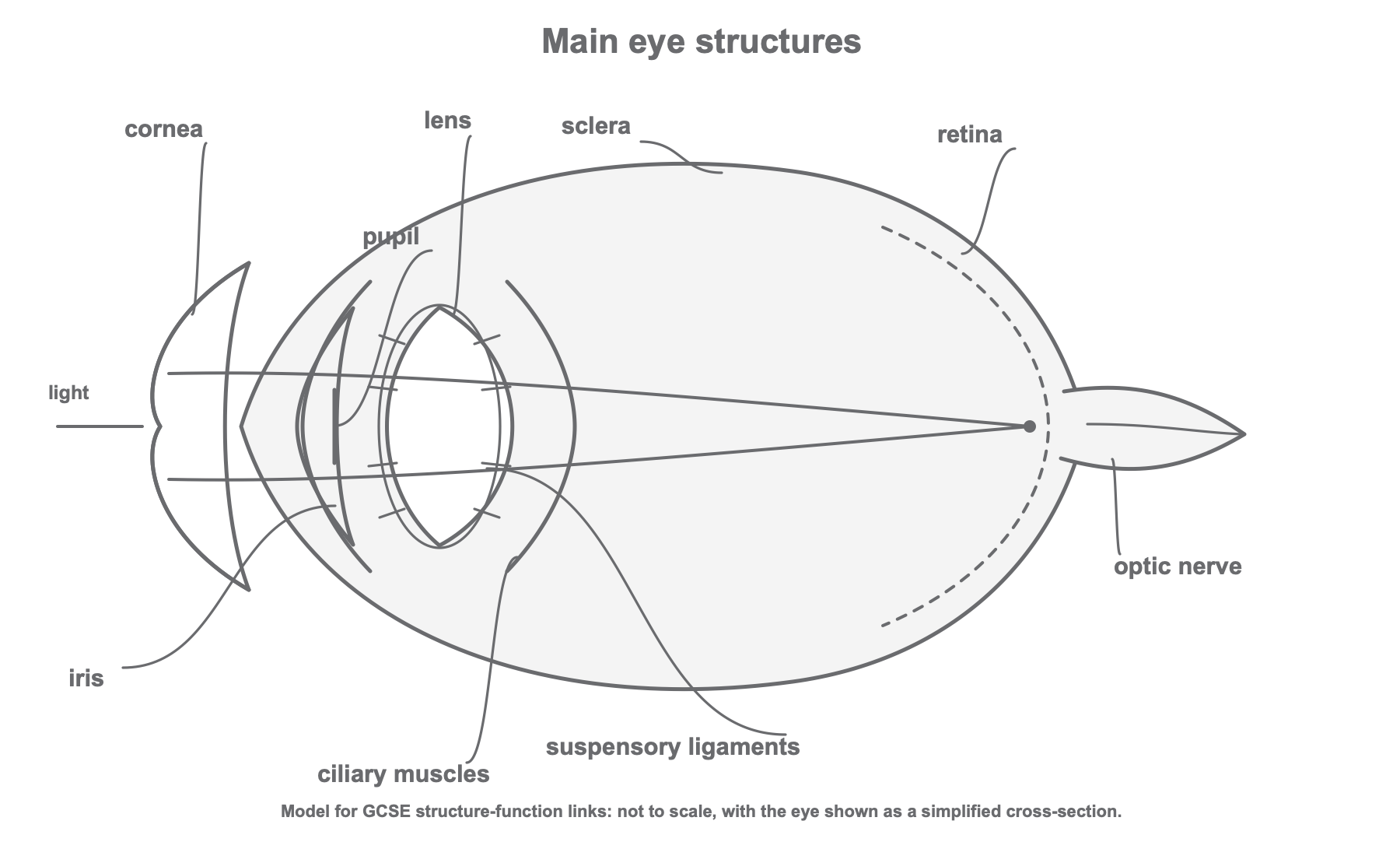
| Structure | Function you should know | Structure-function link |
|---|---|---|
| Retina | Contains receptors sensitive to light intensity and colour | The retina detects focused light and starts nerve impulses. |
| Optic nerve | Carries impulses from the retina to the brain | It links the retina to the central nervous system. |
| Sclera | Tough outer layer of the eye | It protects and supports the eyeball. |
| Cornea | Transparent front surface that refracts light | It lets light enter and bends light towards the retina. |
| Iris | Controls how much light enters through the pupil | It changes pupil size, so the amount of light entering the eye changes. |
| Ciliary muscles | Contract or relax to help change lens shape | They alter the tension in the suspensory ligaments. |
| Suspensory ligaments | Hold the lens and transfer tension to it | Tight or loose ligaments change the shape of the lens. |
| Lens | Changes shape during accommodation | A thicker lens refracts light more strongly; a thinner lens refracts it less. |
The lens is included because accommodation cannot be explained without it. The required AQA structure list names the ciliary muscles and suspensory ligaments because those are the structures that change the lens shape.
Focusing on the retina
Light changes direction when it passes between materials such as air, the cornea and the lens. This bending of light is called refraction.
Refraction
The change in direction of light when it passes from one material into another.
The cornea provides a fixed curved surface at the front of the eye, so it refracts incoming light. The lens fine-tunes the focus by changing shape. The useful target is always the retina: if rays of light are focused on the retina, the receptors can detect a clear image.
Near and distant objects need different amounts of refraction. Light rays from a near object spread out more before they enter the eye, so they need stronger refraction to meet on the retina. Light rays from a distant object are closer to parallel, so they need less extra refraction by the lens.
This lesson is about normal focusing. If light rays focus in front of or behind the retina, that is a vision defect and belongs to the next split lesson.
Continue this lesson.
You’re previewing NovaLearn without an account. Create a free account to read the rest.
Create free account