4.6.2.5a - Plant Cloning by Cuttings and Tissue Culture
Plant cloning produces new plants with the same genetic information as the parent plant. In this biology-only AQA GCSE Biology lesson, the two plant methods are cuttings and tissue culture. The exam skill is to describe how each method produces identical plants and to explain why growers might use them, while also recognising the risks of producing many plants with little genetic variation.
What a Plant Clone Is
A clone is an organism that is genetically identical to another organism. In plant cloning, the new plant is made from cells or tissues of one parent plant, so there is no fusion of gametes and no fertilisation. This makes plant cloning a form of asexual reproduction.
Clone
A clone is an organism or cell with the same genetic information as another organism or cell.
The reason this works in plants is that many plant cells can divide and develop into new plant tissues when they are given suitable conditions. A grower can choose a parent plant with a useful feature, such as strong growth, attractive flowers or high yield, and make copies that keep that feature.
The important GCSE wording is genetically identical, not just "similar". Clones may look slightly different if they grow in different environments, but their inherited genetic information comes from the selected parent plant.
Plant Cloning by Cuttings
Cuttings are the older and simpler plant-cloning method named by AQA. A gardener cuts part of a parent plant, usually a piece of stem with buds or nodes, and places it in conditions where it can grow roots. Once roots and new shoots grow, the cutting becomes an independent plant.
[DIAGRAM: asset_name: plant_cuttings_method - diagram 1; asset_slug: 085_4_6_2_5a_plant_cloning_by_cuttings_and_tissue_culture_diagram1; file: diagram_assets/imagegen_regen_all/085_4_6_2_5a_plant_cloning_by_cuttings_and_tissue_culture_diagram1_imagegen.png; recommended_method: codex_image_gen; description: Monochrome step diagram showing plant cloning by cuttings: select a healthy parent plant, cut a stem below a node, remove lower leaves, place the cutting in moist rooting medium, roots form and a genetically identical new plant grows. Plant-only content.]
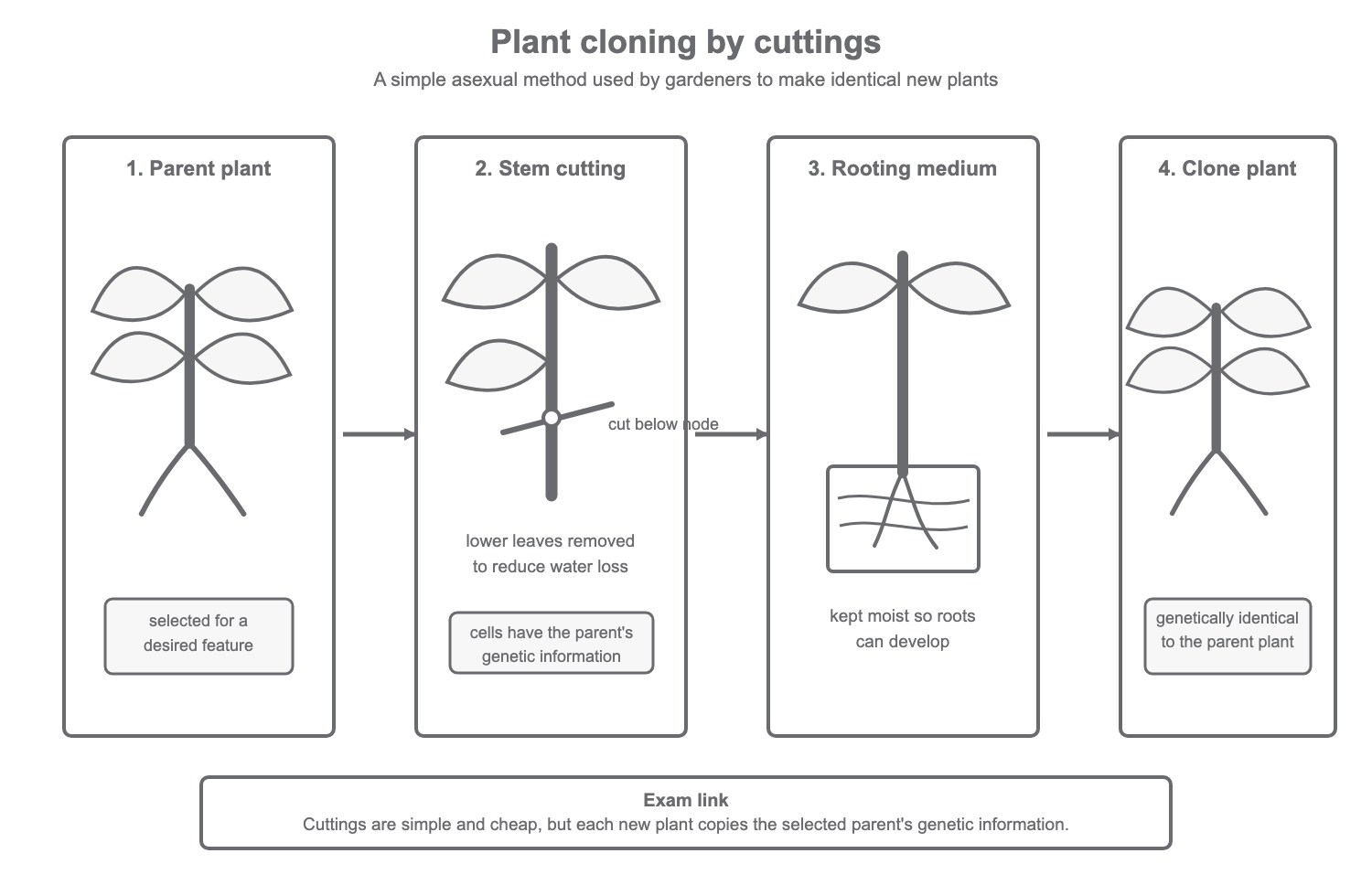
A simple cutting method can be described like this:
- Choose a healthy parent plant with the desired characteristic.
- Cut a suitable section of stem from the parent plant, often near a node where roots can form.
- Remove some lower leaves to reduce water loss.
- Place the cutting into water, compost or another rooting medium and keep it moist.
- When roots have formed, grow the new plant on.
The cutting is a clone because its cells came from the parent plant. If the parent plant has a useful inherited characteristic, the new plant should inherit the same genetic information for that characteristic.
Plant Cloning by Tissue Culture
Tissue culture uses small groups of cells from part of a plant to grow identical new plants. It is also called micropropagation when it is used to produce many plantlets quickly. The method is more technical than taking cuttings because contamination by microorganisms can ruin the culture.
Tissue culture
Tissue culture is the use of small groups of cells from part of a plant to grow genetically identical new plants.
[DIAGRAM: asset_name: plant_tissue_culture_method - diagram 2; asset_slug: 085_4_6_2_5a_plant_cloning_by_cuttings_and_tissue_culture_diagram2; file: diagram_assets/imagegen_regen_all/085_4_6_2_5a_plant_cloning_by_cuttings_and_tissue_culture_diagram2_imagegen.png; recommended_method: codex_image_gen; description: Monochrome process diagram showing plant tissue culture/micropropagation: donor plant, sterile explant or small cell group, nutrient agar culture vessel, multiplication into plantlets, rooting and transfer to compost/nursery. Plant-only content.]
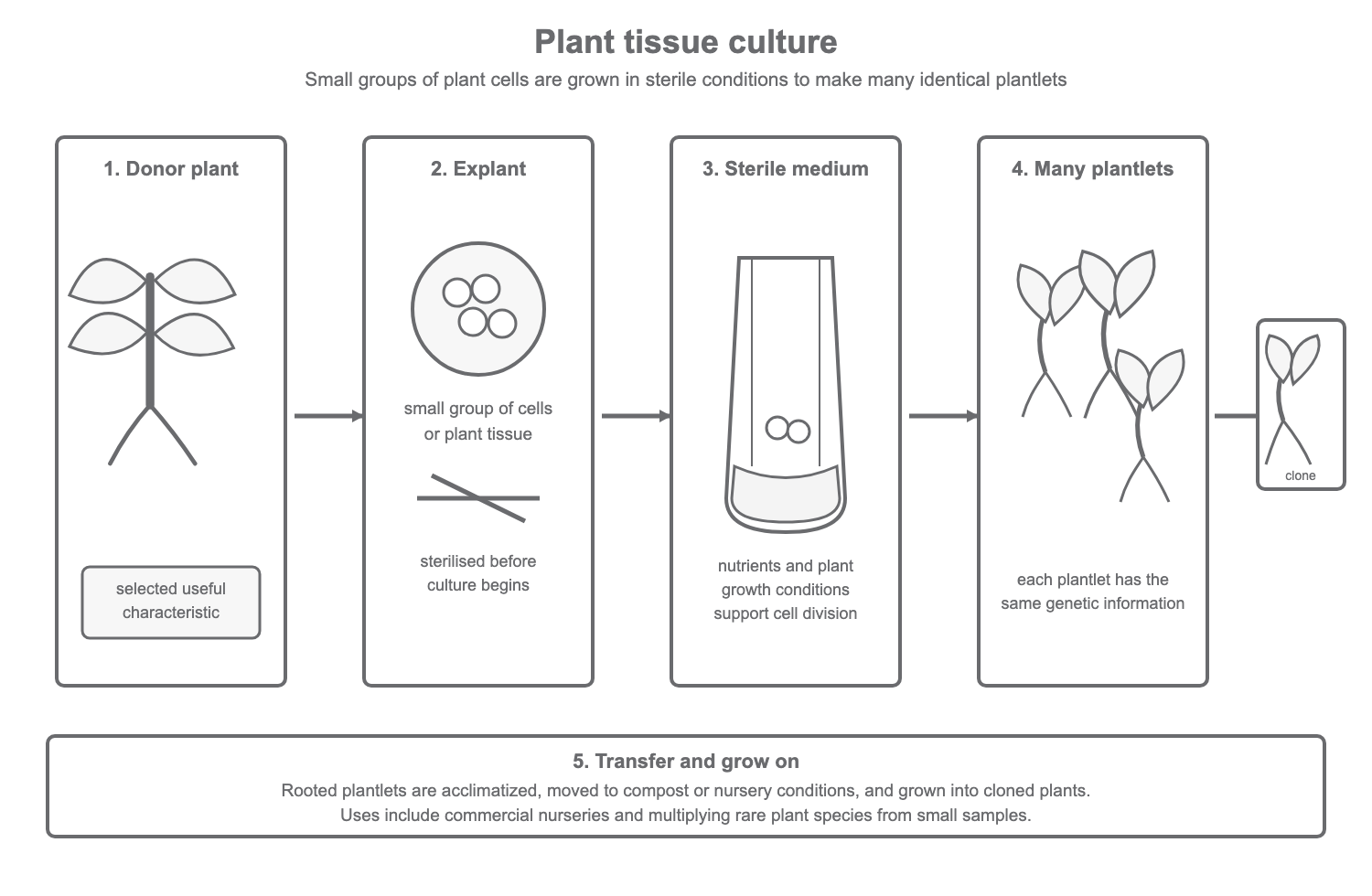
A GCSE description of tissue culture should keep the order clear:
- A small piece of tissue or a small group of cells is taken from a selected parent plant.
- The plant material is placed in sterile conditions on a nutrient medium.
- The cells divide and form many small plantlets.
- The plantlets are grown until roots and shoots are developed.
- The plantlets are transferred to soil or compost and grown on.
Sterile conditions matter because the nutrient medium is also suitable for bacteria and fungi. If microorganisms grow in the culture vessel, they can use the nutrients, damage the plant tissue and stop the plantlets developing.
Continue this lesson.
You’re previewing NovaLearn without an account. Create a free account to read the rest.
Create free account