4.6.3.3 - Development of Genetics
This biology-only topic is about how scientists built the modern idea of genes over time. The exam focus is the sequence of understanding: Mendel's plant breeding, the later observation of chromosomes, the idea that genes are on chromosomes, and the mid-20th-century work on DNA structure and gene function. You are not expected to memorise lots of names or dates; you are expected to explain why Mendel's discovery mattered and why its importance was recognised only later.
Mendel and inherited units
In the mid-19th century, Gregor Mendel carried out breeding experiments on plants. He crossed plants with different characteristics and looked carefully at the characteristics shown by their descendants.
Mendel's important observation was that the inheritance of each characteristic is determined by units passed on to descendants unchanged. This was a powerful idea because it treated inheritance as something carried by separate units, rather than as a general blending of parental characteristics.
Mendel's units
Mendel's units were the inherited factors he proposed to explain how characteristics are passed on unchanged from one generation to the next.
Today, Mendel's units are called genes. That name was not available to Mendel, and he did not know what the units were made of or where they were in cells. His work was still important because it gave scientists a testable pattern for inheritance.
[DIAGRAM: asset_name: development-of-genetics-timeline - diagram 1; asset_slug: 089_4_6_3_3_development_of_genetics_diagram1; file: diagram_assets/imagegen_regen_all/089_4_6_3_3_development_of_genetics_diagram1_imagegen.png; recommended_method: codex_image_gen; description: Monochrome assessed timeline showing the AQA sequence for the development of genetics: mid-19th-century Mendel breeding experiments and inherited units; Mendel's discovery not recognised until after his death; late-19th-century observation of chromosome behaviour during cell division; early-20th-century link between Mendel's units and chromosomes leading to genes located on chromosomes; mid-20th-century DNA structure and gene function; gene theory developed by many scientists. Labels state that dates are orientation only, not recall facts.]
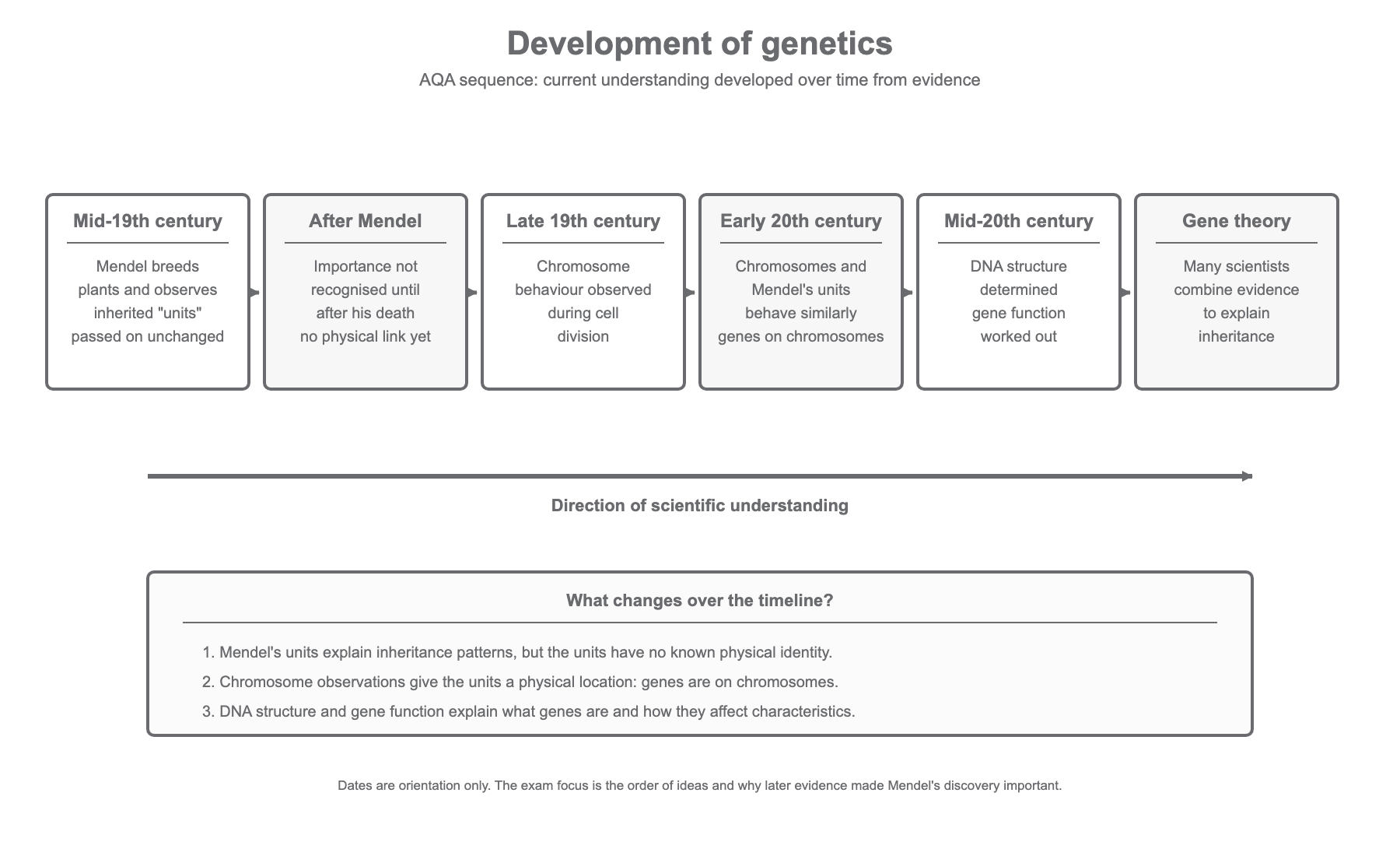
Use the timeline as a route through the lesson. The key skill is to link each new piece of evidence to the next improvement in scientific understanding.
Why Mendel was not recognised
AQA expects you to understand why the importance of Mendel's discovery was not recognised until after his death. The simplest answer is that Mendel had a strong pattern but scientists did not yet have the cell evidence needed to explain it physically.
Mendel's units were abstract. In the mid-19th century, scientists had not yet connected those units to chromosomes, genes or DNA. Without that link, his work was easier to treat as an unusual plant-breeding result rather than as a general explanation of inheritance.
There were also communication and timing problems. Mendel's work was not immediately taken up by the wider scientific community, and the word gene had not yet been coined. His results became much more meaningful once later scientists could compare them with chromosome behaviour.
Mendel's discovery was not recognised at first because he described inherited units before scientists had the chromosome and DNA evidence needed to explain what those units were.
In an answer, connect the delay to the missing explanation: Mendel had evidence for inherited units, but later scientists supplied the chromosome and DNA context.
Chromosomes gave units a place
In the late 19th century, scientists observed the behaviour of chromosomes during cell division. This was a different line of evidence from Mendel's plant breeding, but it became useful because chromosomes also behaved like separate structures that could be passed on.
In the early 20th century, scientists noticed that chromosomes and Mendel's units behaved in similar ways. This led to the idea that the units, now called genes, were located on chromosomes.
Gene
A gene is a unit of inheritance located on a chromosome. At molecular level, a gene is a section of DNA.
Continue this lesson.
You’re previewing NovaLearn without an account. Create a free account to read the rest.
Create free account