4.7.2.4 - Impact of Environmental Change
Environmental change can alter where species are found in an ecosystem and how common they are in different places. This is a Higher-tier, biology-only AQA point: the key skill is to evaluate the impact of a change when you are given suitable information, such as a table, graph, survey summary or description of a habitat. The lesson stays focused on distribution of species, not the later topics on biodiversity, waste, land use or global warming.
Distribution and change
The distribution of a species means where it is found in an ecosystem. It can be described as present or absent in different places, or more precisely as the number, percentage cover or abundance of the species in each area.
Distribution
Distribution is the pattern of where a species is found in an ecosystem.
An environmental change can make a habitat more suitable for one species and less suitable for another. If conditions change, a species may become more common in some areas, less common in others, or move its range so that it is found in different places from before.
For this AQA point, the environmental changes you must consider are:
| Environmental change | What it can alter in an ecosystem |
|---|---|
| Temperature | Enzyme-controlled reactions, survival, reproduction, activity, germination, flowering or where organisms can tolerate conditions. |
| Availability of water | Plant growth, animal drinking water, moist habitats, freshwater depth or flow, and the survival of organisms that dry out easily. |
| Composition of atmospheric gases | The amounts or availability of gases such as carbon dioxide, oxygen, methane and water vapour, which can affect photosynthesis, respiration or temperature depending on the information given. |
Do not assume that every environmental change reduces every species. A warmer area may become less suitable for a cold-adapted species but more suitable for a species that can tolerate higher temperatures.
Types of environmental change
AQA says environmental changes may be seasonal, geographic or caused by human interaction.
Seasonal changes happen as conditions vary through the year. For example, a pond may contain more water in winter than in summer, or spring temperatures may allow some plants to grow earlier. A species may therefore be abundant in one season and scarce in another.
Geographic changes happen between places. For example, a mountain habitat may be colder at higher altitude, or one side of a valley may be wetter than another. A species may be distributed only in the part of the ecosystem where the conditions are within its tolerance range.
Human interaction can change temperature, water availability or the composition of gases. For example, humans may remove water from a river, alter land drainage, release greenhouse gases, or change vegetation cover. In an exam answer, name the human action only if the question gives it or asks for it; the assessed biology is how the changed condition affects distribution.
How factors shift distribution
Temperature affects distribution because organisms only survive and reproduce within a range of conditions. If a site becomes too hot, too cold, or changes the timing of growth and breeding, the species that can complete their life cycles there may change. This can shift a species towards cooler, warmer, higher, lower or more sheltered areas, depending on the information in the question.
Water availability affects distribution because water is needed for biological reactions and for many habitats. Plants may grow poorly if there is too little water, and animals may move to areas with drinking water or suitable prey. In freshwater ecosystems, reduced water volume can also concentrate organisms into smaller areas and change the physical conditions of the water.
Atmospheric gases affect distribution when the gas change alters a process needed by organisms. Carbon dioxide is needed for photosynthesis in plants, but increased carbon dioxide and methane can also be linked to warming if the question gives that information. Oxygen availability matters for aerobic respiration; for aquatic organisms, exam information may discuss dissolved oxygen rather than oxygen atoms inside water molecules.
[DIAGRAM: asset_name: environmental-change-evaluation-framework - diagram 1; asset_slug: 104_4_7_2_4_impact_of_environmental_change_diagram1; file: diagram_assets/104_4_7_2_4_impact_of_environmental_change_diagram1.png; recommended_method: deterministic_drawn; description: Monochrome framework diagram showing how an environmental change in temperature, water availability or atmospheric gases leads to changed habitat suitability, then changed distribution evidence such as abundance, presence/absence or range shift, then an evaluation judgement. Include a small before-and-after abundance profile across five sites to show distribution data being compared, plus a concise checklist for evaluating strength of evidence. Use white background, #6A6B6E linework and labels only.]
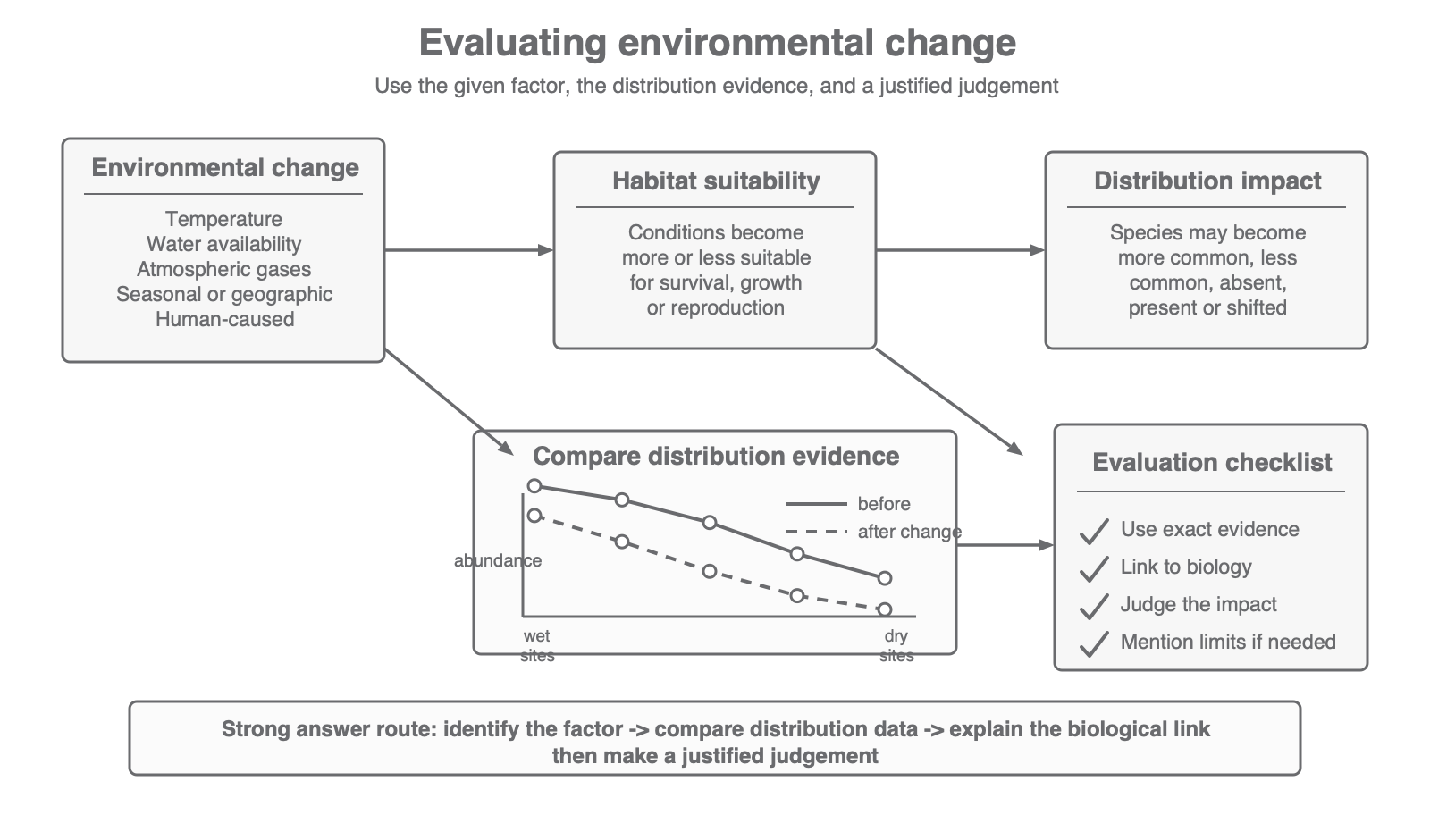
The diagram shows the answer route: identify the environmental factor, link it to habitat suitability, then use distribution evidence to judge the impact. The strongest answers use the data given, not just a general statement such as "the environment changed".
Continue this lesson.
You’re previewing NovaLearn without an account. Create a free account to read the rest.
Create free account