4.5.4.1a - Plant Hormones and Tropisms
Plants cannot move from place to place, but they can coordinate growth so shoots and roots grow in useful directions. This Biology-only lesson explains how plant hormones control growth responses to light and gravity. The separate practical scaffold handles investigation skills, so this lesson stays with the biological explanation.
Plant hormones and tropisms
A plant hormone is a chemical signal that coordinates and controls plant growth and plant responses. Plant hormones are not released by endocrine glands into blood, because plants do not have endocrine glands or a bloodstream. Instead, they are made in plant tissues and affect growth in plant cells.
Tropism
A growth response by part of a plant towards or away from a stimulus.
Two tropisms matter in this specification point:
| Tropism | Stimulus | Meaning |
|---|---|---|
| Phototropism | Light | Growth response towards or away from light |
| Gravitropism, also called geotropism | Gravity | Growth response towards or away from gravity |
A tropism is described as positive if growth is towards the stimulus and negative if growth is away from the stimulus. Shoots are usually positively phototropic because they grow towards light. Roots are usually positively gravitropic because they grow in the direction of gravity.
Auxin and unequal growth
Auxin is the plant hormone named in this specification point. It is involved in growth near the tips of shoots and roots. The key exam idea is not that auxin simply "makes plants grow"; it is that unequal distributions of auxin cause unequal growth rates.
Auxin
A plant growth hormone involved in controlling growth responses in roots and shoots.
Plant organs bend when one side grows faster than the other side. If cells on the right side of a shoot elongate faster than cells on the left side, the shoot bends left. If cells on the upper side of a root elongate faster than cells on the lower side, the root bends down.
Auxin has different effects in shoots and roots:
| Plant organ | Higher auxin concentration causes | Effect on bending |
|---|---|---|
| Shoot | Faster cell elongation | The side with more auxin grows faster |
| Root | Slower cell elongation | The side with more auxin grows slower |
That difference is why the same uneven auxin distribution can make a shoot and a root curve in opposite directions.
Phototropism in shoots
When light comes mainly from one direction, auxin becomes more concentrated on the shaded side of a shoot. In shoots, a higher auxin concentration stimulates cell elongation. The shaded side therefore grows faster than the lit side, so the shoot bends towards the light.
[DIAGRAM: asset_name: phototropism-shoot-auxin - diagram 1; asset_slug: 067_4_5_4_1a_plant_hormones_and_tropisms_diagram1; file: diagram_assets/imagegen_regen_all/067_4_5_4_1a_plant_hormones_and_tropisms_diagram1_imagegen.png; recommended_method: codex_image_gen; description: Monochrome labelled process diagram showing one-sided light on a shoot, more auxin on the shaded side, faster elongation on the shaded side, and the shoot bending towards the light.]
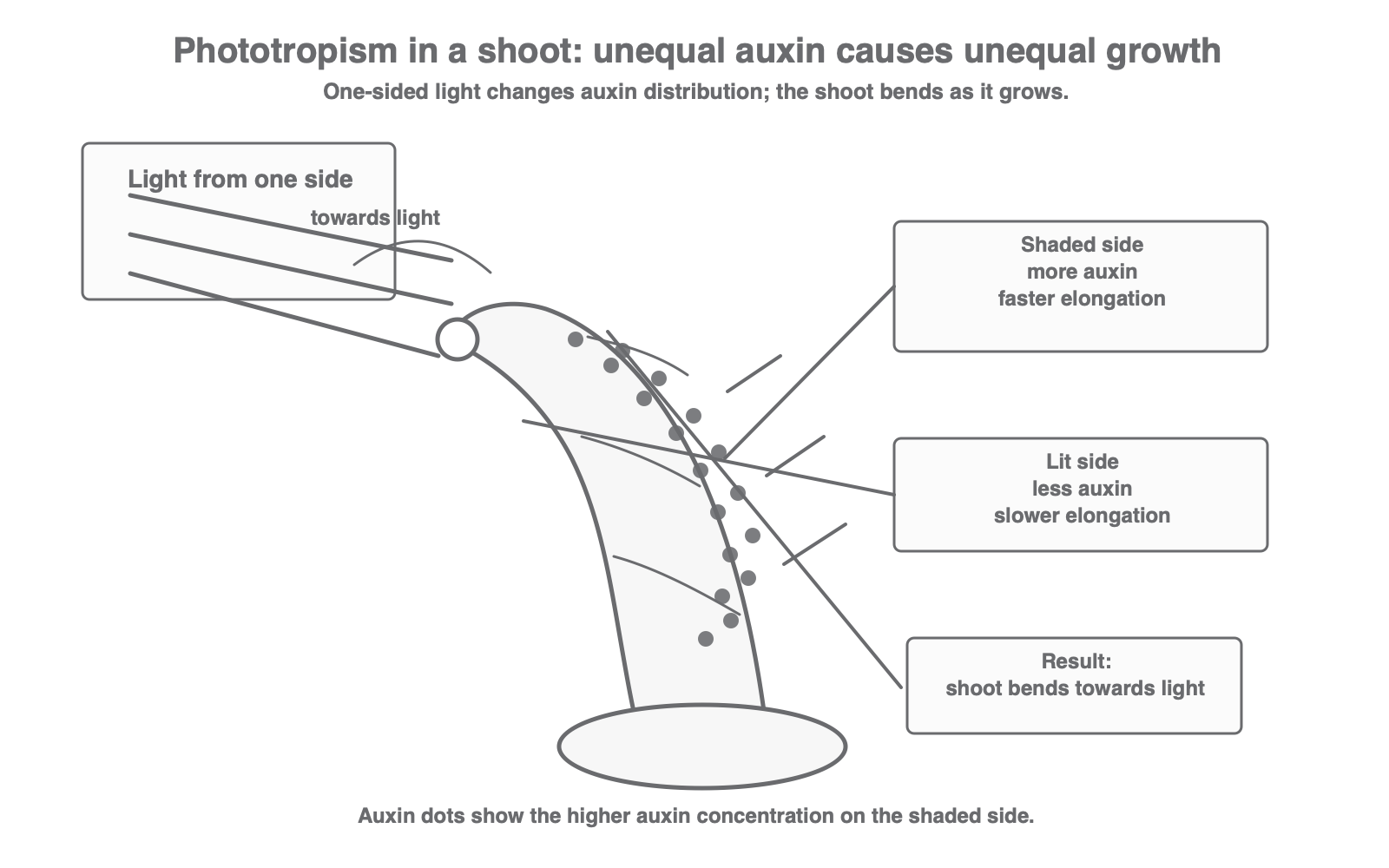
The direction of bending is a result of unequal growth, not because the shoot "moves" like an animal. Growth has happened over time, and more elongation on one side changes the shape of the shoot.
Use this answer pattern for phototropism in shoots:
light from one side -> auxin accumulates on shaded side -> shaded side elongates faster -> shoot bends towards light
Gravitropism in roots and shoots
Gravity also affects auxin distribution. In a horizontal shoot or root, more auxin accumulates on the lower side. The outcome is different in shoots and roots because auxin affects their cell elongation differently.
Continue this lesson.
You’re previewing NovaLearn without an account. Create a free account to read the rest.
Create free account