4.7.2.1b - Required Practical - Sampling Populations
In Required Practical 9, you estimate the population size of a common species in a habitat and investigate how a factor affects where that species is found. The key tools are quadrats and transects, plus careful sampling so the data represent the habitat rather than the places a student happened to notice. AQA can assess the method, the variables, the maths and the quality of conclusions from ecological data.
Aim and key terms
The practical has two linked aims:
- estimate the population size of a common species in one habitat
- use sampling to investigate how a factor affects the distribution of that species
Population
All the organisms of one species living in a habitat.
This is the group you are trying to estimate or compare.
Abundance
How many organisms of a species are present in a habitat or sample area.
This is the number you record from each quadrat, then process.
Distribution
Where organisms of a species are found within a habitat.
A quadrat is a square frame used to sample a known area. For example, a 1 m^2 quadrat samples one square metre of ground. A transect is a line across a habitat, usually made with a tape measure, along which samples are taken.
This practical is usually done with plants such as daisies, dandelions or clover because they are common and do not move around within the habitat. The same skills can also apply to very slow-moving organisms, but the method must still be safe, ethical and suitable for the species being counted.
An abiotic factor is a non-living condition, such as light intensity, soil moisture, soil pH or temperature. In this practical, a useful hypothesis links the factor to distribution. For example: As light intensity increases away from a shaded area, the abundance of clover increases.
Random quadrats for population size
[DIAGRAM: asset_name: random-quadrat-population-estimate - diagram 1; asset_slug: 100_4_7_2_1b_required_practical_9_sampling_populations_diagram1; file: diagram_assets/100_4_7_2_1b_required_practical_9_sampling_populations_diagram1.png; recommended_method: deterministic_drawn; description: Monochrome labelled field grid showing a 10 m by 10 m survey area, random coordinates selected by a random number generator, equal-area quadrats placed at those coordinates, counts of a target plant species in each quadrat, mean count per quadrat and population-size estimate using total habitat area divided by quadrat area.]
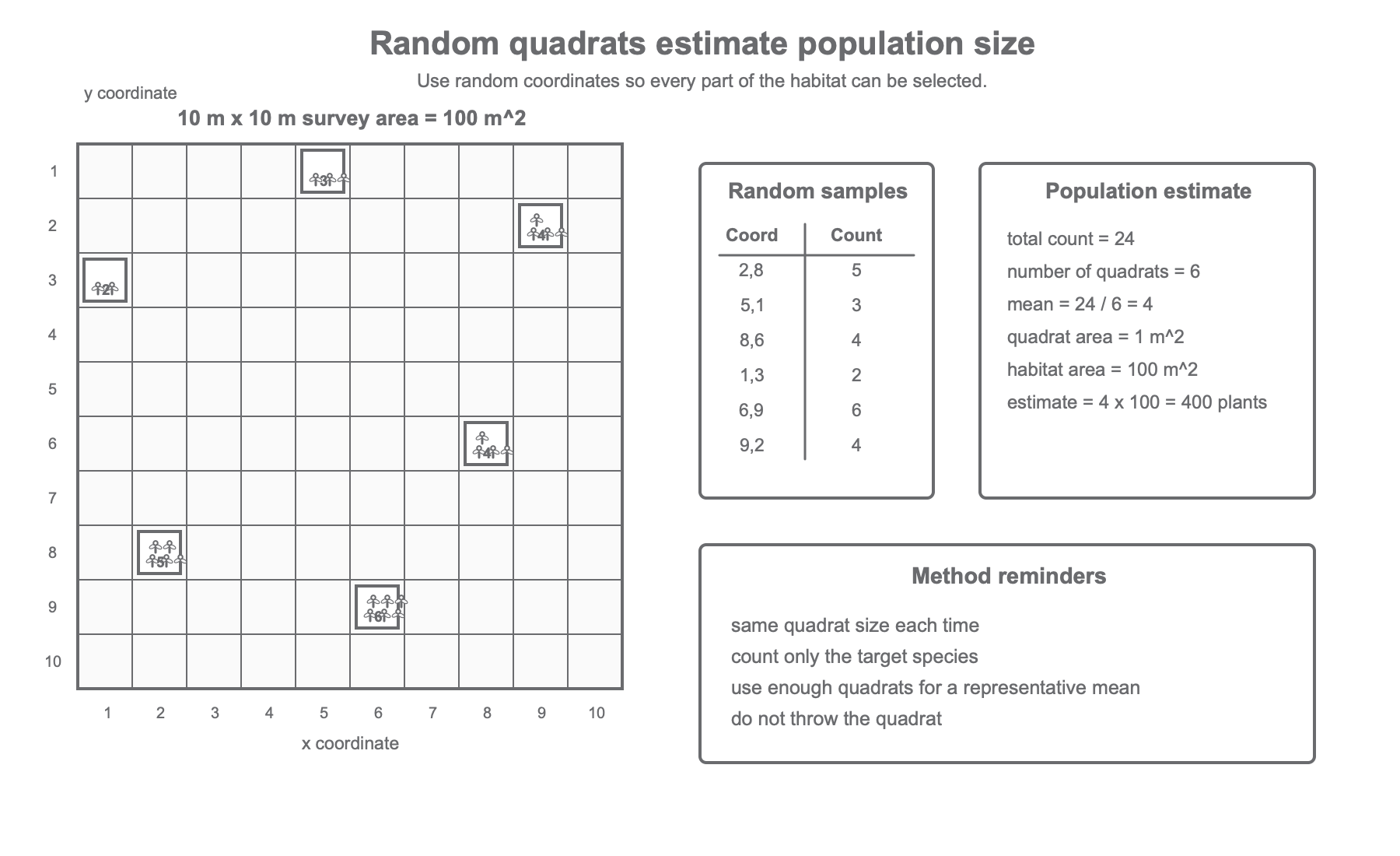
To estimate population size, the whole habitat is usually too large to count directly. Instead, take samples and use them to estimate the total.
A valid random-quadrat method is:
- Mark out the survey area and measure its length and width in metres.
- Calculate the total area of the habitat in
m^2. - Lay an imaginary grid over the habitat, or use tape measures along two sides.
- Use a random number generator to choose coordinates.
- Place the quadrat at each coordinate.
- Count only the target species inside the quadrat.
- Repeat with enough quadrats to get a representative sample.
- Calculate the mean number of organisms per quadrat.
- Use the mean and the area sampled to estimate the population size.
Random placement matters because it reduces sampling bias. Throwing a quadrat over a shoulder is not a good random method: it can be unsafe, may damage organisms and may still favour nearby or easy-to-reach areas.
Population estimate from quadrats
Worked example:
A lawn has an area of 60 m^2. A 0.25 m^2 quadrat is placed at random coordinates. The counts of clover plants are 3, 4, 5, 2, 6 and 4.
mean count per quadrat = (3 + 4 + 5 + 2 + 6 + 4) / 6 = 24 / 6 = 4
Number of quadrat-sized areas in the lawn:
60 / 0.25 = 240
Estimated population:
4 x 240 = 960 clover plants
The answer is an estimate, not an exact count. It becomes more representative when the sample is random, the sample size is large enough and the counting rule is consistent.
Transects for distribution
[DIAGRAM: asset_name: transect-distribution-method - diagram 2; asset_slug: 100_4_7_2_1b_required_practical_9_sampling_populations_diagram2; file: diagram_assets/imagegen_regen_all/100_4_7_2_1b_required_practical_9_sampling_populations_diagram2_imagegen.png; recommended_method: codex_image_gen; description: Monochrome labelled transect across a habitat from shaded ground to open ground, with a tape measure marked 0 to 30 m, quadrats placed at regular 5 m intervals, a light meter/abiotic-factor measurement at each quadrat, plant counts recorded, and notes that this is systematic sampling used to investigate distribution along an environmental gradient.]
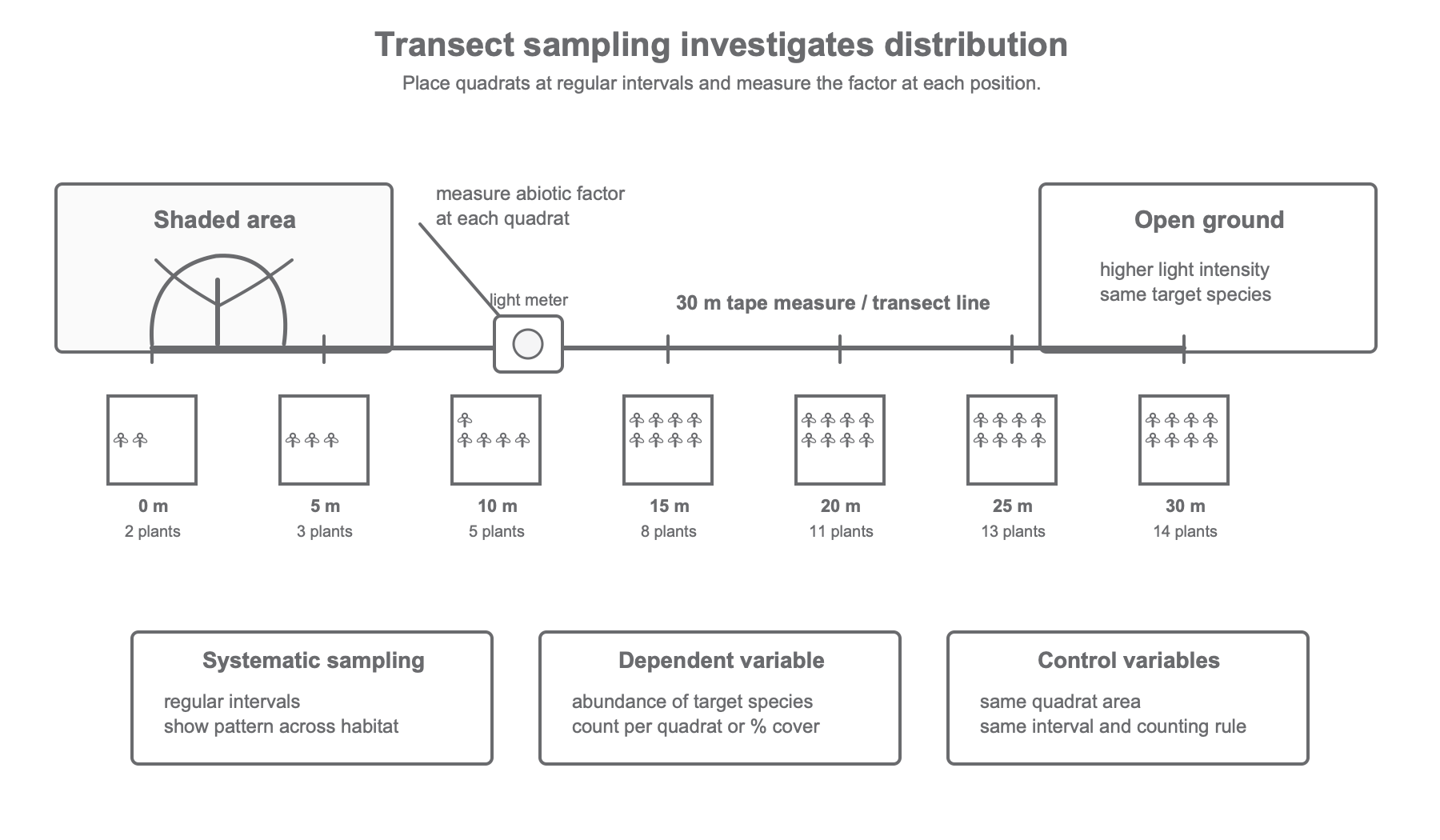
Random quadrats are useful when you want an unbiased estimate for a whole area. A transect is better when you are investigating how distribution changes across a habitat.
In a systematic transect method, samples are taken at fixed intervals, such as every 5 m, along a line. This is not random sampling. It is planned regular sampling so changes along the line can be linked to a factor.
In continuous sampling, the organisms touching or lying along the line can be recorded along the whole transect. In the AQA-style quadrat method below, quadrats are placed at regular intervals instead.
A valid transect method is:
- Choose a factor to investigate, such as light intensity from shaded ground to open ground.
- State a clear hypothesis about how the factor may affect the species distribution.
- Place a tape measure across the habitat to form a transect line.
- Place a quadrat at the
0 mmark and count the target species inside it. - Measure the abiotic factor at the same position, using suitable apparatus such as a light meter, soil moisture meter, thermometer or pH probe.
- Move the quadrat at regular intervals along the transect, such as
5 m,10 m,15 m, and so on. - At each interval, record the count of the species and the abiotic-factor measurement.
- Repeat the transect or use more than one transect if possible.
- Compare abundance or percentage cover with the abiotic factor or with distance along the transect.
Continue this lesson.
You’re previewing NovaLearn without an account. Create a free account to read the rest.
Create free account