4.6.2.5b - Animal cloning and embryo transplants
Animal cloning produces genetically identical copies of animal cells, embryos or organisms. In this biology-only lesson, the two AQA methods are embryo transplants and adult cell cloning. Both can be useful in agriculture and medicine, but both also raise risks, limitations and ethical objections.
What animal cloning means
A clone is genetically identical to another cell or organism. In animal cloning, the copied genetic information is carried in nuclei, because the nucleus contains the chromosomes and genes that control inherited characteristics.
Clone
A cell or organism that is genetically identical to another cell or organism.
Animal cloning is a form of asexual reproduction because it produces genetically identical copies rather than mixing genetic information from two parents in the normal way. This lesson stays with animals only.
Two roles are easy to mix up. A donor provides the genetic information that is copied. A host mother is an adult female whose womb is used to continue development of an embryo; she does not make the clone genetically identical to herself just by carrying it.
Embryo transplants
In an embryo transplant, scientists start with a developing animal embryo. The important timing is that the cells are split apart before they become specialised. A specialised cell has developed for a particular function, so splitting the embryo early means the separated cells can still divide and develop into whole embryos.
The separated embryo cells divide to form identical embryos. These identical embryos are then transplanted into host mothers. If development continues successfully, the offspring produced are clones of each other because they came from cells of the same early embryo.
[DIAGRAM: asset_name: embryo-transplant-process - diagram 1; asset_slug: 086_4_6_2_5b_animal_cloning_and_embryo_transplants_diagram1; file: diagram_assets/imagegen_regen_all/086_4_6_2_5b_animal_cloning_and_embryo_transplants_diagram1_imagegen.png; recommended_method: codex_image_gen; description: Monochrome flowchart showing a developing animal embryo split before cells become specialised, separated cells or early embryos dividing into identical embryos, transfer into host mothers, and cloned offspring genetically identical to each other.]
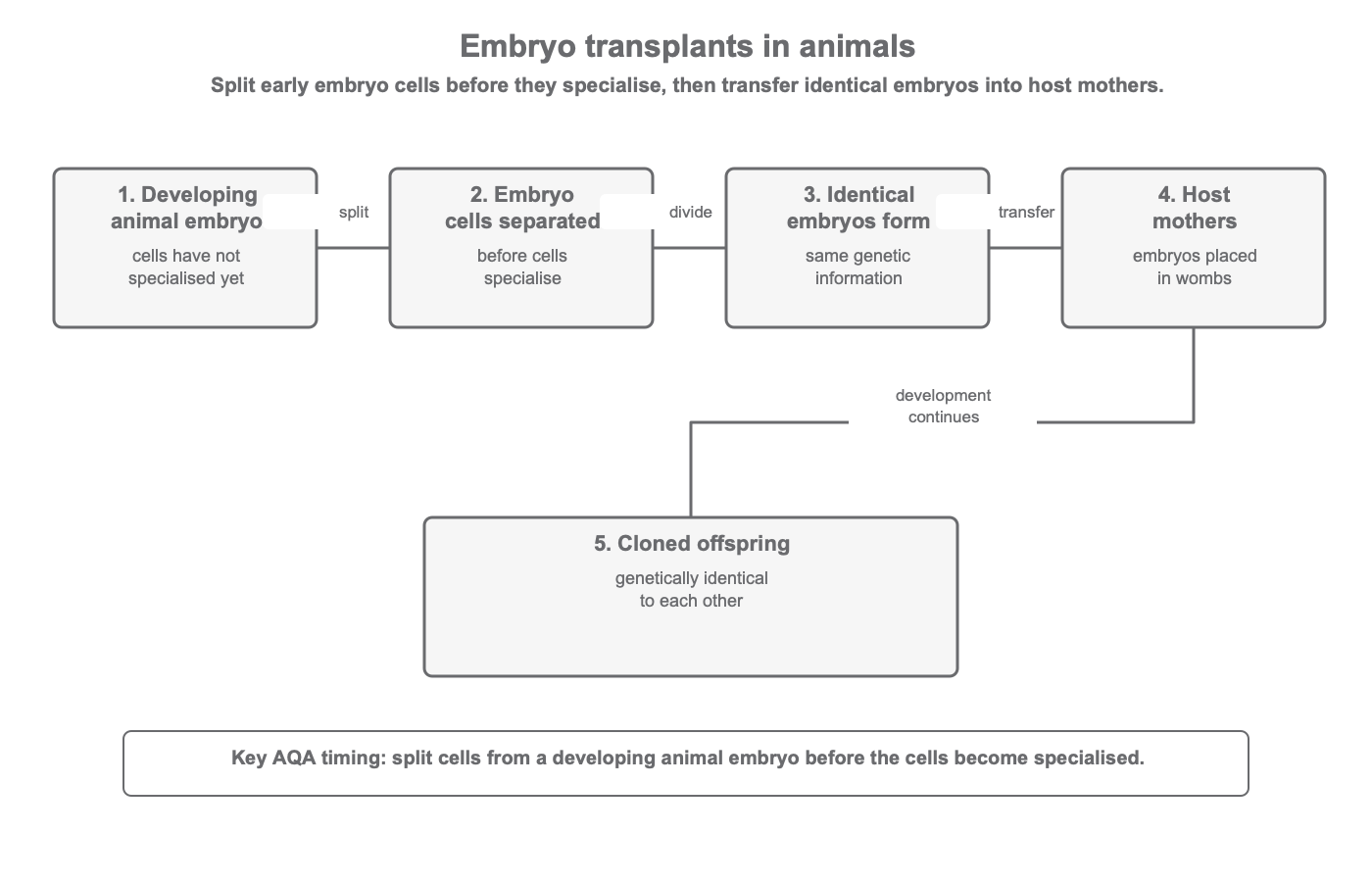
Embryo transplants do not copy an already-tested adult animal. They copy one early embryo into several genetically identical embryos. This can be useful if the original embryo comes from valuable parents, but the method does not let farmers choose a known adult and copy that exact adult.
Adult cell cloning
Adult cell cloning starts with an adult body cell, such as a skin cell, from the animal being copied. The nucleus from this body cell is the key part, because it contains the genetic information that will be copied.
First, the nucleus is removed from an unfertilised egg cell. Next, the nucleus from the adult body cell is inserted into the egg cell. An electric shock stimulates the egg cell to divide and form an embryo. The embryo cells contain the same genetic information as the adult body cell, such as the adult skin cell. When the embryo has developed into a ball of cells, it is inserted into the womb of an adult female to continue development.
[DIAGRAM: asset_name: adult-cell-cloning-process - diagram 2; asset_slug: 086_4_6_2_5b_animal_cloning_and_embryo_transplants_diagram2; file: diagram_assets/imagegen_regen_all/086_4_6_2_5b_animal_cloning_and_embryo_transplants_diagram2_imagegen.png; recommended_method: codex_image_gen; description: Monochrome flowchart showing removal of the nucleus from an unfertilised egg cell, insertion of a nucleus from an adult body cell such as a skin cell, electric shock stimulation, embryo ball of cells, insertion into the womb of an adult female, and a clone with the same genetic information as the adult body-cell donor. No fertilisation or sperm are shown.]
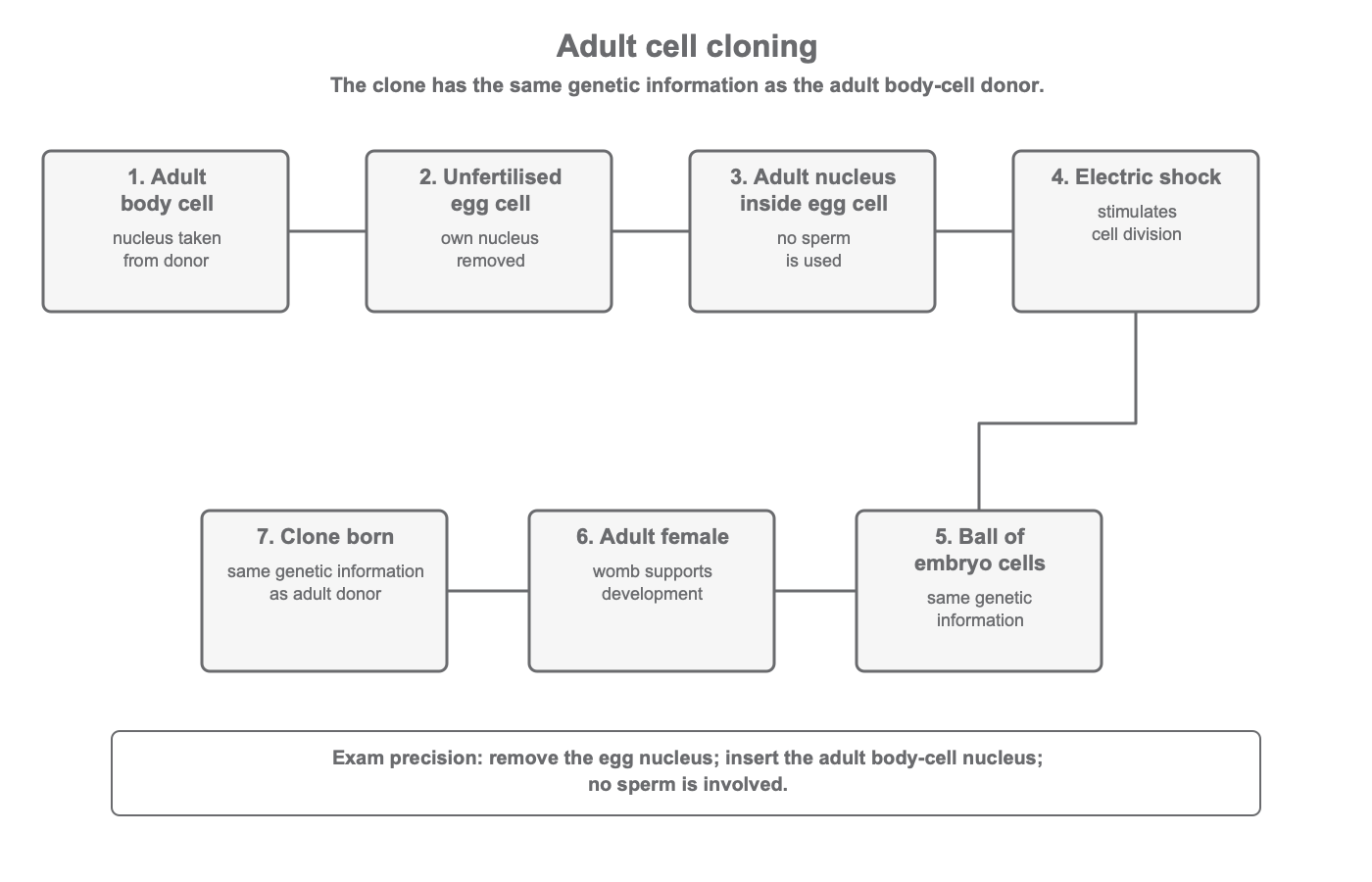
The egg is unfertilised, so this is not normal sexual reproduction. A sperm cell is not used. The adult female's womb provides a place for the embryo to develop, but the AQA genetic-information point is that the embryo cells have the same genetic information as the adult body cell donor.
After the Feynman check, test the sequence. If the egg nucleus is left in place, or if fertilisation by sperm is added, the answer no longer matches the AQA adult cell cloning method.
Continue this lesson.
You’re previewing NovaLearn without an account. Create a free account to read the rest.
Create free account