4.6.3.2 - Speciation
Speciation is the formation of new species. This Biology-only lesson links the idea of natural selection to the work of Darwin and Alfred Russel Wallace, then follows the steps by which an original population can become two different species. The key exam endpoint is precise: two populations have become different species when they can no longer interbreed to produce fertile offspring.
What speciation means
A species is a group of organisms that can interbreed to produce fertile offspring. Fertile means the offspring can reproduce. A horse and a donkey can produce a mule, but most mules are not fertile, so horses and donkeys are not the same species.
Speciation
Speciation is the formation of a new species.
For AQA, the safest wording is that speciation has happened when two populations of one original species become so different that they can no longer interbreed to produce fertile offspring.
This is not just about looking different. Two populations might look slightly different and still be the same species if they can interbreed and produce fertile offspring. The exam focus is reproductive ability, not appearance alone.
Darwin, Wallace and biology
Charles Darwin and Alfred Russel Wallace both helped develop the theory of evolution by natural selection. AQA expects you to treat Wallace as a major scientist in this story, not just as a name beside Darwin.
Wallace independently proposed the theory of evolution by natural selection. Darwin and Wallace published joint writings in 1858, and this prompted Darwin to publish On the Origin of Species in 1859.
Wallace worked worldwide gathering evidence for evolutionary theory. The specification highlights two areas he is especially known for: warning colouration in animals and his theory of speciation. He also did pioneering work on speciation, although later evidence has improved the current scientific understanding of how speciation happens.
The impact of these ideas on biology was large because they gave biology a natural, evidence-based way to explain adaptation, diversity and the origin of new species. Instead of only describing living organisms, biologists could investigate how populations change over time and why different species exist.
Isolation starts the process
Speciation usually begins when populations of the same species become isolated. Isolated means they are separated so that individuals from the different populations do not interbreed.
One simple GCSE route is geographical isolation. A physical barrier, such as a river, mountain range, sea, desert or island separation, can split one population into two. The barrier does not instantly make a new species. It starts the process by reducing or stopping interbreeding between the separated groups.
[DIAGRAM: asset_name: isolation-of-populations - diagram 1; asset_slug: 088_4_6_3_2_speciation_diagram1; file: diagram_assets/imagegen_regen_all/088_4_6_3_2_speciation_diagram1_imagegen.png; recommended_method: codex_image_gen; description: Monochrome map-style diagram showing one population separated by a physical barrier into two isolated populations with different selection pressures and no interbreeding.]
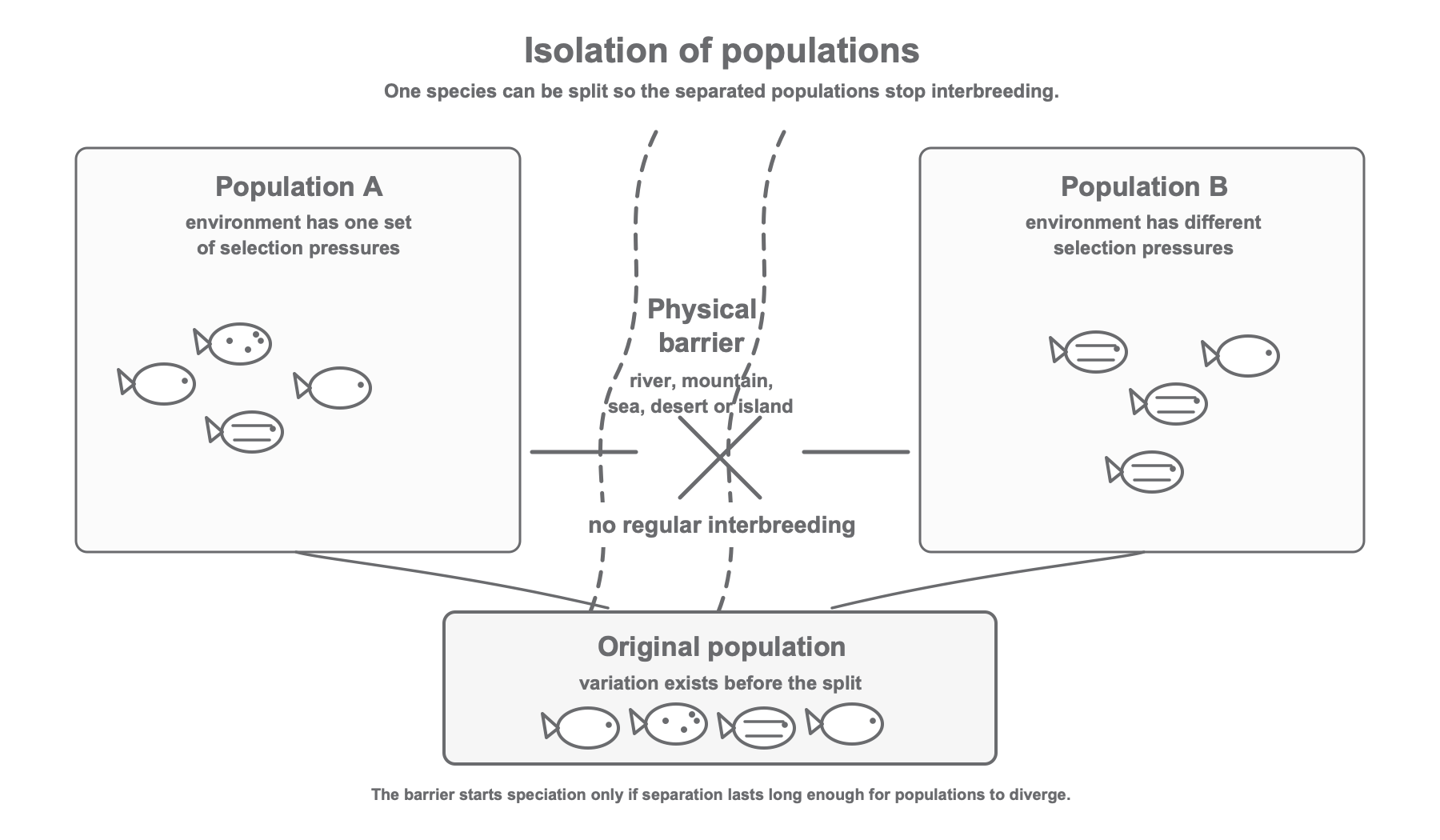
Isolation matters because it stops the two populations from mixing their inherited characteristics freely. If individuals can still move between the two groups and breed often, the populations are less likely to become very different. If isolation continues for many generations, each population can follow a different evolutionary path.
You do not need to name advanced types of speciation for AQA GCSE Biology. Use the plain sequence: a population is isolated, the groups experience different conditions, and they gradually become different.
Natural selection after isolation
Once populations are isolated, natural selection can act differently in each place. The environments may differ in climate, food supply, predators, disease or competition. That means a characteristic that helps survival in one population may not be the most useful characteristic in the other population.
There is usually variation within a population. Some of that variation is inherited. If an inherited characteristic gives individuals an advantage in their environment, those individuals are more likely to survive and reproduce. They pass the alleles for that useful characteristic to their offspring.
Continue this lesson.
You’re previewing NovaLearn without an account. Create a free account to read the rest.
Create free account