4.5.2.2 - The Brain
The brain controls complex behaviour by coordinating activity across billions of interconnected neurones. This biology-only lesson focuses on three regions that you must be able to identify and describe: the cerebral cortex, cerebellum and medulla. Higher-tier students also need to explain why investigating brain function and treating brain damage or disease is difficult.
Brain regions and roles
The brain is part of the central nervous system. It receives information, processes it and coordinates responses, but it does not act as one simple lump of tissue. Different regions carry out different functions, and those regions work together through many interconnected neurones.
Brain
The part of the central nervous system that controls complex behaviour and coordinates many body functions.
For this specification point, the three named regions are the cerebral cortex, the cerebellum and the medulla. You should be able to identify them on a diagram and describe their functions.
[DIAGRAM: asset_name: brain-regions - diagram 1; asset_slug: 054_4_5_2_2_the_brain_diagram1; file: diagram_assets/imagegen_regen_all/054_4_5_2_2_the_brain_diagram1_imagegen.png; recommended_method: codex_image_gen; description: Monochrome side-view diagram of the brain labelling the cerebral cortex, cerebellum and medulla, with concise function notes and a labelled spinal cord connection for orientation.]
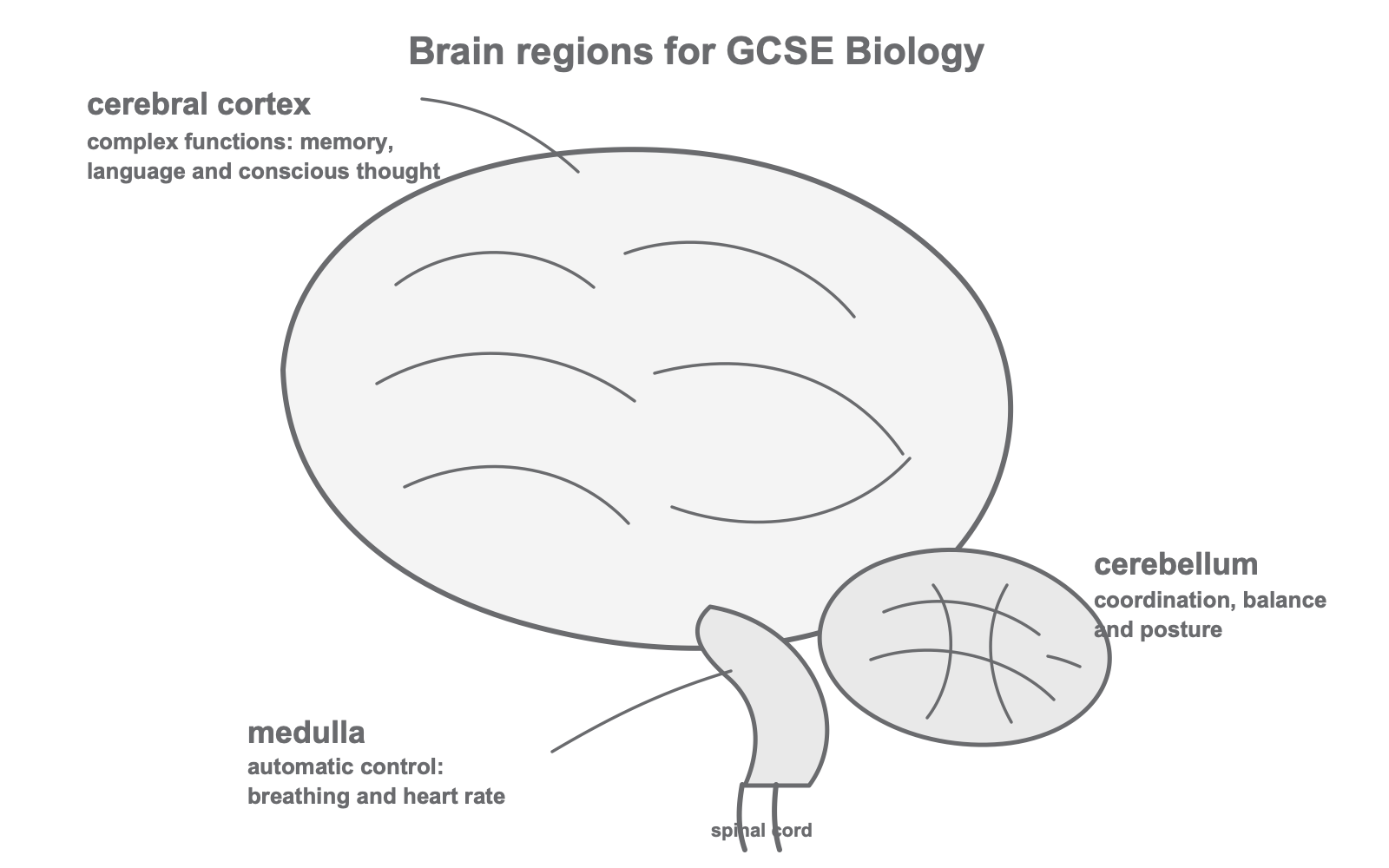
The cerebral cortex is the outer region of the brain. The cerebellum is at the back and below the cerebral cortex. The medulla is at the base of the brain, where the brain connects with the spinal cord.
Cerebral cortex
The cerebral cortex is the outer layer of the brain. At GCSE level, it is linked with the most complex brain functions, including consciousness, intelligence, memory and language.
Cerebral cortex
The outer region of the brain involved in complex functions such as consciousness, intelligence, memory and language.
The cerebral cortex helps explain why the brain can coordinate more than simple automatic responses. It processes information and is involved when a person thinks, remembers, makes decisions or uses language. You do not need to learn detailed lobes of the brain for this lesson.
In an exam, avoid saying only that the cerebral cortex "controls the body". That is too vague. A stronger answer links it to complex functions such as consciousness, intelligence, memory or language.
Cerebellum and medulla
The cerebellum is involved in coordinating muscle movement. It helps make voluntary movements smooth and controlled, and it is also important for balance and posture.
Cerebellum
The brain region involved in coordinating muscle movement, balance and posture.
If a person has difficulty with balance or coordinated movement, the cerebellum is the GCSE brain region to think about. It is not the main centre for language or conscious thought in this lesson.
The medulla controls automatic body functions that are essential for survival, such as breathing and heart rate. These functions continue without conscious thought.
Medulla
The brain region at the base of the brain that controls automatic functions such as breathing and heart rate.
The medulla is sometimes confused with the spinal cord because it is at the base of the brain. Keep the location and function together: the medulla is part of the brain and links to automatic control of vital functions.
Mapping brain functions
This part is Higher tier only.
Neuroscientists map brain regions by linking a region to a function. They can do this using evidence from patients with brain damage, electrical stimulation of different brain regions and MRI scanning techniques.
Studying patients with brain damage can show what a region normally does. For example, if damage in one region is followed by a loss of a particular function, scientists can infer that the damaged region was involved in that function. This evidence has limits because the damage may affect more than one area, different patients may recover differently, and it would be unethical to damage a healthy brain just to test a hypothesis.
Continue this lesson.
You’re previewing NovaLearn without an account. Create a free account to read the rest.
Create free account